 By st20113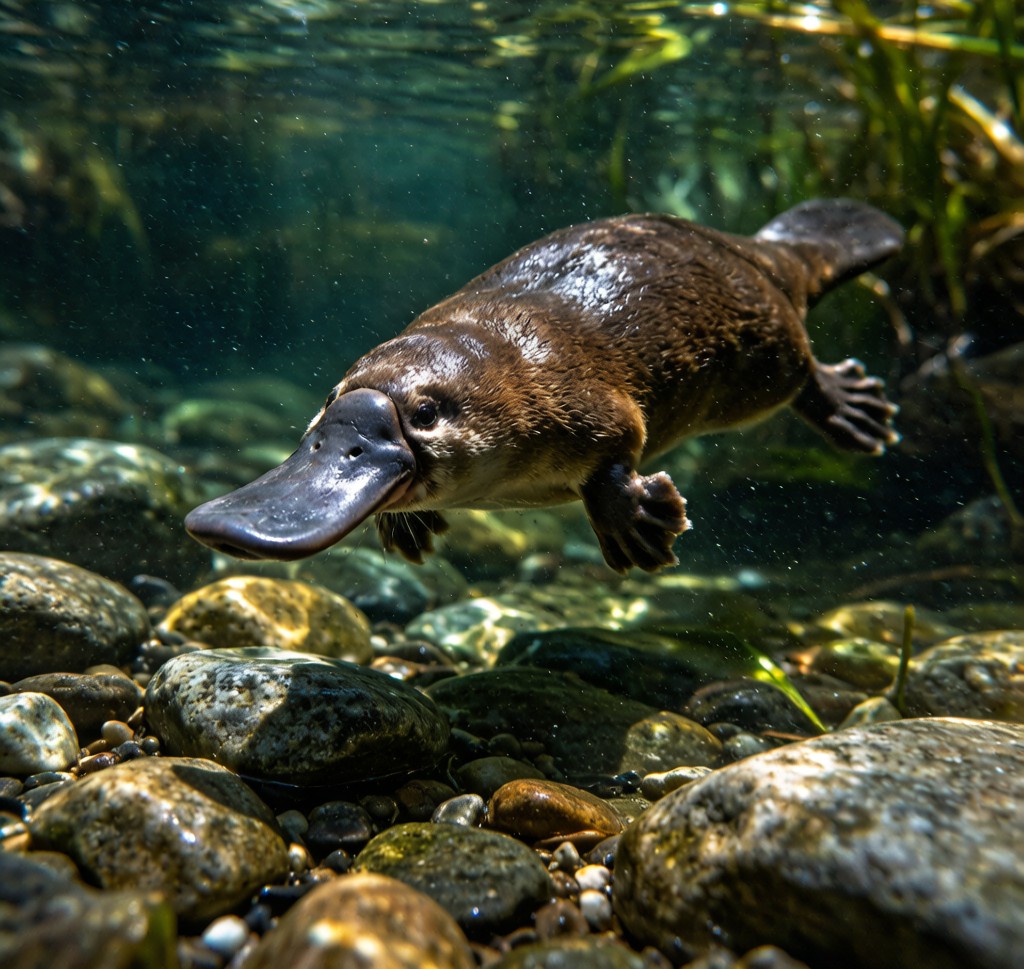
A Platypus (Ornithorhynchus anatinus) swimming in an Australian freshwater stream, showing its duck-like bill and sleek waterproof fur
Overview
The Platypus (Ornithorhynchus anatinus) is one of the most unusual animals on Earth – a monotreme, or egg-laying mammal, that combines a suite of features so bizarre that when the first specimen was sent from Australia to Britain in 1798, the eminent anatomist Sir Joseph Banks reportedly assumed it was a hoax assembled from parts of different animals. The Platypus has a duck’s bill and webbed feet, a beaver’s tail, and the body fur of an otter – yet it is a mammal in every meaningful biological sense: it has fur, is warm-blooded, and produces milk to feed its young. It also lays eggs – one of only five species of monotreme in the world, and the most famous of all egg-laying mammals. Found in the freshwater streams and rivers of eastern Australia and Tasmania, the Platypus is one of Australia’s most iconic and beloved native animals.
The Platypus is one of the few venomous mammals in the world: males have a hollow, retractable spur on each hind foot that is connected to a venom gland and can deliver a painful venom capable of causing severe pain in humans and potentially fatal complications in dogs. The venom is produced only during the breeding season and is used in competition between males for access to females. The Platypus is also one of the few mammals to have electroreception – it can detect the weak electric fields produced by the muscle contractions of prey animals, allowing it to hunt with its eyes, ears, and nose all closed underwater.
Habitat and Distribution
The Platypus occurs in the freshwater streams, rivers, and lakes of eastern Australia – from Cooktown in Far North Queensland to Tasmania and the Flinders Ranges of South Australia – and in populations in New South Wales, Victoria, and Queensland. The species is largely absent from the Murray-Darling Basin, where its habitat has been severely degraded by water extraction and river regulation, and from the drier interior of the continent. The Platypus is an excellent swimmer and is most commonly found in permanent freshwater systems with slow-moving or still water, gently sloping banks with suitable burrowing substrate, and sufficient food resources.
Platypus habitat requirements are closely tied to water quality and food availability. The species requires clear, unpolluted freshwater with abundant invertebrate prey – particularly freshwater insect larvae, crustaceans, and small fish – and banks with suitable substrate for burrow construction. Platypus burrows are excavated in riverbanks and lake margins, with the entrance typically located above the waterline and the tunnel extending horizontally for 1 to 3 meters into the bank. Burrows provide shelter from predators, a refuge from extreme temperatures, and a safe nesting site for females raising young. The species is highly sensitive to water pollution, and the presence or absence of Platypus populations is used by conservation biologists as an indicator of river and stream ecosystem health.
Electroreception and Foraging
The Platypus’s electroreception is one of the most remarkable sensory systems in the animal kingdom and represents a unique adaptation to underwater foraging. The Platypus closes its eyes, ears, and nose when diving, and instead navigates and locates prey using electroreceptors concentrated in the skin of its duck-like bill. These electroreceptors detect the weak electric fields generated by the muscle contractions of living organisms – a shrimp flicking its tail, a worm moving through the sediment, a fish’s heartbeat – and the Platypus can build a detailed sensory map of its surroundings using this electric sense alone. The bill also has highly sensitive mechanoreceptors that detect water movements, and the Platypus integrates information from both senses while foraging.
When foraging, the Platypus swims with its eyes closed, using its electric sense to locate and track moving prey. When prey is detected, the Platypus captures it by rapidly snapping its bill closed, storing the catch in cheek pouches while underwater before returning to the surface to eat. The Platypus must consume approximately 15 to 20 percent of its body weight in food each day to sustain its high metabolism – an enormous feeding requirement for an animal that spends approximately 10 to 12 hours per day foraging. This intensive foraging schedule reflects the high energy demands of maintaining a warm body temperature in cold freshwater streams and supporting the energetic costs of reproduction in females.
Reproduction and Conservation
The Platypus’s reproductive biology is one of the most remarkable of any mammal. After mating – which occurs in the water during the Australian winter (June to October) – the female excavates a long burrow in the riverbank where she will lay and incubate her eggs. The burrow can be up to 20 meters long and may include a nesting chamber at the end, lined with moist reeds and grasses. The female lays 1 to 3 leathery eggs – similar to those of reptiles – and curls around them to incubate them, raising her body temperature using her metabolic heat. The eggs hatch after approximately 10 to 14 days into blind, naked, underdeveloped young called puggles, which are approximately the size of a lima bean. The young remain in the burrow for the next 3 to 4 months, feeding on milk secreted from mammary glands that lack nipples – the milk simply seeps from the skin of the mother’s abdomen into the grooves where the puggle laps it up.
The Platypus is listed as Near Threatened on the IUCN Red List, reflecting growing concerns about population declines in parts of its range driven by habitat degradation, water extraction, pollution, predation by introduced foxes and feral cats, and the cumulative impact of drought and climate change. The species is particularly vulnerable to the impacts of the ongoing drought in southeastern Australia, which has reduced water levels and food availability in many river systems. Conservation efforts focus on improving water quality and flow regimes in Platypus habitat, protecting riverbank burrowing sites from disturbance, reducing introduced predator numbers, and establishing protected areas in key habitat areas. Long-term monitoring programs using eDNA (environmental DNA) sampling are providing new insights into Platypus population trends and distribution.