 By st20113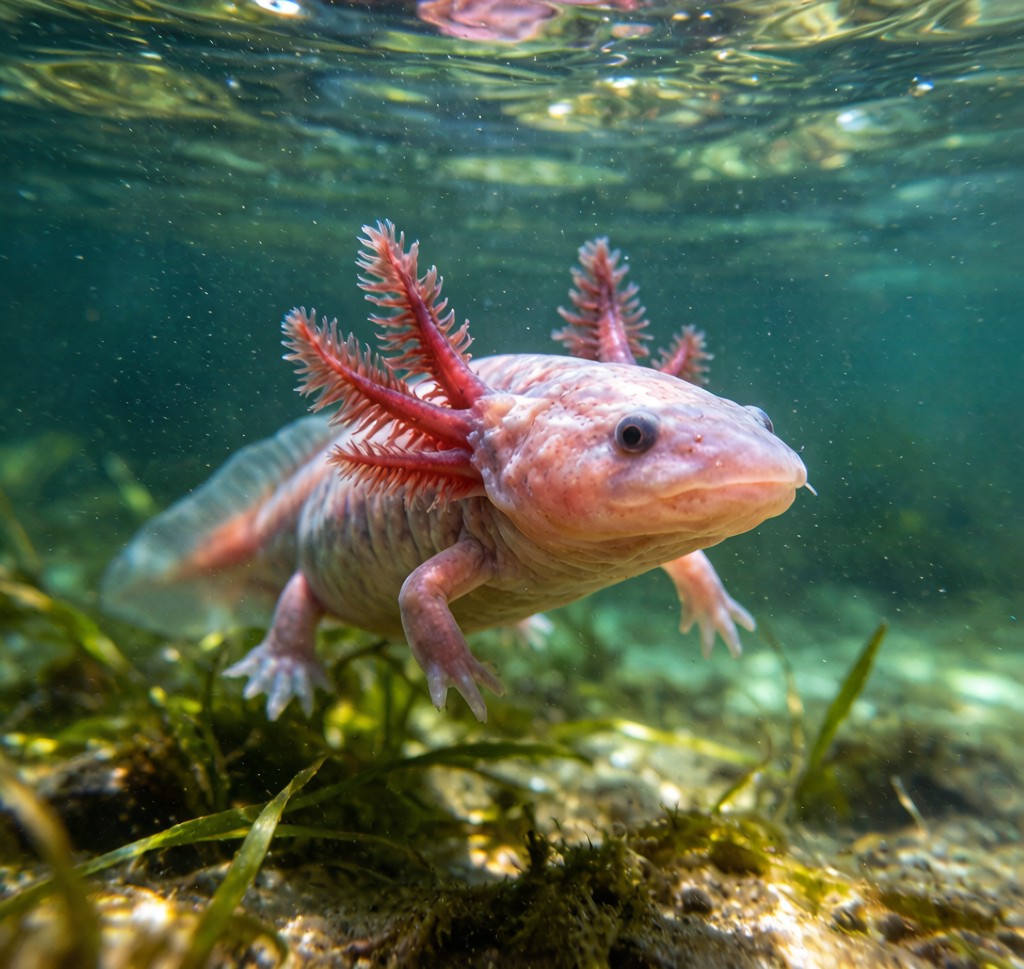
An Axolotl (Ambystoma mexicanum) swimming in the clear canal waters of Lake Xochimilco, Mexico, showing its characteristic external gills
Overview
The Axolotl (Ambystoma mexicanum), also known as the Mexican Walking Fish, is one of the most extraordinary amphibians in the world and one of the most studied organisms in biology. Found exclusively in the remaining freshwater canals and lakes of the Xochimilco area of Mexico City – the last remnant of the vast Lake Xochimilco system that once covered much of the Valley of Mexico – the Axolotl is a neotenic salamander that retains its larval features throughout its entire life. Most dramatically, the Axolotl never undergoes the dramatic metamorphosis into a terrestrial form that characterizes other salamanders: instead, it retains its external gill stalks, finned tail, and aquatic lifestyle throughout its life, even as a sexually mature adult – a phenomenon called neoteny or paedomorphosis.
The Axolotl’s external gills – three feathery, bright red to pink stalks on each side of the head – are among its most distinctive features, protruding dramatically from the head and giving the animal an almost alien appearance. The gills are used for gas exchange, extracting dissolved oxygen from the water. The Axolotl also has extraordinary regenerative abilities: it can regenerate lost limbs, tail sections, portions of the heart, lungs, liver, and even parts of the brain with minimal scarring, making it one of the most studied animals in regenerative medicine research. Its genome – one of the largest animal genomes ever sequenced – contains approximately 32 billion base pairs, about 10 times the number in the human genome.
Habitat and Distribution
The Axolotl is endemic to the Xochimilco canal system in the southern part of Mexico City – the only place in the world where it occurs naturally. This habitat – a network of ancient canals and temporary lake beds (chinampas) – was once part of the enormous Lake Xochimilco, which was largely drained in the 17th to 20th centuries as Mexico City expanded. Today, only fragments of the original lake remain, totalling approximately 2,200 hectares of canals and temporary lakes. The Axolotl survives only in this remnant habitat, which is increasingly degraded by pollution, water extraction, and urban encroachment.
Xochimilco is a human-dominated landscape where traditional agricultural practices – particularly the cultivation of chinampas, the floating garden islands that are a pre-Columbian agricultural innovation – coexist with modern urban infrastructure. The canals that support the Axolotl are increasingly polluted with agricultural runoff, untreated sewage, and urban waste, and the water quality in many areas is insufficient to support healthy Axolotl populations. The introduction of invasive species – particularly tilapia and carp, introduced for aquaculture – has also devastated Axolotl populations by competing for food and preying on juvenile Axolotls.
Biology and Regeneration
The Axolotl’s neoteny – the retention of larval features throughout life – is one of the most studied phenomena in developmental biology. In most salamanders, the larval stage is temporary: the animal undergoes a dramatic metamorphosis in which the gills are absorbed, the tail fin is lost, and the animal develops lungs and limbs for a terrestrial existence. In the Axolotl, this metamorphosis does not occur naturally. The Axolotl remains aquatic throughout its life, breathing through its external gills and using its finned tail for swimming. However, if treated with thyroid hormone, the Axolotl can be induced to metamorphose into a terrestrial form – demonstrating that the genetic program for metamorphosis is present but suppressed.
The Axolotl’s remarkable regenerative abilities have made it one of the most important model organisms in biology and medicine. Unlike mammals, which heal wounds with scar tissue, the Axolotl can regenerate complex structures – including entire limbs, tail sections, spinal cord tissue, heart muscle, and portions of the brain – by dedifferentiating cells at the wound site into a mass of stem-cell-like cells called a blastema, which then proliferate and redifferentiate into the precise tissues that were lost. Research into the molecular mechanisms underlying Axolotl regeneration is providing insights that may eventually be applied to human medicine, particularly for treating injuries to the spinal cord, heart, and limbs.
Conservation
The Axolotl is listed as Critically Endangered on the IUCN Red List, with wild populations having declined by approximately 90 to 99 percent over the past two decades. The species faces an extremely high risk of extinction in the wild due to the continued degradation of its Xochimilco habitat, pollution of the canal water, introduction of invasive fish species, and the collection of wild individuals for the pet trade and traditional medicine. Surveys conducted in the early 2000s found approximately 1,000 Axolotls per square kilometer in Xochimilco; more recent surveys have found fewer than 100 per square kilometer in the best-quality habitat.
Conservation efforts for the Axolotl include habitat restoration projects in Xochimilco, which use floating wetlands and vegetation management to improve water quality; removal of invasive fish species; reintroduction of captive-bred individuals to suitable habitat; and the establishment of a conservation breeding program at the Universidad Nacional Autonoma de Mexico. The Xochimilco Ecological and Cultural Park has been established as a protected area, and a 2016 decree designated the entire Xochimilco canal system as a natural protected area. The Axolotl is also celebrated in Mexican culture and has become a symbol of Mexico City’s environmental challenges – with conservation efforts increasingly integrating traditional chinampa farming communities as partners in habitat protection.