 By st20113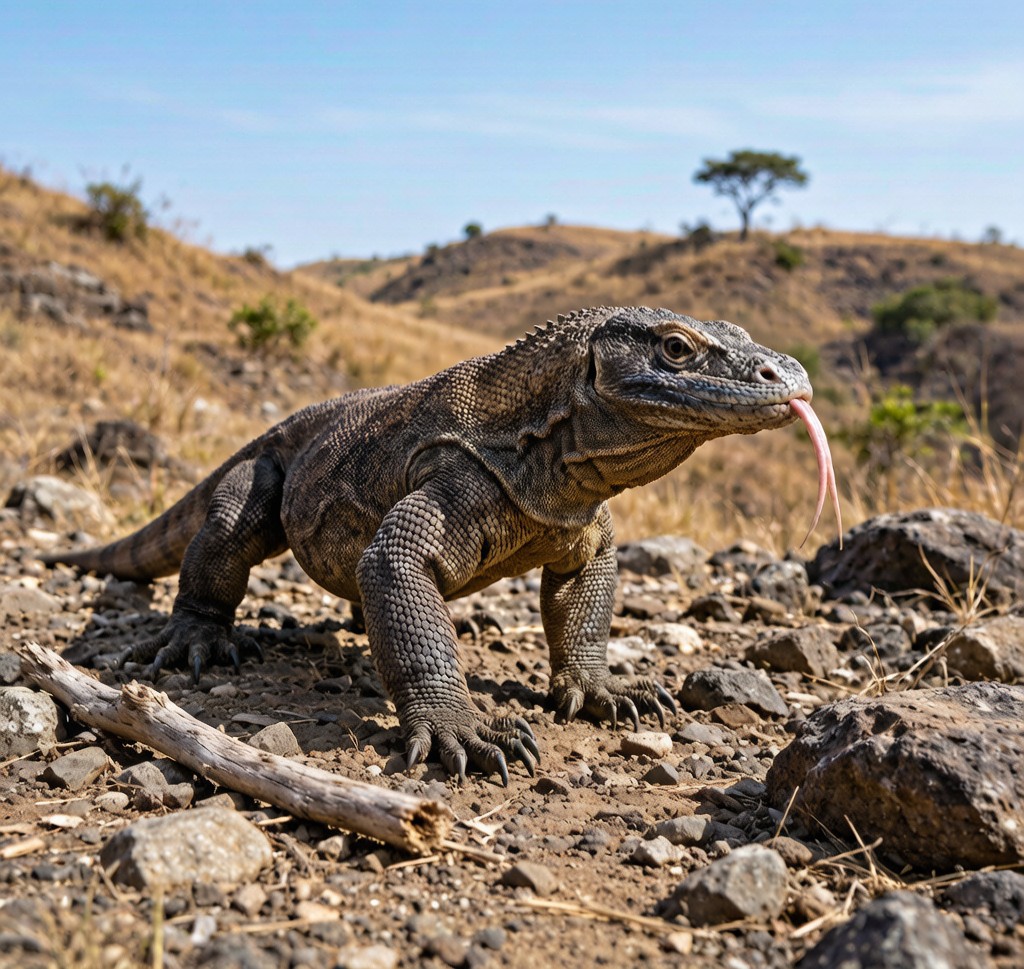
A Komodo Dragon (Varanus komodoensis) standing on a rocky hillside on Komodo Island, Indonesia, displaying its powerful body and forked tongue
Overview
The Komodo Dragon (Varanus komodoensis) is the world’s largest living species of lizard and one of the most formidable predators in the animal kingdom. Found exclusively on a handful of Indonesian islands in the Lesser Sunda region – including Komodo, Rinca, Flores, Gili Motang, and Gili Dasami – the Komodo Dragon is a apex predator that can grow up to 3 meters in length and weigh up to 70 kilograms. With its massive, muscular body, powerful tail, serrated teeth, and venomous bite, the Komodo Dragon is capable of taking prey as large as water buffalo and deer, and is the dominant predator in its island ecosystem, unchallenged by any other large carnivore.
The Komodo Dragon’s venom – delivered through glands in its lower jaw – is one of the most potent of any living reptile, causing severe haemorrhage, anticoagulation, and shock in prey. This venom, combined with the dragon’s powerful claws, shear-like bite force, and ambush hunting strategy, makes the Komodo Dragon uniquely equipped to take down prey many times its own body size. Discovered by Western science in 1910, the Komodo Dragon has captured human imagination as a living dinosaur – an impression reinforced by its massive size, armored appearance, and deadly hunting capabilities.
Habitat and Distribution
The Komodo Dragon occurs naturally on only four Indonesian islands: Komodo, Rinca, Flores, and Gili Motang – all within a small island chain in the Lesser Sunda region east of Bali. This extremely restricted range – spanning approximately 1,500 square kilometers of land area – makes the Komodo Dragon one of the most geographically constrained apex predators in the world. Within these islands, the species occupies a range of habitats including tropical savanna forest, dry monsoon forest, and coastal mangrove, with a preference for open grassland and forest edge habitats where large prey is most abundant.
The Dragon’s island habitat is characterized by dramatic terrain – from volcanic hillsides and dry savannas to steamy tropical forest and rocky coastlines. The islands experience a tropical monsoon climate with a distinct wet season from November to March and a dry season from April to October. During the dry season, the dragons range more widely in search of water and prey. Conservation efforts have established the Komodo National Park covering the core island range, but the species’ extremely limited distribution makes it inherently vulnerable to natural disasters, disease outbreaks, and human disturbance.
Hunting and Venom
The Komodo Dragon is an ambush predator that relies on patience, stealth, and explosive acceleration to catch prey. The dragon lies in wait – sometimes for hours – beside game trails, watering holes, or carrion sources, before launching a rapid attack at speeds of up to 20 kilometers per hour. Young Komodo Dragons primarily eat insects and small vertebrates, but adults are capable of taking prey as large as goats, pigs, deer, and – most impressively – water buffalo weighing 300 kilograms or more. Dragons frequently attack prey that is many times their own body weight, using their powerful claws to disembowel or their venom to weaken and eventually kill the animal.
The Komodo Dragon’s venom is a complex cocktail of toxins that causes a range of physiological effects in prey. The venom contains anticoagulants that prevent blood clotting, vasodilators that lower blood pressure, and neurotoxins that cause paralysis. A single bite from a large dragon can lead to massive haemorrhaging, shock, and loss of consciousness in prey animals within hours. The dragon then tracks the wounded animal – sometimes for days – until it succumbs, using its excellent sense of smell to detect carrion from up to 10 kilometers away. This hunting strategy – described as “bite and wait” – is remarkably effective and allows dragons to take prey that would be far too large to overpower directly.
Reproduction and Conservation
Komodo Dragons are solitary except during mating and for females guarding eggs. Males compete for access to females through wrestling matches in which they rear up on their hind legs and grapple with their forelimbs until one is pushed to the ground. After mating, the female lays 15 to 30 eggs in a nest – typically in a mound built by a megapode bird, which provides natural incubation through the heat of decomposing organic material. The eggs incubate for approximately 8 to 9 months before hatching, and hatchlings – which are only about 40 centimeters long – must immediately climb trees to escape cannibalistic adults. Juveniles spend the first few years of life in trees, feeding on insects and small vertebrates, before descending to the ground at approximately 3 to 5 years of age.
The Komodo Dragon is listed as Endangered on the IUCN Red List, with populations estimated at 1,380 to 3,370 individuals. The species faces several serious threats including habitat loss (particularly on Flores where forest clearance for agriculture is ongoing), persecution by villagers who fear attacks on livestock and humans), and the impact of climate change on prey availability and nesting success. Komodo National Park, established in 1980 and designated a UNESCO World Heritage Site in 1991, provides a high level of protection for the core populations on Komodo and Rinca. Research using satellite tracking and field surveys continues to improve understanding of the species’ ranging behavior, habitat use, and population dynamics.