 By st20113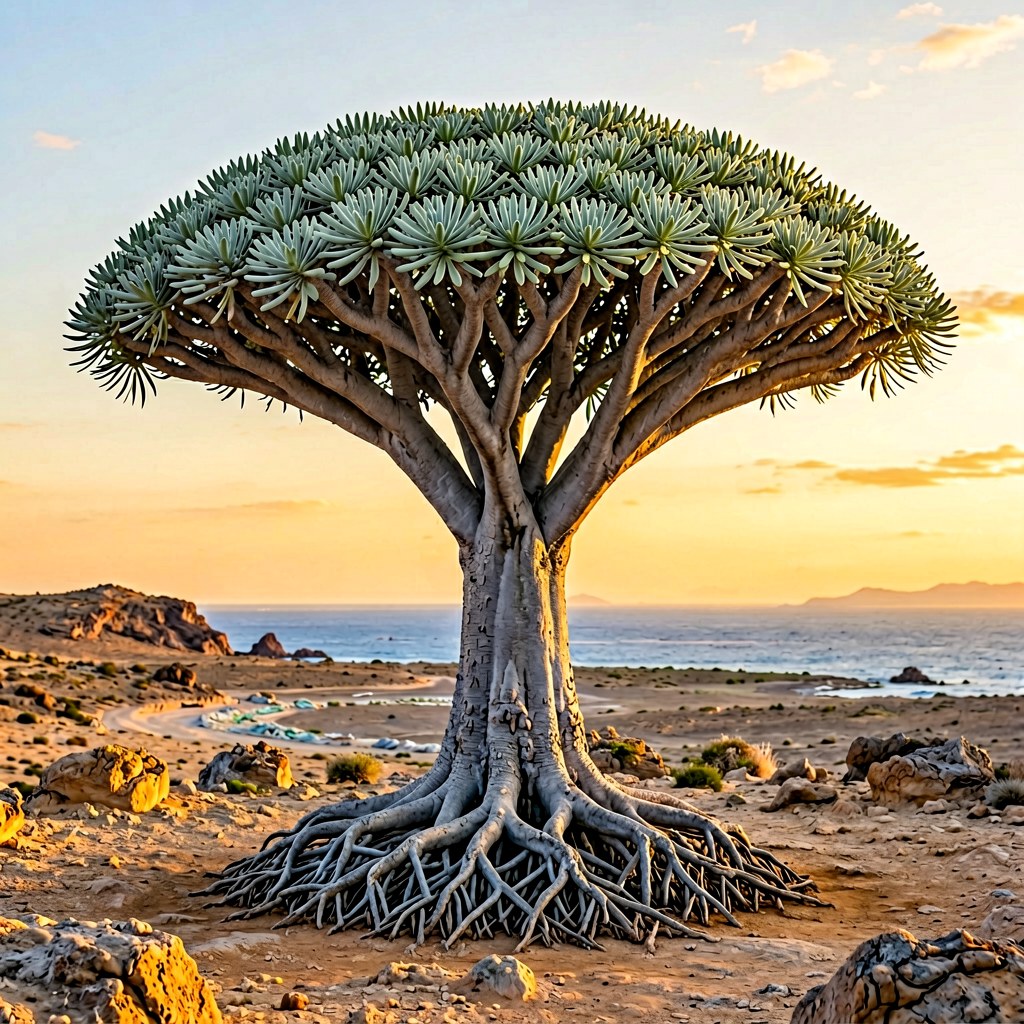
Dracaena cinnamomea | Dragon Blood Tree
Introduction
The dragon blood tree (Dracaena cinnamomea) is one of the most visually arresting trees in the plant kingdom, famous for its bizarre umbrella-shaped crown and the dark red resin that bleeds from its bark when cut. A member of the genus Dracaena, this strange, tree-forming monocot is native to the isolated island of Socotra in the Indian Ocean, where it has become an emblem of the island’s unique endemic flora. Unlike most trees, it belongs to the asparagus family rather than to typical woody dicots, and its growth form reflects a long isolation in an arid, monsoon-swept environment. The canopy spreads as a flattened dome of rigid, blade-like leaves on repeatedly forking branches, a shape that some botanists interpret as an adaptation to shed excess rainfall and conserve moisture. For centuries the crimson resin, known as dragon’s blood, has been harvested for dye, medicine, and varnish. The species is long-lived, slow-growing, and ecologically important as a shade and nesting resource for birds.
Taxonomy
Dracaena cinnamomea is placed in the family Asparagaceae, subfamily Nolinoideae, within the order Asparagales, a grouping established by modern molecular phylogenetics that removed the genus from its former family Dracaenaceae. The genus Dracaena contains roughly one hundred and twenty species of shrubby and arborescent monocots spread across Africa, the Arabian Peninsula, and South Asia, though the dragon blood trees form a distinctive subclade of island endemics. The most famous relative is Dracaena cinnabari of Socotra, with which D. cinnamomea shares the umbrella crown and red resin, and the Canary Island dragon tree Dracaena draco. For readers interested in desert succulents, the better-known [Saguaro Cactus](https://www.gloencyc.com/saguaro-cactus/) occupies a comparable ecological role as a long-lived, water-storing icon of arid landscapes, though it belongs to a completely separate lineage of flowering plants. Early collectors sometimes confused the various dragon trees, and the genus was long misplaced among lilies and agaves. DNA evidence now firmly anchors Dracaena among the Asparagales alongside yuccas and asparagus.
Physical Characteristics
The dragon blood tree grows as a single, often branching trunk that reaches 8 to 12 meters in height, capped by a broad, umbrella-like crown formed by dichotomously branching limbs ending in rosettes of leaves. The bark is grey-brown and fissured, and when injured it exudes a startling red, resinous sap that hardens into drops of dragon’s blood. The leaves are stiff, lanceolate, and succulent, 30 to 60 centimeters long and only 2 to 4 centimeters wide, arranged densely at the branch tips where they catch low-angle light. Growth is remarkable for its regularity: branches fork in a roughly parallel pattern, producing the layered, flat-topped canopy. Flowers appear in panicles at the branch ends, bearing small, fragrant, white or greenish blossoms about 1 centimeter across. The fruits are small spherical berries that turn orange-red when ripe and are eaten by birds, which disperse the seeds. The overall form, with its sculptural symmetry, has been compared to a giant umbrella or an upturned mushroom.
Habitat
Dracaena cinnamomea is endemic to Socotra, an island politically part of Yemen that lies at the mouth of the Gulf of Aden, where it occupies a narrow band of rocky limestone plateaus between roughly 300 and 1500 meters elevation. The climate is harsh and seasonal: a winter monsoon brings fog and light drizzle, while summer is hot and almost rainless, so the tree has adapted to capture moisture from mist rather than rely on soil water. It grows on thin, alkaline soils among granite and limestone outcrops, often in open dragon-tree woodlands mixed with frankincense and euphorbia shrubs. The umbrella crown maximizes the interception of diffuse monsoon light and sheds the rare heavy downpours. Beyond Socotra the species is cultivated as an ornamental in dry tropical gardens, but it cannot tolerate frost or prolonged waterlogging. Grazing goats and expanding human settlement have reduced many historic stands to scattered individuals on inaccessible cliffs.
Diet
As a photosynthetic autotroph, the dragon blood tree builds its tissues from carbon fixed in its stiff, succulent leaves through the standard C3 pathway of oxygenic photosynthesis. The thick leaves are packed with water-storage parenchyma and a waxy cuticle that limits transpiration, allowing the plant to keep its stomata open for gas exchange during the cooler, humid monsoon fogs without losing dangerous amounts of water. Carbon dioxide drawn from the air is converted by RuBisCO into triose sugars, which are transported to the growing trunk, roots, and developing inflorescences. Mineral nutrients, particularly potassium, calcium, and trace elements from the limestone substrate, are absorbed by a shallow but extensive root system and moved upward through the vascular bundles of the monocot stem. The tree requires no external food, yet it engages in subtle mutualisms: bird visitors that eat the berries help disperse seed, and the red resin may deter bark-feeding insects and seal wounds against infection.
Reproduction
The dragon blood tree is perennial and reproduces both sexually by seed and vegetatively by basal suckers that arise from the root crown of mature individuals. Flowering is irregular and tied to favorable moisture, with fragrant white panicles emerging at branch tips after rains; the blossoms are visited by moths, bees, and possibly small birds that transfer pollen between trees. Each fertilized flower develops into a berry containing one or a few seeds, and ripe fruits are consumed and dispersed by resident and migratory birds, which carry the seeds away from the parent canopy. Germination is slow and demands the brief cool, moist conditions of the winter monsoon, which is why seedling recruitment is naturally rare and episodic. Vegetative suckers provide a steadier means of local persistence, cloning the parent and forming small groves around old trees. Because the species is long-lived but slow to replace itself, populations are vulnerable to any factor that suppresses either seedling establishment or the survival of mature bearers.
Conservation
The dragon blood tree is classified as vulnerable on the IUCN Red List, with the principal threats being overgrazing by introduced goats, timber cutting for beehives and construction, and the creeping effects of climate change on Socotra’s already marginal moisture regime. Reduced monsoon fog and more frequent droughts lower seedling survival, while goats preferentially browse young plants that lack the protective spines of other arid species. The tree is protected under Yemeni and local Socotran regulations, and several stands fall within proposed reserves and the Socotra Archipelago UNESCO World Heritage site. International botanical gardens maintain ex situ collections, and conservation NGOs have run community nurseries that supply saplings for restoration and give locals an alternative income. Public awareness campaigns stress that sustainable harvest of the resin, rather than felling, preserves both the tree and the traditional economy. Because the species is endemic and irreplaceable, its fate is closely tied to the broader protection of Socotra’s unique island ecosystem.
Fun Facts
- The red sap called dragon’s blood was once prized as a violin varnish and as a pigment for medieval illuminated manuscripts.
- Its umbrella-shaped crown is thought to maximize capture of monsoon fog while shedding the rare heavy tropical rains.
- Specimens are believed to live for several hundred years, with some individuals estimated at more than six centuries old.
- The resin has been used in traditional medicine as a styptic and antiseptic for wounds across the Middle East and Mediterranean.
- Despite looking like a classic hardwood, the dragon blood tree is a monocot more closely related to asparagus and lilies than to oaks.