 By st20113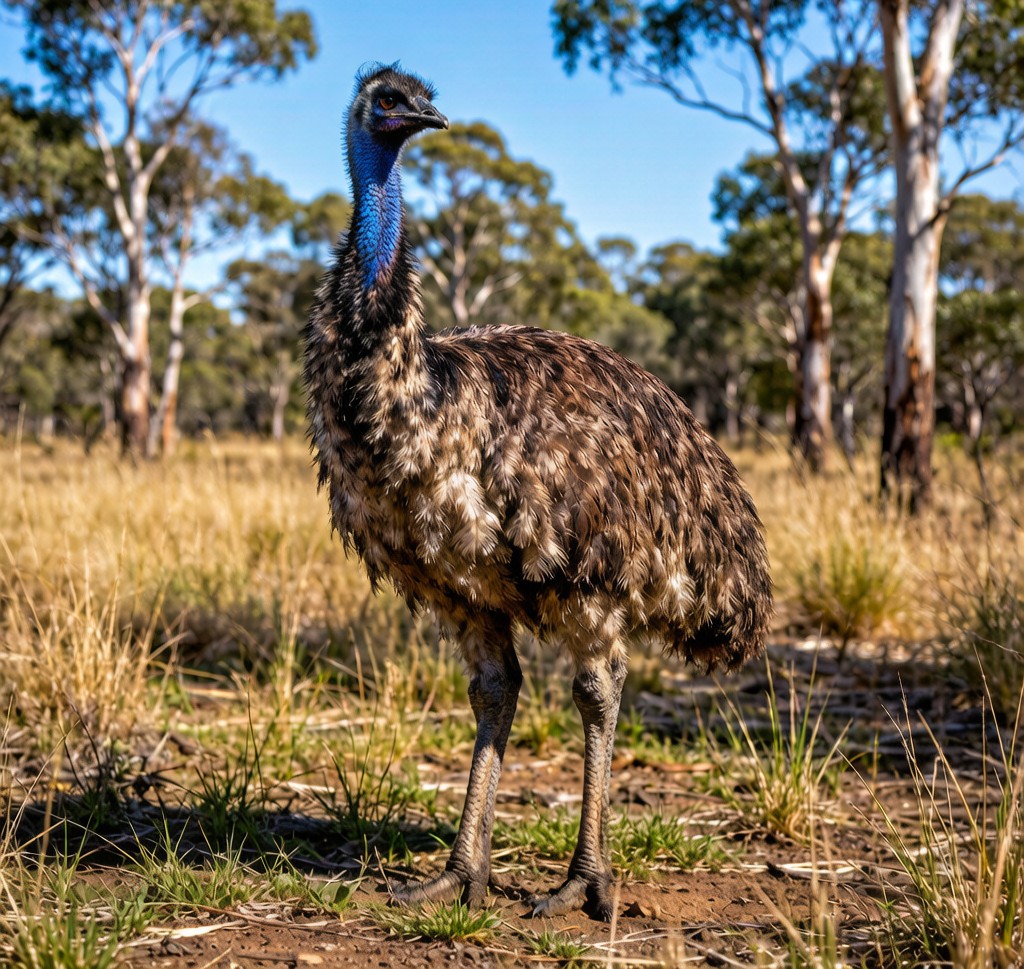
An Emu (Dromaius novaehollandiae) standing tall in the Australian outback, with eucalyptus trees in the background and a dry landscape
Overview
The Emu (Dromaius novaehollandiae) is Australia’s tallest and heaviest bird – the second tallest bird in the world after the ostrich – and one of the most distinctive and widespread native animals in the Australian landscape. Standing approximately 1.5 to 1.9 meters tall and weighing 18 to 55 kilograms, the Emu is a large, flightless bird with a long neck, relatively small head, shaggy grey-brown plumage, and extraordinarily powerful legs that make it an excellent runner capable of sustaining speeds of 30 kilometers per hour and sprinting at 50 kilometers per hour for short distances. The Emu’s shaggy appearance – from which its scientific name novaehollandiae (New Holland) is derived, referring to the informal colonial name for Australia – is caused by the double-shafted structure of each feather, which splits at the tip to create a hairy, unkempt appearance.
The Emu is the only living species in the genus Dromaius, though two related island species – the Kangaroo Island Emu and the Tasmanian Emu – became extinct following European colonization. The Emu has a remarkably long lifespan for a bird, with individuals surviving 10 to 20 years in the wild and up to 35 years in captivity. Despite being flightless, the Emu is a strong and capable swimmer and has been observed swimming across rivers and inlets throughout its range. The Emu appears prominently on the Australian coat of arms alongside the Kangaroo, symbolizing the nation’s unique fauna.
Habitat and Distribution
The Emu is found throughout most of mainland Australia – from the tropical woodlands of the north to the temperate forests of the southeast, and from the arid interior to the coastal plains – making it one of the most widely distributed of Australia’s native animals. The species is absent only from Tasmania, some offshore islands, and the most heavily settled areas of southeastern Australia. Within this vast range, the Emu occupies almost every major habitat type, from coastal heathland and open forest to arid scrubland, grassland, and desert – demonstrating remarkable ecological flexibility.
The Emu’s distribution is closely tied to rainfall patterns and food availability. Following the breeding season, Emus often move significant distances – particularly in years of good rainfall – in search of fresh vegetation and insect prey. This nomadism brings them into frequent contact with agricultural landscapes, where they are sometimes regarded as pests by farmers who see them as competitors for feed and water. The construction of settlement fences across the Australian interior in the 20th century caused significant local Emu population declines, as Emus – unable to cross fences – were confined to smaller areas and their populations crashed. The removal of many internal Australian fences in recent decades has helped populations recover.
Diet and Ecological Role
The Emu is an omnivore that feeds on a wide variety of plants and animals, though plant material constitutes approximately 80 percent of its diet by weight. Its diet changes dramatically with the seasons and local availability: in summer it feeds primarily on dry grasses and seeds; in winter it eats fresh green vegetation, flowers, and fruits; and throughout the year it supplements its diet with insects including grasshoppers, beetles, caterpillars, and ants, as well as small vertebrates and eggs. Emus are particularly important as seed dispersers – their gut passage time of approximately 24 hours allows seeds to travel significant distances before being deposited, and some species of Australian plants appear to have evolved specifically to have their seeds dispersed by Emus.
The Emu’s digestive system shows several adaptations to its variable diet: a long intestine that can process both fibrous plant material and animal protein, a two-chambered stomach, and the ability to tolerate plant secondary compounds including toxic alkaloids found in some Australian plants that would be harmful to many other animals. The Emu drinks water frequently when available but can survive for long periods without it, obtaining sufficient water from its food and from morning dew on vegetation.
Breeding and Conservation
The Emu’s breeding biology is remarkable for the central role that the male plays in parental care. During the breeding season – which varies with latitude and rainfall – the male Emu prepares a ground nest by scraping a shallow depression in the soil and lining it with grass, leaves, and bark. He then attracts a female through an elaborate courtship display, after which the female lays 5 to 20 large eggs (each approximately 12 centimeters in length and weighing 450 to 900 grams – one of the largest eggs of any bird relative to female body size). The male then incubates the eggs – a process that takes approximately 55 to 65 days – without eating, drinking, or leaving the nest except for brief periods of defecation.
Once the chicks hatch – covered in brown and cream stripes that provide camouflage in the Australian bush – the male leads them away from the nest within days and raises them alone for the next 6 to 8 months, defending them aggressively against predators and teaching them to find food and water. Emu chicks are highly precocial – they can run within hours of hatching – and the distinctive striped juvenile plumage is retained for approximately three months before being replaced by adult plumage. The male’s dedicated parental care – the most intensive of any ratite bird – and the species’ relatively slow reproductive rate (one clutch per year) mean that Emu populations are sensitive to factors that increase adult or juvenile mortality. The Emu is listed as Least Concern on the IUCN Red List, and populations have recovered significantly following the removal of internal fencing and the reduction of Emu harvesting for meat and leather in recent decades.
[…] and C. c. johnsonii in northern New Guinea. Its closest relatives include the ostrich and the emu, with which it shares the ratite group — birds that lack a keel on their breastbone, rendering […]
[…] both parents take turns incubating on their feet beneath a fold of abdominal skin. As with the emu, both parents share incubation and chick-rearing duties in a demanding cooperative effort. After […]