 By st20113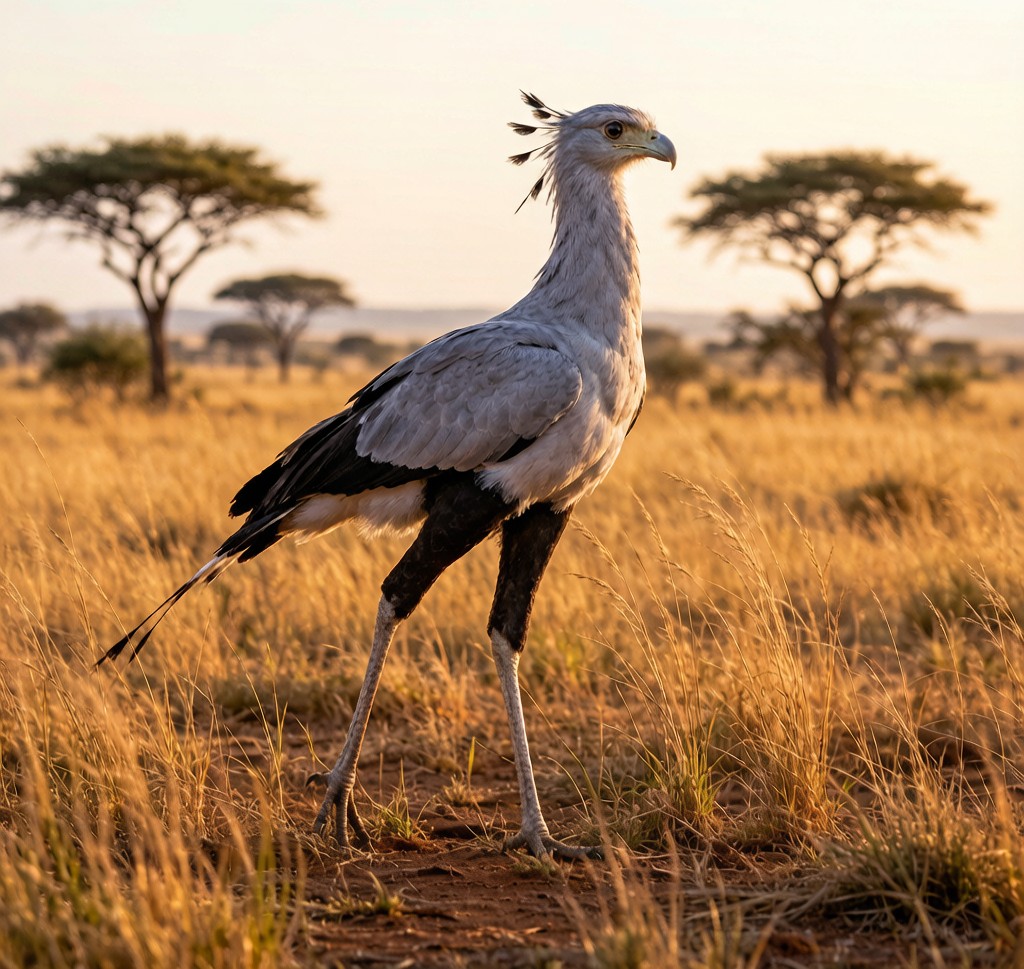
A Secretary Bird (Sagittarius serpentarius) striding across the African savanna, displaying its distinctive eagle-like body and crane-like legs
Overview
The Secretary Bird (Sagittarius serpentarius) is one of the most extraordinary birds of prey in the world. Unlike any other raptor, the Secretary Bird is terrestrial, spending the vast majority of its time on the ground where it hunts snakes, small mammals, and insects across the open savannas of sub-Saharan Africa. Its striking appearance – an eagle’s head and torso mounted on impossibly long, crane-like legs – makes it instantly recognizable and one of the most photographed birds in Africa. Standing approximately 1.3 meters tall with a wingspan of over 2 meters, the Secretary Bird is a dominant predator in its grassland ecosystem.
The species name Sagittarius serpentarius literally means “archer of serpents,” a reference to its legendary ability to kill and eat venomous snakes including cobras and adders. With powerful legs capable of delivering kicks of tremendous force – up to 195 newtons in laboratory measurements – and a thick, scaly leg covering for protection against snake bites, the Secretary Bird is the most effective snake-killer among all birds of prey.
Habitat and Distribution
Secretary Birds are found throughout sub-Saharan Africa, from Senegal in the west to Ethiopia in the east, and south to South Africa. They inhabit a wide range of open grassland and savanna habitats, preferring areas with short to medium-height grass where they can hunt by walking, with scattered trees and termitaria (termite mounds) that provide nesting sites. They are largely absent from dense forest, true desert, and wetlands.
The species is most abundant in protected areas such as the Serengeti in Tanzania, the Maasai Mara in Kenya, and Etosha National Park in Namibia, where populations are relatively undisturbed. Secretary Birds require large territories for hunting – a pair may range over 50 to 150 square kilometers – and are highly sensitive to habitat degradation from intensive agriculture, overgrazing, and pesticide use, which reduces prey availability and contaminates their food chain.
Diet and Hunting Behavior
The Secretary Bird’s hunting strategy is unlike that of any other bird of prey. Rather than soaring or perching to hunt from the air, the Secretary Bird walks through the savanna in a manner more reminiscent of a secretary’s shuffling gait – hence its name – covering up to 30 kilometers per day on foot. As it walks, it flushes prey from the grass by stomping, kicking, and flapping its wings to scatter the vegetation.
When a snake or small mammal is flushed, the Secretary Bird’s remarkable leg weaponry comes into play. It delivers rapid, powerful kicks with its scaled legs, each strike capable of stunning or killing prey instantly. Research suggests that the kick mechanism involves the bird’s heel tendon acting as a spring, storing and releasing energy with explosive force. For venomous snakes, repeated kicks incapacitate the snake before it can strike. The bird then swallows prey whole or in large pieces. Their diet includes snakes up to one meter in length, lizards, rodents, small tortoises, frogs, large insects, and occasionally birds.
Breeding and Nesting
Secretary Birds are monogamous and pair for life, maintaining a territory year-round. They build enormous platform nests in the crown or upper forks of flat-topped acacia trees, typically 2 to 7 meters above ground. Both sexes participate in nest construction, adding sticks, grasses, and dried mud to create a nest that can exceed 1.5 meters in diameter and 30 centimeters in depth. Pairs reuse and enlarge the same nest over multiple breeding seasons, with some documented nests being used for over 50 years.
The female lays 1 to 3 eggs (usually 2) which are incubated primarily by the female for approximately 45 days. Chicks hatch asynchronously, with an interval of up to a week between the first and last chick, and the later-hatched chick typically dies from starvation or siblicide in most broods. The surviving chick is fed by both parents for approximately 80 to 85 days before fledging, remaining dependent on the parents for food for several months after its first flight. Young Secretary Birds attain adult plumage at approximately 2 years of age and typically begin breeding at 4 to 5 years old.
Conservation Status
The Secretary Bird is listed as Endangered on the IUCN Red List, with populations estimated at 6,700 to 67,000 mature individuals and declining. The species faces multiple threats across its vast African range, including habitat degradation from agricultural expansion and overgrazing, direct persecution by farmers who shoot or poison them in retaliation for preying on poultry, and collecting of eggs and chicks for traditional medicine and the pet trade.
Perhaps the most insidious threat is the accumulation of organochlorine pesticides in their food chain. Secretary Birds are apex predators of the grassland ecosystem, and the bioaccumulation of persistent organic pollutants from poisoned prey can cause eggshell thinning and reproductive failure. Conservation efforts focus on protecting key habitat areas, monitoring populations through road-based surveys, raising awareness among rural communities, and studying the species’ ranging behavior using GPS tracking technology. The Secretary Bird is also celebrated as a cultural symbol – it appears on the coats of arms of both Sudan and South Africa – which has helped raise its profile as a species requiring protection.