 By st20113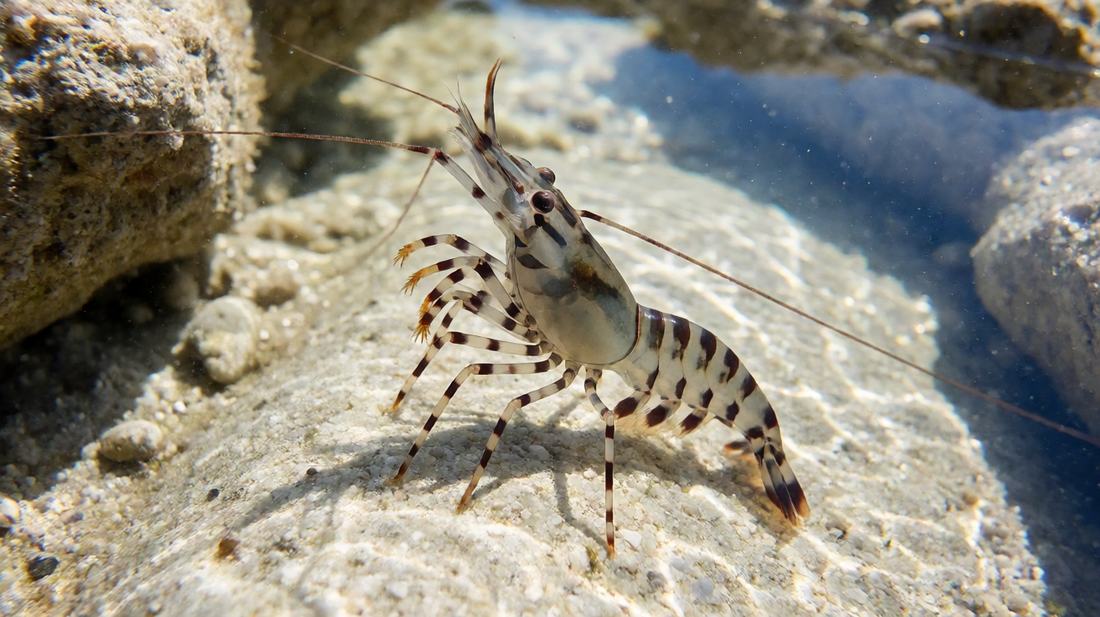
Palaemon serratus | Common Prawn
Species Profile · Palaemonidae
Common Prawn
The see-through, banded prawn of every rock pool in western Europe — a scavenger that keeps the shore clean and feeds the fish we catch.
IUCN: Not Evaluated
Range
Length
Rostrum
Depth
Legs
The glassy prawn of the rock pool
See-through, banded and everywhere on the shore
The common prawn is the see-through, striped prawn of the rock pool. Anyone who has looked into a pool at low tide has probably seen one. Most people do not notice it. It is small and almost glassy. Its legs carry dark red-brown bands. A long saw-toothed spike sits between its eyes. Its antennae are as long as its body.
It lives on rocky and muddy ground, from the shallowest pools down to about 40 m. Its range runs from Denmark and the British Isles south along the Atlantic coast of Europe to Mauritania. It also covers the Mediterranean and the Black Sea. By day it hides among algae and under stones. At night it comes out to scavenge. It is an important prey species for coastal fish. It also supports small inshore fisheries, above all in southern Europe.
There it is caught in baited traps and sold fresh. The species has never been formally assessed for the Red List. That is normal for a common sea species with large, widespread numbers and no clear threats. It is well studied all the same. It is easy to keep, easy to breed and widely used in sea biology.
Family tree
Palaemon, some 30 saw-toothed prawns
The common prawn belongs to the family Palaemonidae. That is a large group of shrimps and prawns of fresh, brackish and sea water worldwide. Its genus is Palaemon. That group holds some 30 or more species in the Atlantic, Mediterranean and Indo-Pacific. Thomas Pennant described it in 1777. Its scientific name is unusually descriptive. Palaemon is the name of a Greek sea god. Serratus is Latin for saw-toothed.
That refers to the long, serrated rostrum, the spike that points forward between the eyes. The spike carries a row of teeth along its upper edge. The number and layout of those teeth are standard features for naming palaemonid prawns. The common prawn usually has 7 to 9 of them. Within the family it is close to some other European species. They include the small grass prawn, Palaemon elegans. That one is even commoner in British rock pools and lacks the strong bands on the legs. Another is the Baltic prawn, Palaemon adspersus, which prefers lower salt.
All of these species share the same general grounds. They are often found together, so close study is needed. The prawn sits in the order Decapoda. That order holds the shrimps, prawns, crabs, lobsters and crayfish. Its members have 10 legs, and the front pairs are often turned into claws or pincers. The common prawn shares an order with the European lobster, a far larger decapod of the same rocky coasts. The two share a basic body plan and a hard outer shell that must be shed to grow. They also share a life cycle in which the female carries her eggs until they hatch.
Clear body, 7-9 teeth
How to identify one
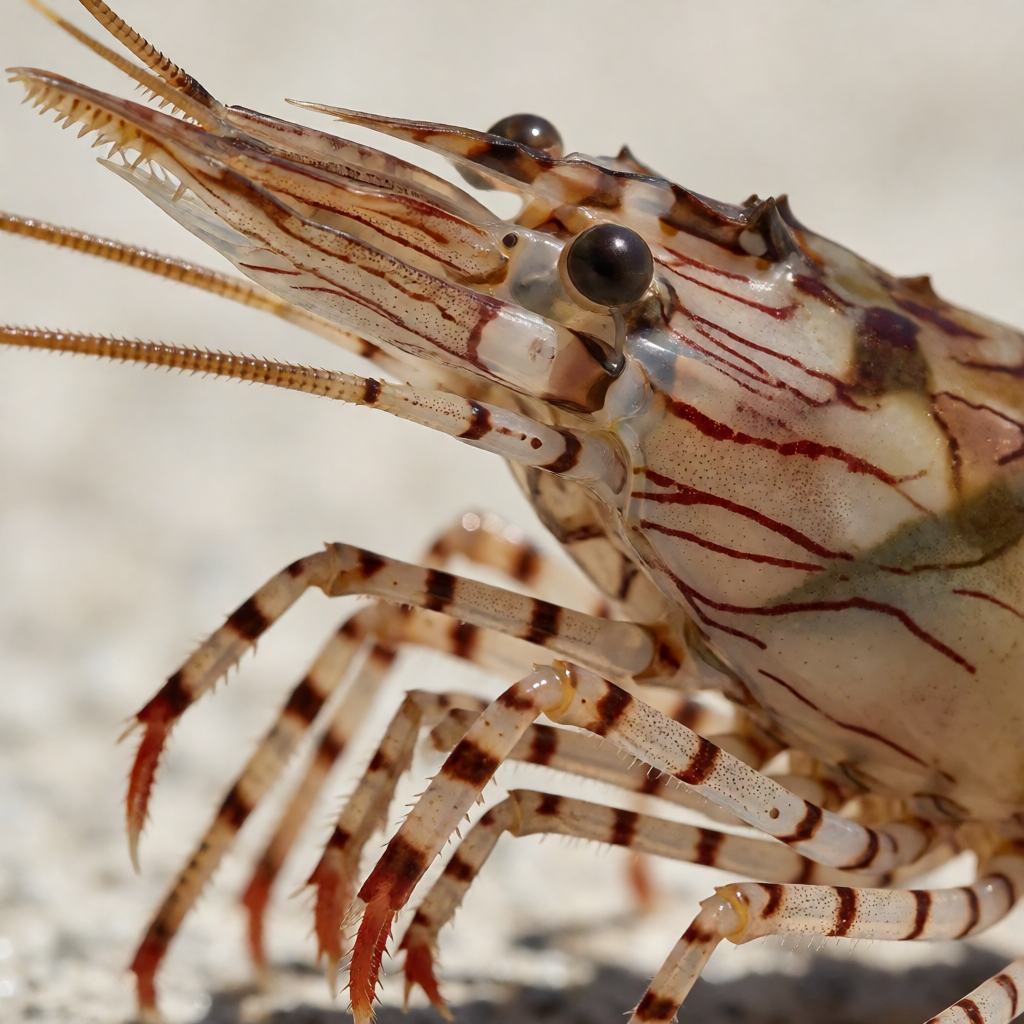
The common prawn is slender and flattened from side to side. Its total length is up to about 11 cm. Most are much smaller, between 4 and 7 cm. Males are smaller than females. Its most striking feature is that it is clear. The body is almost colourless and jelly-like. The gut, the inner organs and the muscles show through the shell. That makes it hard to see against water or wet rock. Over that clear body run markings. The body and legs carry dark red-brown bands and stripes along their length. The antennae and the tips of the limbs are banded too.
These marks grow clearer as the prawn grows. The carapace is smooth and hard. The front of the head carries the rostrum, a long, narrow spine that curves upward. It has 7 to 9 teeth on its upper edge and a few on the lower. That is where the species gets its name. The eyes are large and dark, on short movable stalks. The first pair of walking legs is turned into long, slender pincers with fine fingers. They are used for grooming and for picking food off surfaces. The second pair is similar and also slender. Neither is heavily built. The species is a scavenger and a grazer, not a crusher.
The two pairs of antennae are very long. The second pair is often as long as the whole body. They are thickly supplied with chemical and touch sensors. So it can find food and sense hunters without seeing them. The abdomen is divided into 6 segments, each with a pair of swimming limbs, the pleopods. The tail ends in a fan, formed by the last pair of limbs and the telson. Like all crustaceans, the common prawn must moult to grow. It sheds its whole outer shell and swells into a soft new one before it hardens. For a day or two after each moult it is at risk from hunters.
1
2
3
Rock pool to 40 m down
Where it lives
The common prawn lives in shallow coastal water and is most often found on rock. Its depth range runs from the low-water mark down to about 40 m. It occurs on rocky and muddy bottoms, in rock pools and in gullies. It also lives among beds of seaweed and seagrass, in estuaries and on dark parts of underwater cliffs and boulder slopes. It prefers warm water, with a favoured temperature of about 16 degrees Celsius. Its range shows that. It runs from about 61 degrees north in Scandinavia to about 18 degrees north off West Africa. It also covers the Mediterranean and the Black Sea, where the water stays warmer than the Atlantic at the same latitude.
The species copes with brackish water, which is why it turns up in estuaries. But it does not go as far into low salt as some of its relatives. By day, common prawns shelter in cracks, among algae and beneath stones. They often sit in groups. They are found above all in the darker parts of rock pools and shallow caves. There they are safe from both hunters and bright light. At night they come out and move about over the rock and the seabed, looking for food. This habit of hiding by day and feeding at night is shared with many shallow-water crustaceans.
It looks like a response to being eaten. Prawns are easy to spot when they move and almost invisible when they hide. Where rocky shores offer plenty of weed and cracks, the species can be very common. It is one of the standard prawns of the tidal zone in western Europe. It also lives on softer ground, including muddy bottoms and seagrass meadows. There it is found in smaller numbers than on rock.
It eats almost anything
What it eats
The common prawn eats almost anything. Its diet includes seaweed and other algae, small crustaceans, worms and other small animals, detritus and organic bits, and carrion of almost any kind. It feeds mostly by scavenging and grazing. It uses its slender pincers to pick food from the surface of rocks, weed and sediment. It is strongly drawn to any dead animal, which it strips quickly. In this role it helps to keep shallow rocky shores clean. It is part of the reason that dead fish and crabs on the seabed vanish so fast in warm coastal water.
Because it will eat nearly anything edible, the species is easy to keep and easy to farm. That is one reason it has been so much studied. The prawn’s feeding is guided mainly by chemical senses rather than by sight. Its long antennae are covered in sensors that pick up dissolved substances at very low levels. So it can find food in the dark and from a distance. It moves up-current towards a scent. Feeding peaks at night, when it leaves cover.
As well as eating, the common prawn is an important meal for others. Coastal fish eat it in quantity. They include wrasse, bass, pollack and cod. Seabirds take it from rock pools and shallow water. Larger decapods and octopuses hunt it too. Its numbers make it one of the links between the detritus and small life of the shore and the fish that people catch.
A brood carried under the tail
The breeding cycle
The common prawn breeds in season, with spawning concentrated in the warmer months of spring and summer. Its breeding habits are typical of prawns and shrimps. The male leaves a mass of sperm near the female’s opening after a short courtship. The female then lays a batch of eggs. She fertilises them as they come out and glues them to the underside of her abdomen. They are held there by the pleopods. A large female can carry as many as 4000 eggs at a time.
She carries them for about 4 to 6 weeks until they hatch. During that time she cannot feed well and gives the brood constant care, fanning the eggs and cleaning them. The eggs hatch into free-swimming larvae that join the plankton. There they pass through a series of zoeal stages, each ending in a moult. They feed on small drifting animals as they drift. After several weeks the larvae change into small post-larval prawns. These settle into the rock-pool and shallow grounds of the adults.
Because the larvae drift in the plankton, they can be carried a long way from where they hatched. That is part of the reason the species has such a large range and so few distinct local groups. Growth is rapid and the animals moult often when young, less often as they age. Females grow larger than males and can probably produce more than one brood in a season. The species lives 2 to 3 years. Most prawns die before they reach top size, so the yearly turnover is high. Numbers can recover quickly from heavy predation or heavy fishing.
Not Evaluated, and no cause for alarm
Conservation
The common prawn has not been assessed for the global IUCN Red List. It is therefore listed as Not Evaluated. That is the ordinary case for most sea life. It should not be read as a sign of trouble. The species has an enormous range, from Scandinavia to West Africa and throughout the Mediterranean and Black Sea. It is common in the right grounds. It also produces large broods that drift far on ocean currents.
That gives it a strong power to recolonise areas that have been emptied. The Food and Agriculture Organization’s vulnerability index gives it a low score of 10 out of 100. That measure reflects fast growth, early maturity and high output of young. There is a fishery all the same. Common prawns are caught by hand and in baited traps and pots along the coasts of Portugal, Spain, France, Italy and the Adriatic. They are sold fresh as a premium product in parts of southern Europe. The fishery is small-scale, inshore and mostly by hand.
So it has not drawn the intense management given to larger stocks, and in most areas it is not even assessed. Local pressure on the species comes less from fishing than from habitat change. Pollution and excess nutrients in coastal waters cut the amount of suitable ground. So do the loss of seagrass beds, building works, dredging and the decay of rocky shores. A warming sea is expected to shift the animal’s range northwards over the coming decades. The main practical need is simply to keep shallow coastal grounds healthy. That is also what keeps the many species that depend on this prawn as food.
Quick hits
Five things to remember
- Its body is almost completely clear, so the gut shows through.
- The name serratus means saw-toothed, after the spike between its eyes.
- A large female can carry as many as 4000 eggs under her abdomen.
- Its antennae can be as long as the body and smell food in the dark.
- It rates low for fishing risk, scoring 10 out of 100.
[…] The species sits in the order Amphipoda. Its family is the Gammaridae. That family holds about 200 species in all. It shares the class with the Common Prawn. […]
[…] are in fact shrimps turned on their backs. A relative from the same subphylum is Common Prawn. Both wear a hard shell and jointed […]