 By st20113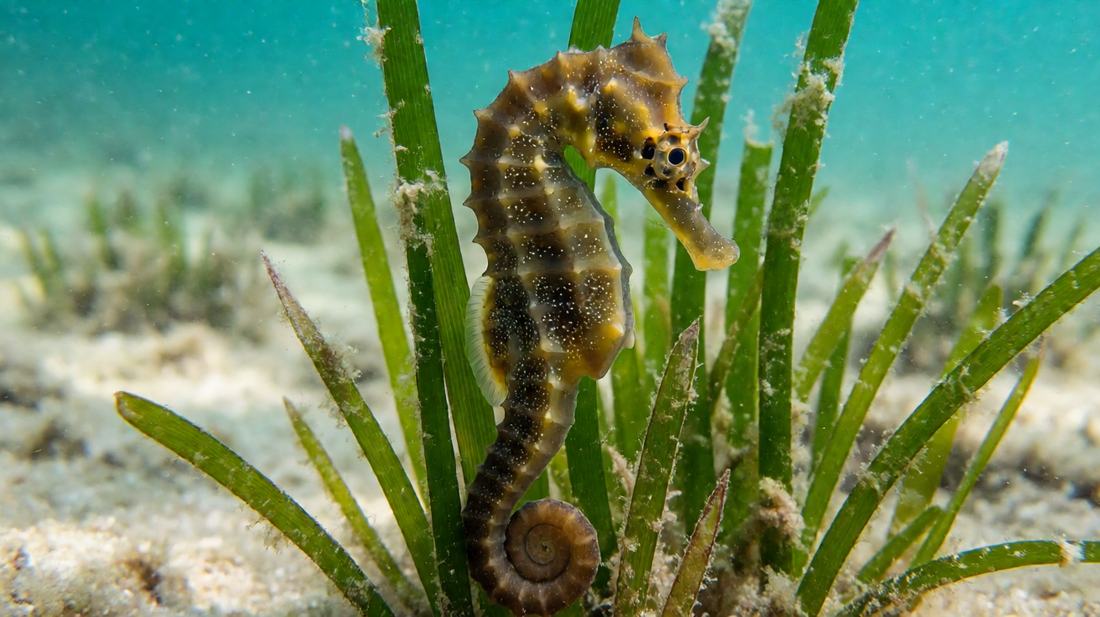
Hippocampus hippocampus | Short-snouted Seahorse
Species Profile · Syngnathidae
Short-snouted Seahorse
A fish with the head of a horse, the tail of a monkey and the pouch of a marsupial — and one that turned up in the estuary of the Thames in the middle of London.
IUCN: Data Deficient
Range
Length
Depth
Pouch
Fin
A fish that is not like a fish
A seahorse of the European coast
The short-snouted seahorse is a small and a very strange fish. It lives in the shallow and the sheltered water of the north-east of the Atlantic. It also lives in the Mediterranean. It is one of the 2 seahorses of the European coast. It is the one with the shorter and the blunter snout. The whole of the seahorse is built on a plan with no parallel among the fishes. It has the head of the horse. It has the prehensile tail of the monkey. It has the pouch of the marsupial and the bony armour of the insect. The whole of the body is encased in the plates of the bone. The seahorse swims in a vertical position. The small dorsal fin beats very rapidly. The tail is coiled around a stem of the eelgrass. It can also grip a branch of the weed.
The species is a fish of the shallow and the muddy water. It lives in the estuary and on the bed of the seagrass. It is a very poor swimmer. It lives its whole life within a very small area. It does not migrate and it does not travel. It spends the greater part of the day anchored to a single stem. It waits for the small crustaceans to drift within reach of the snout. It is one of the most perfectly camouflaged fish of the shallow sea. Its mottled skin is brown and yellow and olive. That skin matches the weed and the mud of its chosen site. The most remarkable feature of the biology of the seahorse is a reversal. The ordinary roles of the 2 sexes are turned around. It is the male that carries the developing eggs. The eggs sit in a pouch on his belly.
The male gives birth to the young. The female takes no part in the care of the brood. She does hand over the eggs to the pouch of her partner. That transfer comes at the end of a long and an elaborate courtship. The courtship lasts for several days. It is repeated at the same hour each morning. The short-snouted seahorse is the commoner of the 2 European species. It is the commoner one in the north of the range. It is the one that has been found in the estuary of the river Thames. That estuary lies in the heart of London. The fish was found in the heart of a great industrial city. That was one of the most surprising pieces of the news of the natural history. The news came in the last 20 years.
Family tree
Hippocampus, the seahorses
The short-snouted seahorse was described by Linnaeus in 1758. He gave it the name of Syngnathus hippocampus. The modern treatment places it in the genus Hippocampus. Those are the seahorses. The family is the Syngnathidae. That is the group of the seahorses and of the pipefishes. The seadragons belong to it as well. The group contains about 300 species. It is characterised by the elongated and the armoured body. It is also characterised by the long and the tubular snout. It is characterised by the habit of the male of carrying the eggs. The family belongs to the order Syngnathiformes. That order also contains the trumpetfishes and the cornetfishes and the snipefishes. The whole of the order is a group of small fishes. They are very unusual ones, and they live in the shallow water.
The group is an ancient one. The fossil seahorses are known from the Miocene. The seahorses are the most specialised members of the family. The body has lost the straight line of the pipefish. It has become short and deep. The tail has lost the fin. It has become a grasping organ. The head has rotated through 90 degrees. The rotation is on the axis of the body. So the fish can look forward while the body stays upright. The short-snouted seahorse is the close relative of the Long-snouted Seahorse (Hippocampus guttulatus). The 2 species are the only seahorses of the coast of Europe. They live in the same beds of the seagrass and the same estuaries. They are frequently caught in the same haul of the trawl. They are separated by the length and the shape of the snout.
They are also separated by the arrangement of the rings of the body. They differ in the pattern of the skin as well. The snout of the long-snouted seahorse is a long one. It is more than a third of the length of its head. The snout of the short-snouted seahorse is much less than a third. That difference is the quickest way to tell the 2 apart. The seahorses of the genus Hippocampus are notoriously difficult to classify. The group has been the subject of a long debate. The debate concerns the number of the valid species. About 40 named species were once in doubt. The great majority of them are now thought to be valid. The molecular evidence supports the judgement. So does the morphological evidence.
Bony rings and a blunt snout
How to identify one
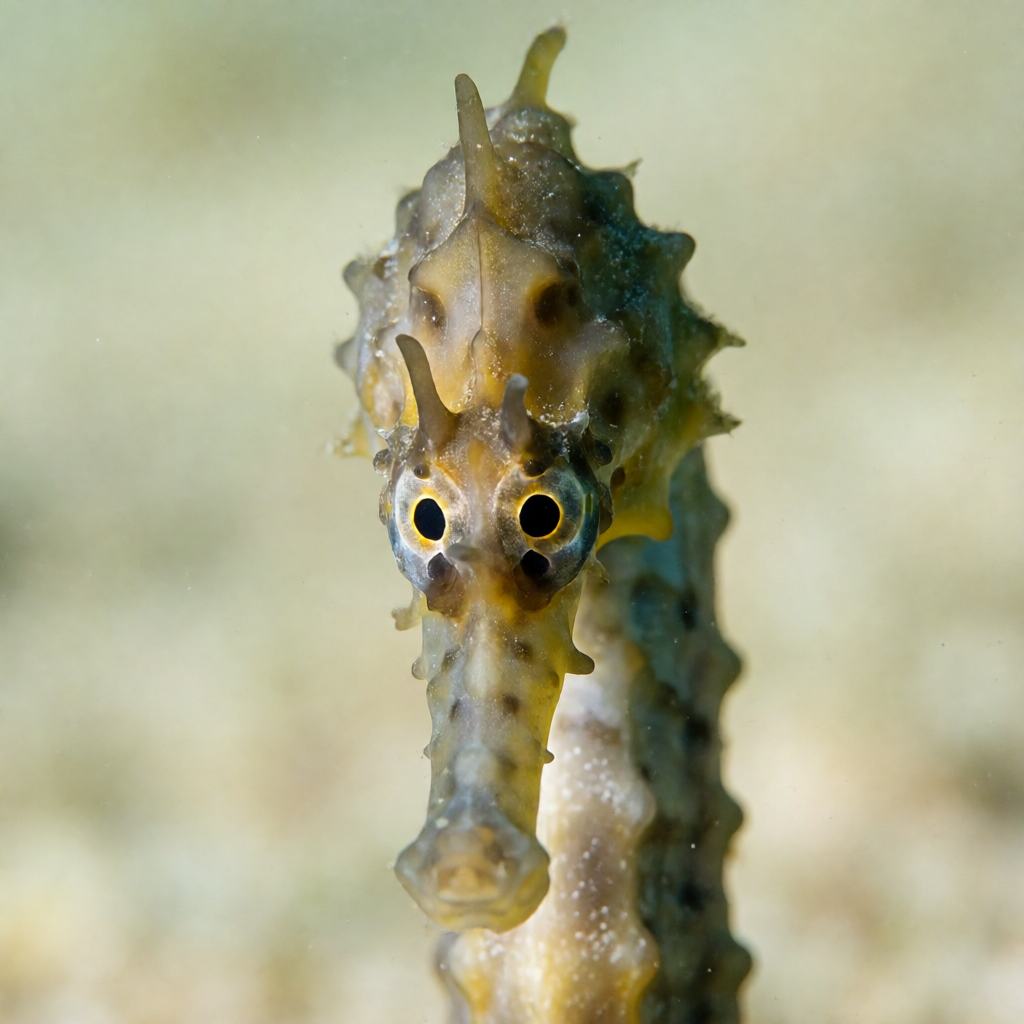
An adult short-snouted seahorse reaches a length of about 15 centimetres. The female is on average a slightly larger fish than the male. She is a more stoutly built fish as well. The whole of the body is encased in a series of the bony rings. Those rings are arranged in the trunk and in the tail. The arrangement of the rings is a standard character of the classification of the group. The number of the fin rays is another one. The head carries a short and a blunt and a slightly upturned snout. That snout is much less than a third of the length of the head. The eyes are large and are set on the sides of the head. They move independently of one another. So the fish can watch 2 directions at the same time. The body remains still while it does so. The eye of the living fish is a brilliant red in the adult.
The body is a mottled mixture of the brown and the olive. The yellow and the grey are part of the mixture too. The mixture is a very variable one. The skin carries small pale flecks and dark blotches. It often carries a pattern of the fine white spots along the flank. The colour of the fish changes with the habitat. It changes with the state of the fish and with its social situation. The whole of the change comes from the pigment cells in the skin. It takes place over a period of minutes or of hours. The dorsal fin is small. It is set on the middle of the back. It beats between 20 and 70 times a second. The beating of that single fin is the whole of the propulsion of the fish. The fish is therefore a very slow and a very manoeuvrable swimmer.
It cannot make a rapid escape. The tail has lost the fin of the other fishes. It has become a muscular and a tapering organ. It curls inward on itself. The fish uses the tail as a hand. It grips the stem of a plant with the tip of the tail. It can hold the position for hours. The male carries a pouch on the front of the belly. The opening of the pouch is a slit. That slit is closed by the tissue of the body. The female carries no pouch. The 2 sexes are otherwise very much alike.
1
2
3
Seagrass, estuary and lagoon
Where it lives
The short-snouted seahorse is a fish of the shallow and the very sheltered water. The species lives on the bed of the seagrass. It lives on the muddy and the sandy bottom. It also lives in the estuary and in the lagoon. It is found on the edge of the rocky reef as well. The fish is usually found at a depth of less than 20 metres. It has been recorded at the depth of about 77 metres. The range of the species is confined to the north-east of the Atlantic. The Mediterranean lies within it as well. That water is tropical and warm temperate. The species occurs from the west of Scotland in the north.
It reaches the south of the North Sea and the coast of the Netherlands. Its southern limit is the coast of Senegal and the Gulf of Guinea. It is found around the islands of the Azores and of Madeira and of the Canaries. The whole of the Mediterranean is within the range. The fish of the British and the Irish coast are at the very northern limit. Their presence is made possible by the warm water of the current. That current carries the plankton up the western coast of Europe. The species is a fish of the very small home range. The individual fish remains within an area of a few square metres. It stays there for the whole of its life. The fish does not travel and does not migrate.
It relies on the food that happens to drift past its chosen stem. The daily movement of the fish is very short. That is why any damage to a bed of the seagrass destroys its population. The population does not recover from the neighbouring areas. The cover of the seagrass and of the weed is essential to the species. The plant gives the anchoring and the concealment. The fish is also recorded on the artificial structures of the coast. It has been found in the estuaries and in the harbours. It has been found on the shore of the great city too. The discovery of the fish in the estuary of the river Thames was important evidence. That evidence led to the legal protection of the 2 British seahorses.
A sucker of tiny crustaceans
What it eats
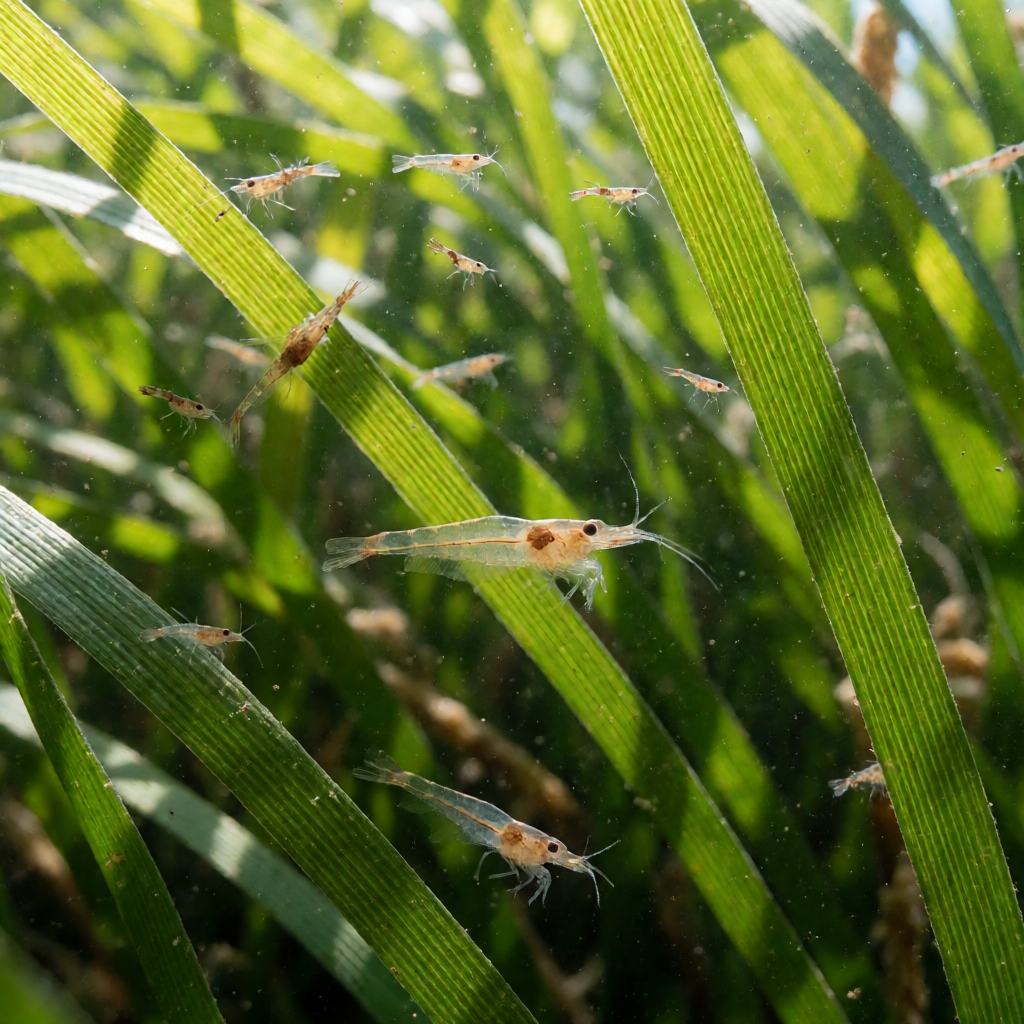
The short-snouted seahorse is a predator of the smallest crustaceans. Those animals live in the water column and on the surface of the weed. The diet is made up almost entirely of the mysids. The small shrimps are important too. The copepods and the amphipods matter as well. The species also takes the very small fish larvae. It takes the other small animals of the plankton too. The whole of the prey is small. It is taken one at a time. The fish has no need of the teeth. The method of the capture is one of the most extraordinary. It is one of the strangest feeding mechanisms of the fishes.
The seahorse does not bite and does not chew. It waits until the prey is within a very short distance of the snout. Then it expands the mouth cavity and the throat very rapidly. It sucks the prey in with the water. The whole of the movement takes a few thousandths of a second. That is one of the fastest of the movements of any of the animals. The fish has no true stomach. The food passes very rapidly through the gut. The species must therefore feed almost constantly. It needs enough nutrition from the very small prey. The fish feeds through the whole of the daylight. It is most active in the first hours of the morning.
It is active again in the last hours of the afternoon. The fish is a very patient and a very still hunter. It spends the greater part of its time attached to the stem of a plant. The head is slightly raised. The eyes move independently of one another. The whole of the feeding activity of the species is invisible to the casual observer. The fish is so well concealed and so very still. The species is not able to compete with the faster fishes of the open water. It does not need to. The whole of its life is arranged around one kind of prey. That prey is small and slow, and the other fishes of the shallow water overlook it.
The male becomes pregnant
The breeding cycle
The short-snouted seahorse has one of the most unusual systems of reproduction. The system is one of the most unusual in the whole of the world. The male carries the developing eggs. He alone tends the brood. The whole of the sequence is the reverse of the ordinary arrangement. That arrangement is the one of the fishes and of the higher animals. The pair perform an elaborate courtship. It is repeated on a number of the successive mornings. It is at its most intense at the beginning of the breeding season. The 2 fish begin the display by changing the colour of the body. They then rise through the water together. They entwine the tails and the bodies.
The female then transfers the eggs to the open pouch of the male. The eggs come from an opening at the base of her belly. The transfer takes place in a few seconds. The female does not take part again. The pouch of the male must be emptied first. The pouch of the male closes after the transfer. The eggs are fertilised inside it. The embryo develops in the pouch for between 2 and 4 weeks. The lining of the pouch provides the fluid and the oxygen. It provides a measure of the nutrition for the developing young as well. The male carries several hundred of the eggs at a time. The whole of the brood is released at the end of the term.
It comes out as a mass of the miniature seahorses. Those young fish are exact copies of the adult in all but the size. The male gives the young no further care. The young fish float away with the current. They take the food of the plankton from the first hours of life. The pair meet again within a short time of the release of the brood. The whole of the cycle is repeated a number of times in the breeding season. The young grow very quickly. They are able to breed within a few months. The short generation time is the main reason for the success of captive breeding. The species is maintained and bred very readily in captivity. The aquaria of the zoos and of the public aquariums of Europe do the work.
Data Deficient, and protected
Conservation
The short-snouted seahorse is assessed as Data Deficient on the global Red List. The absence of a firm category reflects a real difficulty. The fish is small and very well concealed. It lives at a low density over a very great area. Counting such a fish is very hard. The species is assessed as Near Threatened in the regional assessment of the Mediterranean. The difference between the 2 assessments is instructive. It shows the care that must be taken with the regional and the global categories. The greatest threat to the species is the incidental capture in the trawls. The dredges of the fishing industry are a danger too. The destruction of the bed of the seagrass is a threat as well. The muddy bottom is damaged by the same gear. The fish is taken as a bycatch in very great numbers. That happens in the shrimp fisheries of the Mediterranean and of the west of Africa.
Much of that catch is dried and is sold in the trade of the curiosities. A smaller proportion of the live fish is collected under the licence. Spain and Portugal issue those licences for the trade of the aquaria. The habitat of the species is under the pressure of the pollution. It is under the pressure of the development of the coast. The anchoring and the dredging matter as well. The loss of the seagrass bed is a particularly serious matter. The fish cannot move to another area. The population of a bed is destroyed with the bed. The species has no commercial value in itself. The fishing industry does not target it. So the control of the species depends on the control of the gear. The habitat must be controlled as well. It does not depend on the direct regulation of a fishery.
The species has been protected in the United Kingdom since the year 2008. The act of the wildlife and the countryside does the work. Two of the marine conservation zones of the coast of England were established for a purpose. The purpose was the protection of the population and the habitat of the 2 seahorses. The whole of the genus Hippocampus is listed in the second appendix. That is the appendix of the convention on the international trade. The species is also covered by the Bern convention. The OSPAR convention covers it too. So does the protocol of the Barcelona convention for the Mediterranean. The animals are readily bred in the captivity. More than 900 of the young were born in a single year. That happened at the aquarium of the zoological society of London. That figure is an indication of the potential of the captive breeding. The captive breeding can reduce the pressure of the collection on the wild population.
Quick hits
Five things to remember
- It is the male that becomes pregnant. The female transfers her eggs into the pouch on the belly of her partner. She takes no part in the care of the brood.
- The fish has no true stomach. The food passes through the gut so rapidly that the animal must feed almost without a pause. It does so through the whole of the daylight.
- The seahorse does not bite its prey. It sucks the animal in with a movement of the mouth and the throat. That movement takes a few thousandths of a second.
- A colony of the species was discovered in the estuary of the river Thames in the year 2007. It was one of the pieces of the evidence that led to the legal protection of the British seahorses in the year 2008.
- The whole of the genus is listed in the second appendix of the convention on the international trade in the endangered species. The export of a single seahorse therefore requires a permit.