 By st20113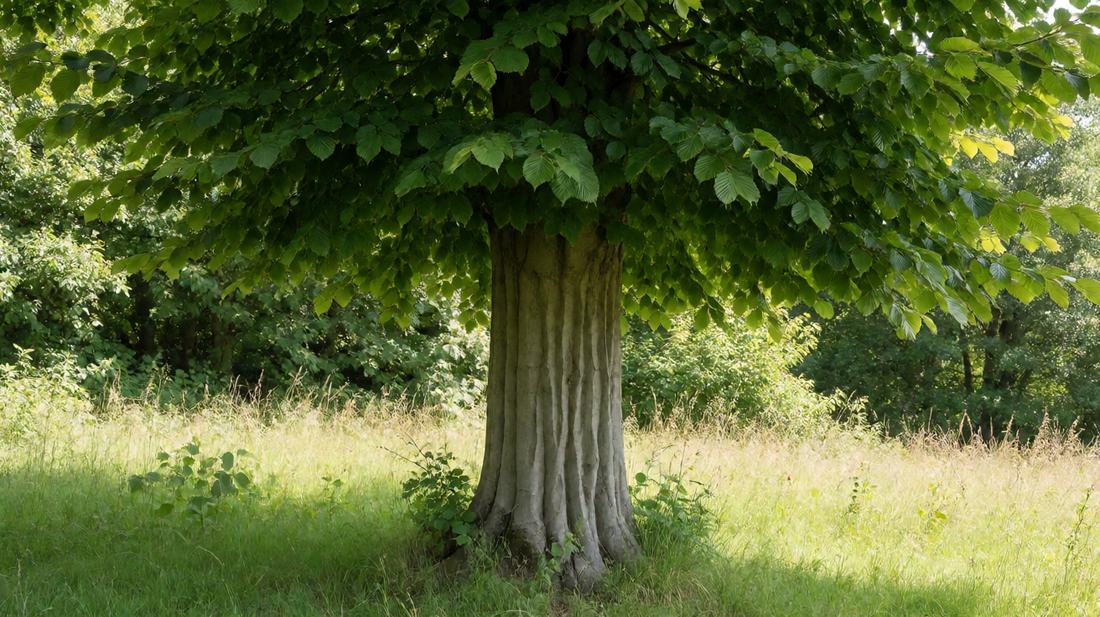
Carpinus betulus | European Hornbeam
Species Profile · Betulaceae
European Hornbeam
A modest tree in the wood and one of the best hedges in Europe — its name means horn-beam, wood hard enough to be used like horn.
IUCN: Least Concern
Range
Height
Leaves
Buds
Wood
The horn-beam tree
Modest in the wood, brilliant as a hedge
The European hornbeam is a tree with two faces. In a wood it is modest and slow-growing. Few people notice it. Clipped and grown as a hedge, it is one of the best garden plants in Europe. It is dense, tidy and holds its dead brown leaves all winter.
Its name tells the story. Hornbeam means horn-beam, wood hard enough to use like horn. For centuries it made yokes, tool handles, mallets, cart wheels and the cogs of mill machinery. It belongs to the birch family, so it is a cousin of hazel and alder. It is native to central, eastern and southern Europe and to western Asia.
It reaches into southern England. Europe has only 3 hornbeams. Hornbeam also regrows fast when cut. People have coppiced and pollarded it for so long that many woodland hornbeams are far older than they look.
Family tree
Carpinus, about 40 small trees
The European hornbeam belongs to the family Betulaceae, the birches, and to the genus Carpinus. That genus holds about 40 small and medium trees across the temperate north. Within the family it sits in the subfamily Coryloideae, the hazels and hornbeams. Members of that group are pollinated by wind. They make nuts in leafy husks, not the winged seeds of the true birches. For much of the 20th century the hornbeams and hazels had their own family, Corylaceae. Older books still use that name.
DNA work has since shown that they belong inside the birches. The genus name Carpinus is the old Latin word for the tree. The species name betulus means birch-like. That refers to the leaves, which look like birch leaves. The wood is very hard and once made yokes and beams. That is where the English name comes from. The closest relative in European woods is the silver birch, another member of the same family.
The two share the wind-blown catkins, the small hard fruit and the knack of colonising open ground fast. In everything else they differ. Birch has papery white bark and light wood. Hornbeam has heavy, dense timber. The other 2 European hornbeams live in the south and east. Both are smaller trees of drier, warmer ground.
Fluted trunk, flat buds
How to identify one
The European hornbeam is a deciduous tree. It usually reaches 15 to 25 m and only rarely 30 m. Its best feature is the trunk. The bark is smooth and greenish-grey, even on old trees, and the trunk is almost always fluted. Vertical ridges and hollows run up it like the folds of a rope. Smooth bark on a big hardwood is unusual. Hornbeam shares the trait with beech, which often grows beside it. Buds tell the two apart. Beech buds are long, sharp and stick out from the twig.
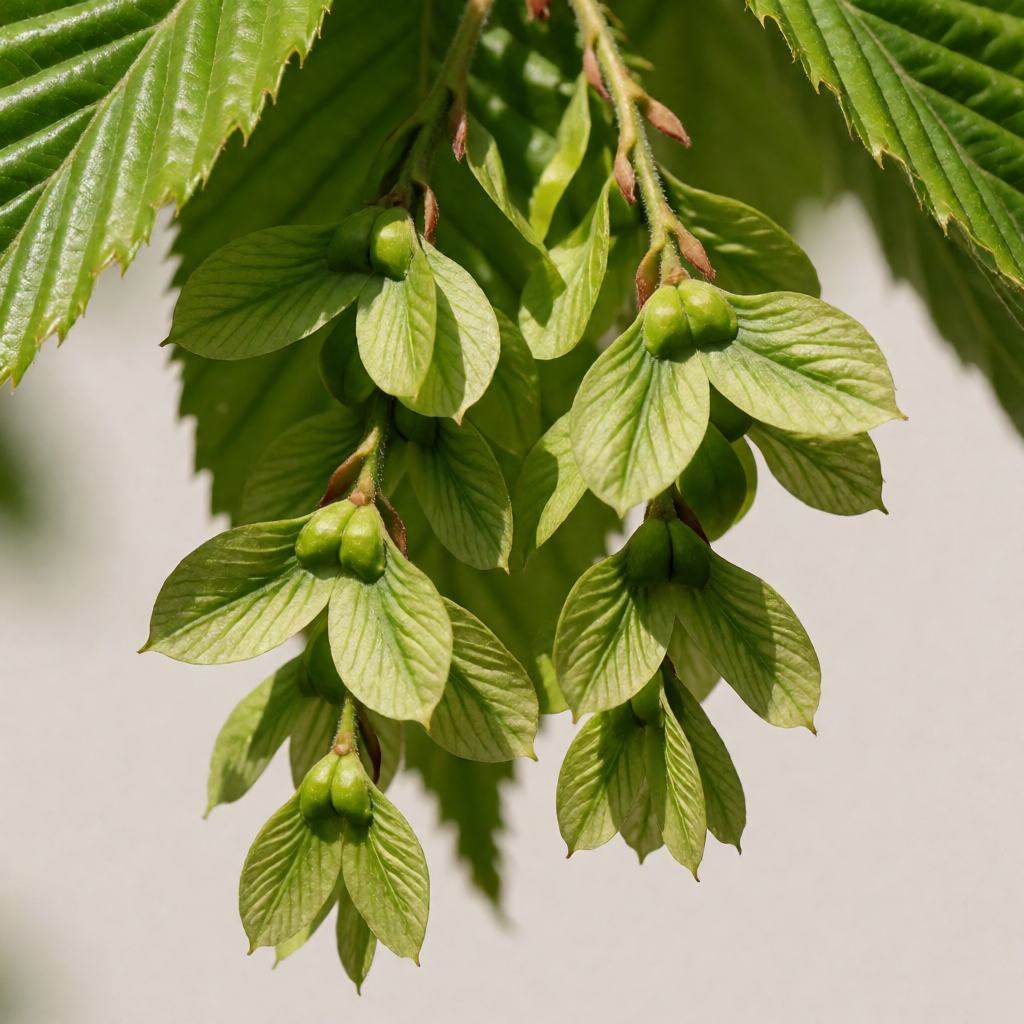
Hornbeam buds are at most 10 mm long and lie flat against the shoot. The leaves are alternate and 4 to 9 cm long. They are oval with a double saw edge. Between 10 and 15 pairs of parallel veins stand out and give the leaf a deeply ribbed, cardboard-like texture. No other common European tree matches that. The tree is monoecious. It carries male and female flowers on the same trunk, and both sit in catkins. The catkins open in spring, at about the same time as the leaves. Male catkins are yellow and hang loose.
Female catkins are smaller and green, and they grow into the seed clusters. The fruit is a small hard nut 7 to 8 mm long. A three-pointed leafy husk 3 to 4 cm long wraps part of it. The nuts hang in long clusters that look like hops. They ripen in autumn. The wood is the tree’s other great feature. Hornbeam timber is pale, very dense and very hard. It is heavier than oak, awkward to saw and famously tough. Freshly cut, it is heavy enough to sink in water.
1
2
3
Heavy soil and warm slopes
Where it lives
The European hornbeam grows in central, eastern and southern Europe and in western Asia. Its range runs from southern Britain and northern France east through Germany, Poland and the Balkans to Turkey, the Caucasus and northern Iran. Its northern limit crosses southern Sweden and the Baltic states. The tree needs a warm climate to do well. It rarely grows above 1000 m, which is why it is missing from most of Scandinavia and from the higher mountains. It is a tree of mixed broadleaf forest, not of pure stands. It grows with oak almost everywhere in its range.
In central Europe it also grows with beech, where beech is the main tree. It is a typical tree of scree forests too, the woods on loose rocky slopes below cliffs. Hornbeam does best on heavier, damper soils. In England it prefers ground with a pH between about 3.6 and 4.6. It copes with a much wider range, up to about 7.6. It dislikes soils with either very high or very low clay content. Its roots are shallow and wide, not deep.
That makes it a poor choice for a windy site and a good one for holding soil on a slope. Where hornbeam dominates, the woods have a clear history. In southern Essex, Hertfordshire and north Kent it often makes up more than half the trees in ancient woods and wood pastures. People managed it there as coppice and pollard for centuries. Two of the best hornbeam landscapes in Europe are Epping Forest in England and the Halltorp reserve on the Swedish island of Öland.
It makes its own food
What it eats
The European hornbeam makes its own food by photosynthesis. It needs sunlight, water and soil minerals rather than any outside diet. Its leaves are thin and strongly veined. The ribbed surface helps the tree balance light against water loss. The grooves channel rain and shelter the stomata beneath. That lets the tree keep working on days when a flatter leaf would have to shut down.
The tree often grows on heavy, sometimes waterlogged ground. It survives there because its shallow roots have a big surface area near the top, where oxygen is still available. Hornbeam also links up with fungi on its roots. Those fungi reach further than the roots and help the tree take up phosphorus and other nutrients. One result of shallow roots is that hornbeam suffers in drought. A long dry summer shows in it before it shows in deeper-rooted oaks nearby.
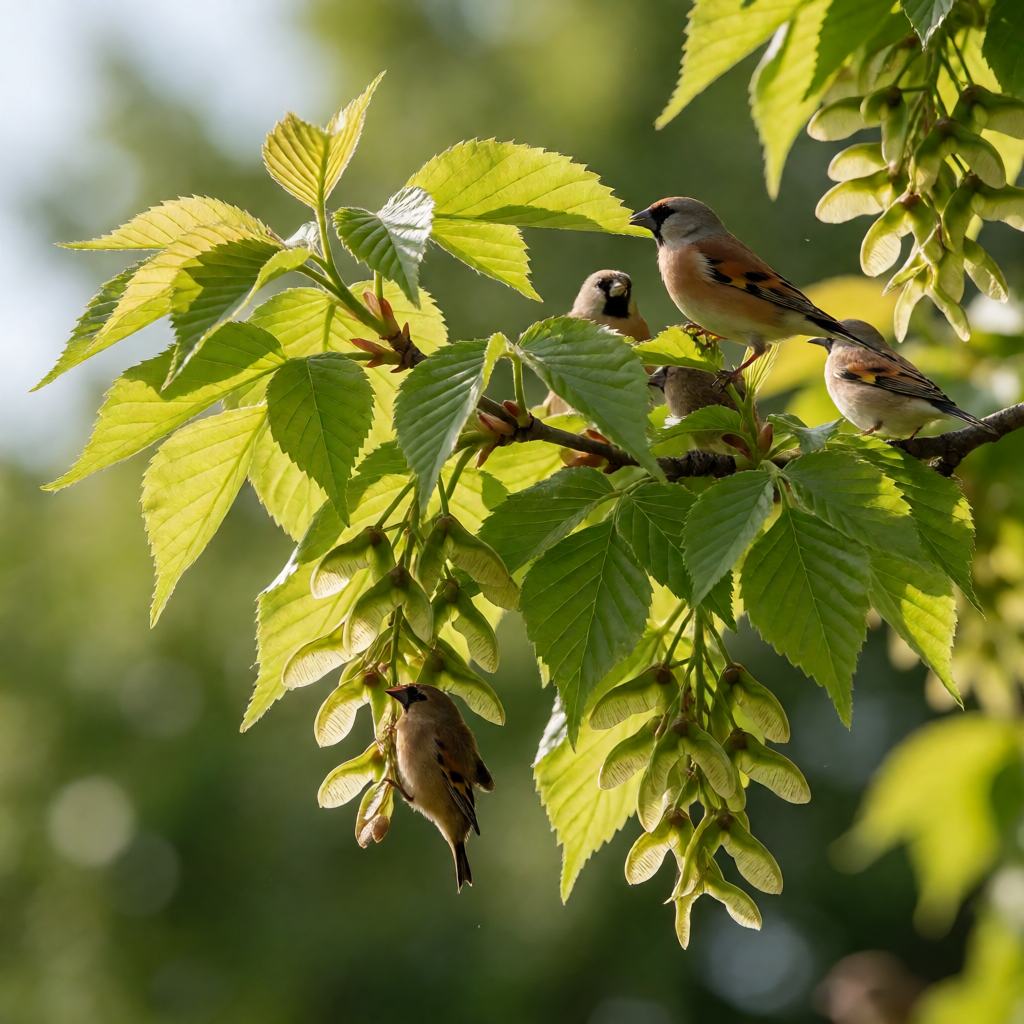
A range of caterpillars eats the leaves. The case-bearer moth Coleophora anatipennella is one. Finches, tits and small mammals take the nuts, though the hard shell keeps most of them out. Where hornbeam grows as a hedge, its dense foliage is valuable. The tree holds its dead leaves through the winter, which gives small birds cover in the coldest weeks. A wren or a dunnock often spends January inside a hornbeam hedge.
Catkins and hop-like nut clusters
The breeding cycle
The European hornbeam flowers in spring and is pollinated only by wind. That explains the huge amounts of pollen it makes and the plain, petal-less flowers. Male and female catkins grow on the same tree, so each one can be both father and mother. The two kinds open slightly out of step, which favours crossing between trees rather than self-fertilisation. Male catkins are 3 to 5 cm long, yellow and drooping. On warm dry days they release clouds of pollen. Female catkins are green and upright, and the same drifting pollen reaches them.
Each fertilised flower makes 1 hard nut about 7 to 8 mm long. A three-lobed leafy husk wraps part of each nut. The nuts hang in long, loose clusters that look like hops, and they ripen in autumn. Wind does the spreading, because the husk acts as a small wing and the clusters hang clear of the branches. Seed is fertile but slow. Hornbeam seed often waits until the spring of the second year after it was shed. Seedlings need light and a gap to get going.
The tree makes up for that in other ways. It coppices and pollards extremely well, pushing strong new shoots from a cut stump. A coppiced stool can live for centuries as a low, wide, gnarled base with several trunks above it. That is why so many woodland hornbeams are much older than their size suggests. The tree also seeds heavily and regrows in quantity wherever there is light and open ground.
Least Concern, but coppice abandoned
Conservation
The European hornbeam is classed as Least Concern. That follows a European assessment in 2017. The tree was found to be common over most of a large range, with no range-wide threats. Its native ground covers much of Europe and reaches into western Asia. It also regrows from a cut stump faster than many hardwoods, so it bounces back from felling. None of that makes it safe everywhere.
Its value as fuel and as raw material for tools made hornbeam the target of centuries of wood management. Much of the hornbeam in Britain and central Europe is now coppice rather than mature trees, because the wood was cut on a cycle. When markets for hornbeam wood vanished in the 1900s, many of those woods were planted with conifers, cleared for farming or simply left. Abandoned coppice slowly turns into dense shade, and few species can live in it. Hornbeam also casts heavy shade and regrows in quantity. So it can invade wood pastures and open woodland and push out plants that need light.
The species still depends on ancient woods staying wooded rather than being converted. It also needs management plans that value coppice and pollard cycles. Most modern use is ornamental. Hornbeam is planted on a very large scale for hedges, screens and topiary. It takes repeated clipping, grows in almost any soil and holds its leaves all winter.
Quick hits
Five things to remember
- The name hornbeam means horn-beam, after timber as hard as horn, once used for yokes, mallets and mill cogs.
- Freshly cut hornbeam wood is dense enough to sink in water.
- A clipped hornbeam keeps its dead brown leaves all winter, which makes it one of the best hedging trees in Europe.
- Its seed clusters look like hops, and the seed often waits until the second spring to come up.
- The buds lie flat against the twig and never reach more than 10 mm, unlike the long, sharp buds of beech.