 By st20113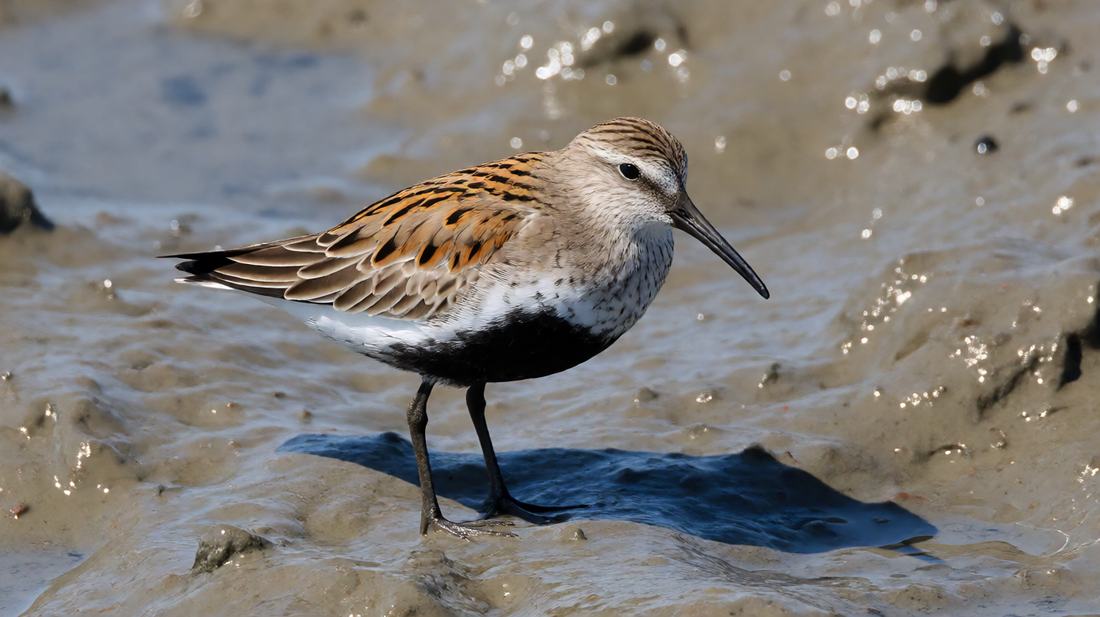
Calidris alpina | Dunlin
Species Profile · Scolopacidae
Dunlin
The small wader that gathers on the estuary by the tens of thousands and turns as one — and whose black summer belly patch makes it the easiest wader of all to name.
IUCN: Least Concern
Range
Length
Weight
Nest
Incubation
The wader of the mudflat
A shorebird of two worlds
The Dunlin is a small, dumpy wading bird. It is one of the most numerous shorebirds of the northern hemisphere. In winter it gathers on tidal mudflats. The flocks may run to many thousands of birds. They move over the wet mud as a single grey mass. They rise into the air in tight, twisting clouds. The birds flash dark and light as they turn together. The Dunlin is 17 to 21 cm long. Its wings span 32 to 36 cm. It weighs about 40 to 75 g. It is small enough for a human hand to close around. Its most useful feature is the bill.
The bill is black and fairly long for the size of the bird. It curves gently downwards along its whole length. A feeding bird in winter looks like a small pale grey bundle. Its drooping probe is stuck into the mud. In summer the same bird is transformed. The breeding plumage brings a rich rufous-brown, black-streaked back. The head turns greyish with a pale stripe above the eye. Most striking of all is a large black patch. It covers the lower breast and the belly. That patch makes a summer Dunlin easy to name. Even a beginner can do it from a distance. The species breeds across the Arctic and the subarctic.
Its range runs from northern Europe and Greenland to Siberia and North America. It winters on coasts and tidal flats from cool lands to the tropics. Birds ringed on the tundra of northern Europe turn up in Britain, France and Iberia. Some reach the western coast of Africa. That yearly movement is one of the great migrations of the shorebird world. It is classed as Least Concern on the global Red List. Several of its populations have fallen a great deal in recent decades. The Dunlin lives on tidal mudflats. Those places face land reclamation, barrages, dredging, pollution and disturbance. So the bird is a good gauge of the health of the tidal zone.
Family tree
Calidris, the stints and sandpipers
The Dunlin sits in the family Scolopacidae, the sandpipers and their allies. This is a very large and diverse family of shorebirds. It includes the curlews, godwits, snipes, sandpipers and phalaropes. Within it the Dunlin belongs to the genus Calidris, the stints and sandpipers. That genus holds about 2 dozen species. They are small to medium waders adapted to soft wet ground. It is closely related to the other small Calidris sandpipers it flocks with in winter. In the field it is most often compared with the Curlew Sandpiper and the Little Stint. Both share its general habits. They differ in the length and curve of the bill. They also differ in the black belly patch and the colour of the plumage.
It also flocks with larger waders such as the Eurasian Curlew. The size gap between the 2 species is striking. The curlew’s bill alone is longer than the whole Dunlin. The Dunlin varies a great deal across its enormous range. Up to 9 or 10 subspecies have been described. The most familiar are alpina of northern Scandinavia and the Baltic. Schinzii lives in Britain, Ireland and the Baltic coasts. Arctica lives in north-east Greenland. Several more forms occur in Siberia and North America. They differ in body size and in the length of the bill. They differ in the extent of the black belly patch.
They also differ in whether they migrate long or short distances. Arctic and subarctic breeders travel furthest. Birds of temperate areas such as Britain and the Baltic make short journeys. They go only to the coasts of western Europe. So a winter flock on a British estuary may hold birds from many breeding groups. Those groups head in different directions. Decades of ringing have made this clear. The scientific name is a little misleading. Alpina means of the Alps. That has nothing to do with the bird’s real range. Linnaeus gave the name from a specimen whose origin was misunderstood.
Black belly, drooping bill
How to identify one
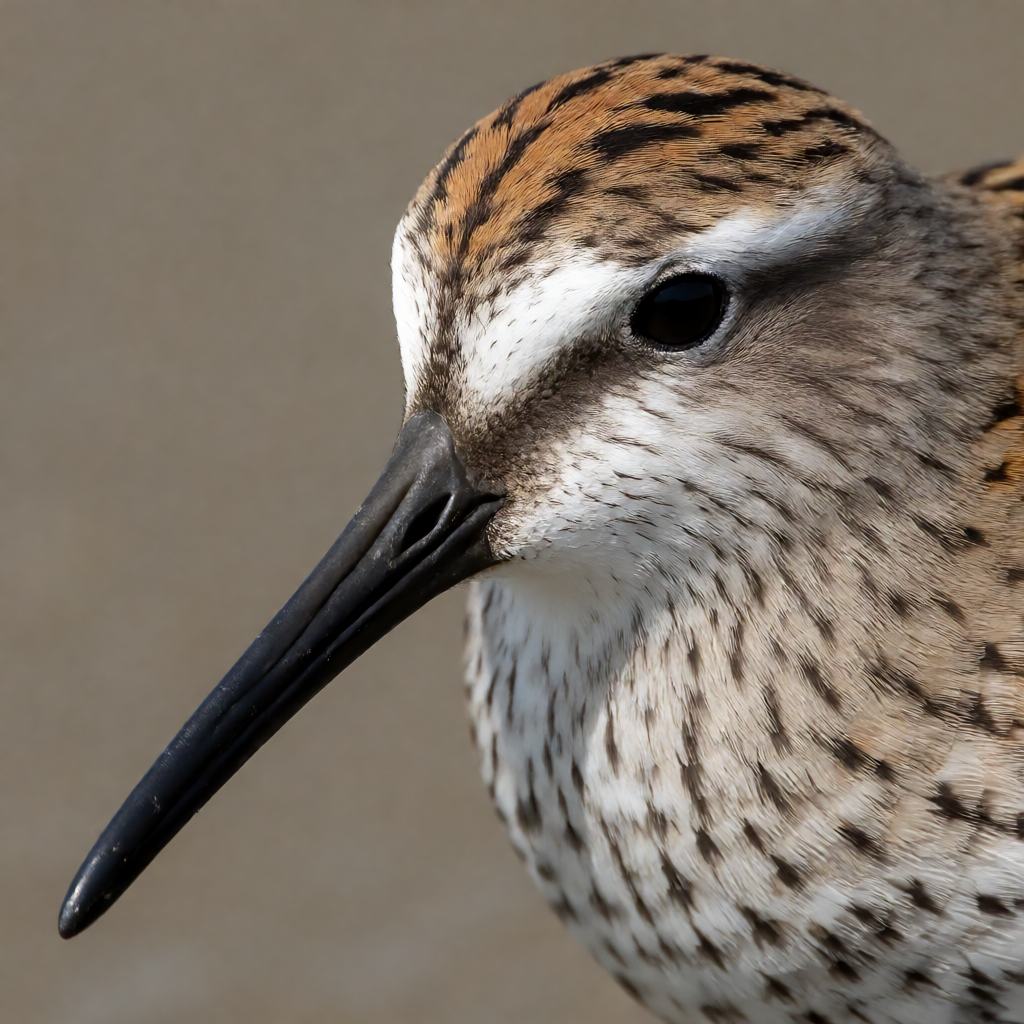
An adult in breeding plumage is 17 to 21 cm from bill to tail. Its wings span 32 to 36 cm. It weighs about 40 g at the light end and 75 g at the heavy end. A bird that has laid down fat before migration weighs much more. A Dunlin about to fly several thousand km puts on so much fuel that its weight alone is misleading. The bill is black and straight at the base. It curves gently downwards towards the tip. Its length varies a good deal between subspecies and between sexes. Females average longer bills than males. That lets the 2 sexes take slightly different prey from the same mud. It also cuts competition between them. The eye is dark.
In breeding plumage the head carries a pale supercilium and a darker crown stripe. The breeding dress is a rich mix of rufous, chestnut, black and white. The feathers have dark centres and pale or rufous fringes. That gives the back a mottled, scaly look. The lower breast and belly carry the extensive black patch. That patch is the bird’s most famous feature. The flanks and vent stay white. In winter the black patch disappears entirely. The bird becomes plain pale grey-brown above and white below. Fine streaking shows on the breast and neck. In this plumage the bird is much harder to name. The most reliable clues are its size and its downcurved bill.
Watch for its rapid, mechanical probing action. Note also its habit of joining other small waders. Young birds in their first autumn look like winter adults in general tone. They show a neat scaly pattern on the upperparts. That comes from the pale fringes of fresh feathers. They moult into adult winter plumage during their first autumn. So a young bird at the end of its first winter is hard to age. The legs are black and fairly short. The wings are long and pointed. In flight the bird shows a narrow white wing bar and white sides to the rump. It is one of the fastest and most agile of the small waders. It can change direction in an instant inside a tight flock.
1
2
3
Tundra in summer, estuary in winter
Where it lives
The Dunlin uses 2 habitats, one in summer and one in winter. It is unusually faithful to both. It returns to the same stretch of tundra to breed and the same flats to winter. That makes its movements possible to study in unusual detail. The breeding grounds are the wet tundra of the far north. They also include subarctic moorland. The bird nests on the ground among mosses, lichens and low shrubs. It favours areas that are boggy but not flooded. It wants small pools, hummocks and patches of shallow standing water. The chicks need insect food and dry ground. The adults need soft wet soil to probe for invertebrates.
The bird occurs from sea level to well above the tree line. In temperate parts of its range it breeds on wet heath and blanket bog. The uplands of Britain and Ireland are a good example. That shows how flexible its requirements are. In winter the species moves to the coast. It becomes a bird of tidal flats and sandy beaches. It uses saltmarshes, lagoons and sheltered shallow bays. In those places the tide exposes soft sediment twice a day. It also appears on the shores of large inland waters and on flooded fields. Above all it is an estuarine bird. Estuary counts are the standard way to track its numbers.
The value of estuaries to the species is hard to overstate. One large estuary may hold tens of thousands of wintering Dunlin. The birds depend on the small animals of the mud. They also depend on the tidal zone being quiet enough to feed. They need several hours on either side of low water each day. The species uses many tidal flats in many lands. So it is protected under international agreements on migratory waterbirds. A network of counted and protected sites now exists. That has made the Dunlin one of the best documented shorebirds in the world.
A prober of the soft mud
What it eats
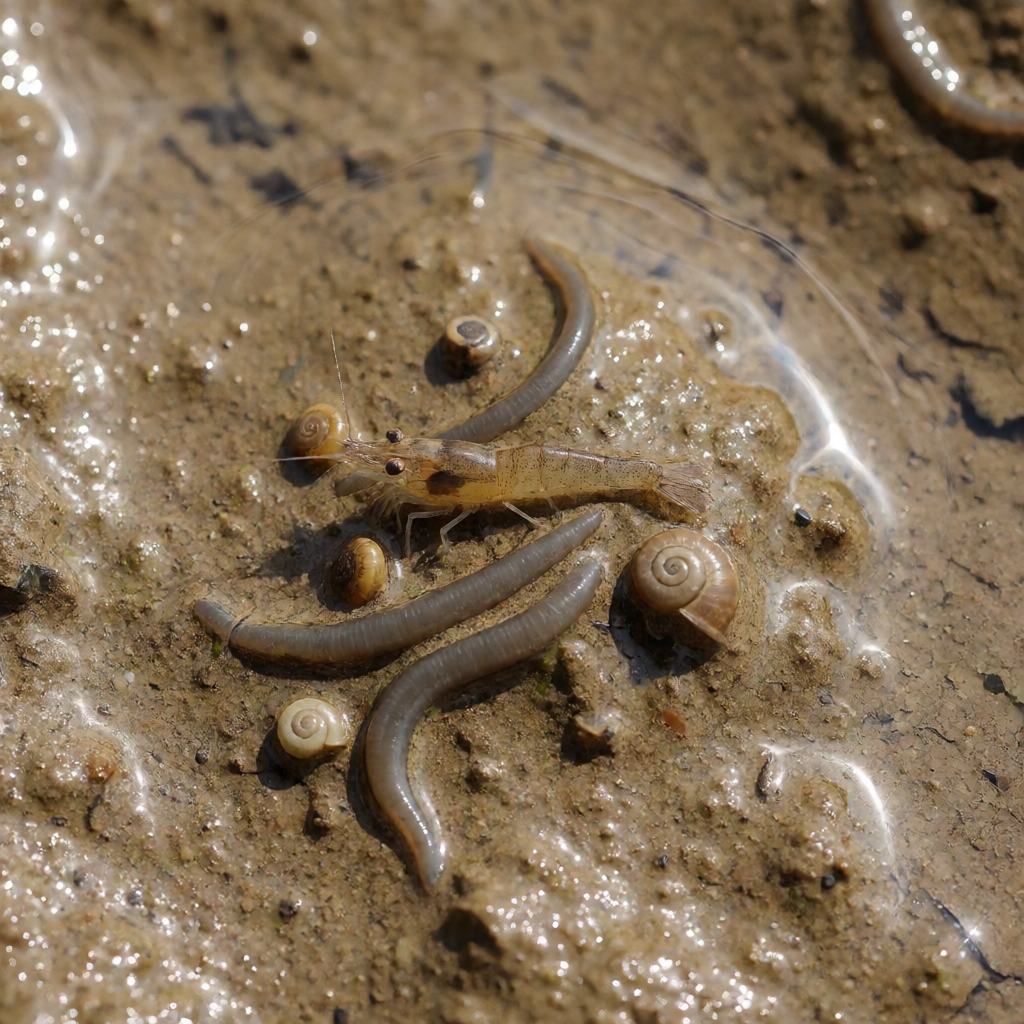
The Dunlin feeds on small invertebrates taken from soft wet ground. Its diet is dominated by marine worms and small crustaceans. Molluscs, insects and their larvae also matter. The exact mix varies greatly between sites and seasons. It depends on whatever the local mud offers. In winter on an estuary the classic prey are polychaete worms and small bivalves. Shrimps and tiny snails from the surface layer of sediment are taken too. The bird probes its bill into the mud to find them. The tip of the bill holds a dense cluster of sensitive nerve endings. These detect the vibrations and chemical traces of buried prey. So the bird can feed by touch alone.
It works in water or mud that is completely opaque. The probing action is fast and repetitive. There are several insertions a second on rich ground. The Dunlin can swallow a worm as long as its bill. It does so with a rapid movement of the head. It will also pick food from the surface when prey is exposed. That happens often on the ebbing tide. On the breeding grounds the diet shifts towards insects and their larvae. It takes craneflies, beetles, midges, caddisflies and moth larvae. These matter for the adults and for the fast-growing chicks. The chicks need soft, protein-rich food.
They cannot handle the hard-shelled prey that adults take on the coast. The species feeds both by day and by night. On tidal flats it is often more active at night. That is especially true in midwinter when the days are short. It relies on touch rather than sight to do so. Feeding flocks move across the mud in a loose line. They sweep the surface in a steady pattern. The birds stay alert. That is why the flock rises as one when a peregrine or a merlin appears.
A scrape in the moss
The breeding cycle
The Dunlin arrives on its breeding grounds in late spring. The males arrive first and set up territories. They do so by display flights and by calling from the ground. The species is unusual among waders in having a variable mating system. Most pairs are monogamous, but polygyny does occur. Females sometimes desert the brood before the chicks have fledged. The male then finishes the rearing alone. The nest is a shallow scrape on the ground. It usually sits among moss, lichen, grass or low shrubs. The surrounding vegetation hides it well from above. It often sits on a small hummock or tussock where it will stay dry. The bird lines it with a little plant material arranged with the bill.
Between 3 and 4 eggs are laid, most often 4. They are pale with heavy dark markings that match the background. So a nest is almost impossible to find. The observer must watch the sitting bird to its place. Incubation lasts between 20 and 22 days and both sexes share it. The male takes the larger share at night and the female more of the day. The split varies. The chicks hatch covered in speckled brown down. They leave the nest within hours. Both parents feed them for the first days. Then they begin to find their own insect prey. They can fly at between 19 and 21 days of age.
That is a startlingly short time for a bird that will soon fly thousands of km. Fledging success depends strongly on insect numbers on the tundra. Those numbers depend on the weather. Cold wet summers can destroy a whole season’s output. Nests and chicks are vulnerable to skuas, gulls, foxes and small mammals. Once the young have fledged the birds gather on the tundra in loose flocks. Then they move south. Adults usually leave before juveniles. The migration runs in long flights with stops at favoured wetlands. There the birds refuel before going on.
The yardstick of the estuary
Conservation
The Dunlin is assessed as Least Concern on the global Red List. Its enormous range and very large population justify that label. The global picture again hides damage at the level of local numbers. A number of the forms and breeding numbers are in decline. The main threat is the loss and damage of the tidal feeding areas. The whole population depends on them for the winter months. The pressures are familiar from every temperate coast. Reclaiming mudflats for industry, ports, housing and farming removes the feeding ground. Barrages, flood defences and dredging change the shape of estuaries. They cut the extent of soft sediment.
Pollution from industry and farming cuts the small animals in that mud. Disturbance is a further and growing problem. The birds must feed for many hours each day in winter. Every time walkers, dogs, bait diggers or boats put a flock to flight, the birds spend energy. They cannot afford that. It cuts their survival in cold weather. The effect adds up across a busy estuary. Climate change adds another dimension. The warming of the Arctic is changing the tundra that supports the breeding birds. Shifts in sea level and weather affect the estuaries where the birds winter.
So the species faces pressure at both ends of its migration. On the breeding grounds, moorland is being planted with trees. Bogs are drained and upland grazing has grown heavier. All of this cuts the extent of suitable habitat. In some areas the species has gone from sites where it was once common. The Dunlin is numerous and widely counted. So it has become the best test of the health of tidal flats. A decline in any one flat is often the first sign of change. Something has shifted in the sediment or in the food supply. That makes the species both a conservation subject and an instrument of conservation.
Quick hits
Five things to remember
- A bird of only 40 to 75 g may fly several thousand km between the Arctic and the African coast.
- The black belly patch appears only in summer and vanishes completely in winter.
- The bill tip is packed with nerve endings that find buried prey in mud the bird cannot see through.
- Females have longer bills than males, so the 2 sexes take slightly different prey from the same mud.
- Winter flocks of many thousands turn and flash as one, which makes it hard for a falcon to single out a target.