 By st20113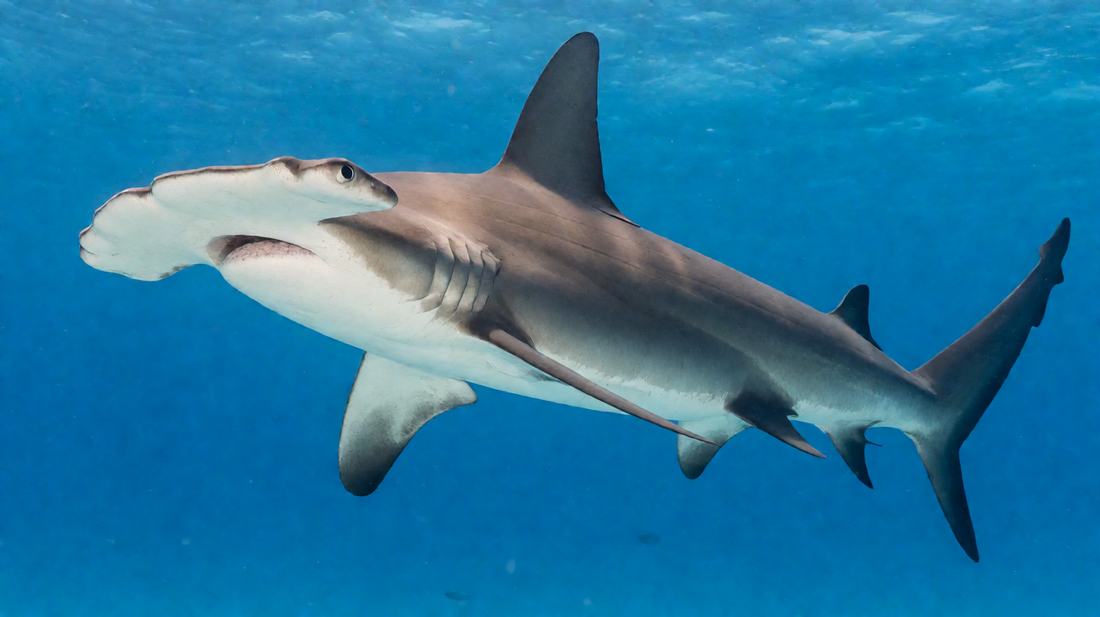
Sphyrna zygaena | Smooth Hammerhead
Species Profile · Sphyrnidae
Smooth Hammerhead
The hammerhead with the smooth, unnotched head and the coolest range of its family — and a species that lost a very large share of its number in three generations over the value of its fins.
IUCN: Vulnerable
Range
Length
Weight
Young
Head
The hammer with the smooth head
A shark of the cool coast
The smooth hammerhead is a large and powerful shark. It lives in the coastal seas of the temperate and tropical parts of the world. It is the second largest of the 9 or the 10 species of the family of hammerhead sharks. Its range reaches the furthest into cooler water of any of them. The animal has a strange and unmistakable head. It is one of the most recognisable of all the fishes of the sea. The cephalofoil is a great flat blade of the skull. It carries the eyes at the 2 ends and the nostrils along the leading edge. No other group of fishes has a structure like it. The smooth hammerhead differs from the great hammerhead in the shape of the front of that blade.
The front is curved and smooth across the whole of the width. It carries no central notch. So the shark with the smooth head is the easiest of the group to tell apart at a distance. That difference in the shape of the head is the single most useful field character of the family. The species is a strong and active predator of the open coast. It feeds mostly on rays and skates. It also eats small sharks and cephalopods and bony fishes. It is one of the very few of the large sharks that gathers in big schools. It also makes long seasonal movements along the coast. The species is assessed as Vulnerable on the global Red List.
It has declined very heavily over the last half century under the pressure of fishing. It is one of the principal targets of the trade in fins. It is also taken in very large numbers as bycatch. The longline and gill net fisheries of the whole world catch it. The species breeds slowly. That mix of slow breeding and very heavy fishing explains 2 things. It explains how far the numbers have fallen. It also explains why recovery is so slow.
Family tree
Sphyrna, the hammerheads
The smooth hammerhead was described by Linnaeus in 1758. Modern work places it in the genus Sphyrna. That genus sits in the family Sphyrnidae. The family is a small group of the 9 or the 10 living species. Its members sit in 2 genera. The whole family is known by the cephalofoil. That is the flattened skull that spreads out to the sides. It carries the eyes and the nostrils in a position that no other vertebrate has. The structure came from a very great change in the anatomy of the head of the ancestral shark. The smooth hammerhead is a close relative of the Great Hammerhead (Sphyrna mokarran). That is the largest of the family. Its cephalofoil has an almost straight leading edge.
It also has a deep central notch. The 2 are the 2 largest species of the genus. They are also the 2 most widely spread of the group. Comparing the 2 is one of the standard exercises for anyone who names the sharks of the warm seas. The smooth hammerhead is the smaller and the more temperate of the 2. Its head has a smooth and curved front. The great hammerhead has a straight and notched front. The whole group of the hammerheads sits in the order Carcharhiniformes. The requiem sharks and the other ground sharks sit there too. Genetic studies of the modern period have shown something useful. The family is the sister of the group that holds the tiger shark. That group also holds the other large coastal sharks of the region.
The hammerhead line has been separate from the rest of the order. That split lasted a very long period of geological time. The fossil record of the group goes back to the Eocene. The species name comes from the Greek word for the hammer or the yoke. It refers to the shape of the head. Linnaeus gave that name to the species and it has been in use ever since. The name of the genus also comes from the Greek for the hammer. Modern work treats the species as monotypic. The groups of the different parts of the world are not split into subspecies. Yet genetic work has shown something else. The animals of the different ocean basins are not entirely interchangeable. The group of the Atlantic is at least partly separate from the group of the Indo-Pacific.
A blade with no notch
How to identify one
An adult smooth hammerhead is between 2.5 and 3.5 metres long. The largest recorded individual was a little over 4 metres. Its mass reaches as much as 400 kilograms in the heaviest females. The species is a solidly built animal with a cylindrical body. It has a very large and broadly triangular first dorsal fin. The second dorsal and the anal fins are much smaller. The upper lobe of the caudal fin is long. It is the main organ of propulsion in the swimming. The head is the most remarkable of the structures of the animal. It is the cephalofoil. That is a great flat blade of cartilage that extends out from the skull. It reaches for about a quarter of the length of the body.
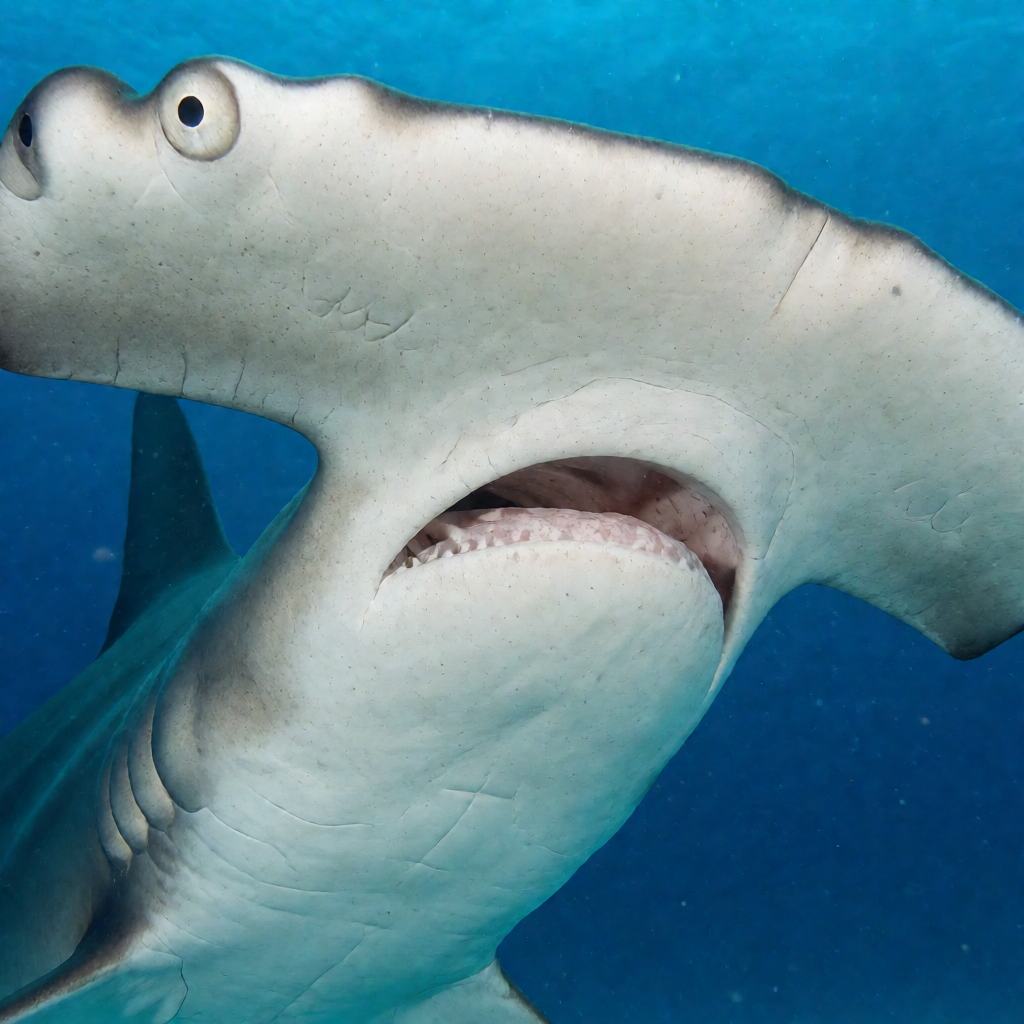
The front of that blade is a smooth and broadly curved edge. It has no trace of the central notch that marks the great hammerhead. The eyes sit at the extreme ends of the blade. The nostrils lie along the leading edge. The mouth sits underneath the head at the centre of the blade. The function of the cephalofoil has been studied a great deal. Modern work has shown that it serves several purposes at once. The wide spacing of the eyes gives the animal an overlapping field of view. So it has binocular vision to the front and to the back. The underside of the blade has a very great area. It carries an enormous number of the electroreceptive organs of the ampullae of Lorenzini. Those organs let the species detect the electrical fields of prey buried under the sand of the bottom.
The wide and flat head also works as a hydrofoil that lifts the animal as it swims. The colour of the upperparts is a dark grey or a grey-brown. The underside is a pale white. A sharp line runs along the flank between the 2. The tips of the pectoral fins are often darker than the rest of the body. That pattern is the standard camouflage of the sharks of the open water. The skin carries minute placoid scales. Those scales give shark skin its roughness and cut the drag of the water. The teeth are small and strongly serrated. They have a cockscomb shape. They are built for cutting soft prey rather than for crushing shells. So the species can slice rays and squid into pieces that it can swallow.
1
2
3
Coast, bay and shelf
Where it lives
The smooth hammerhead is a shark of the coastal and the shelf water. It lives from the very shallow water of the bay and of the estuary. It also lives down to the depth of about 20 metres over the shelf. It is the most temperate of the hammerheads. Its range reaches further north and further south than that of any other member of the family. The species lives in the Mediterranean and off the coast of the British Isles. It also lives off the north-east of the United States and off the south of Brazil. It is found off the southern part of Africa and off the south of Australia and off Japan. So the species is an animal of the cool and the warm seas of the whole of the world. It is not an animal of the tropics alone. The species gathers in big schools. The schools are often of the 10 to the 100 of the animals.
The schooling is strongest in the young and the subadult fish. The schools of the young fish use the shallow and sheltered water of the bay as a nursery. The adult fish are more solitary. They are found more often alone or in small groups. The species makes long seasonal movements. The fish of the north of the range move south in the autumn. They return to the north in the spring. That movement is thought to follow the warmth of the water and the amount of prey. Tagged animals have been recorded travelling very long distances along the coast. Few sharks can float at the surface without swimming all the time. The hammerheads are among them. That ability comes from a very large liver that is rich in oil.
The liver provides the buoyancy. The smooth hammerhead is often seen at the surface. Its dorsal fin and the tip of the tail break the water. That habit of basking at the surface explains something. Fishing boats find the species very easily. The species is a strong swimmer. It uses a very fine sense of smell and the electric sense of the cephalofoil to find prey. It hunts in the shallow water of the coast. It also hunts over the sandy and muddy bottom. The rays and skates on which it feeds are most abundant there.
A hunter of squid and fish
What it eats
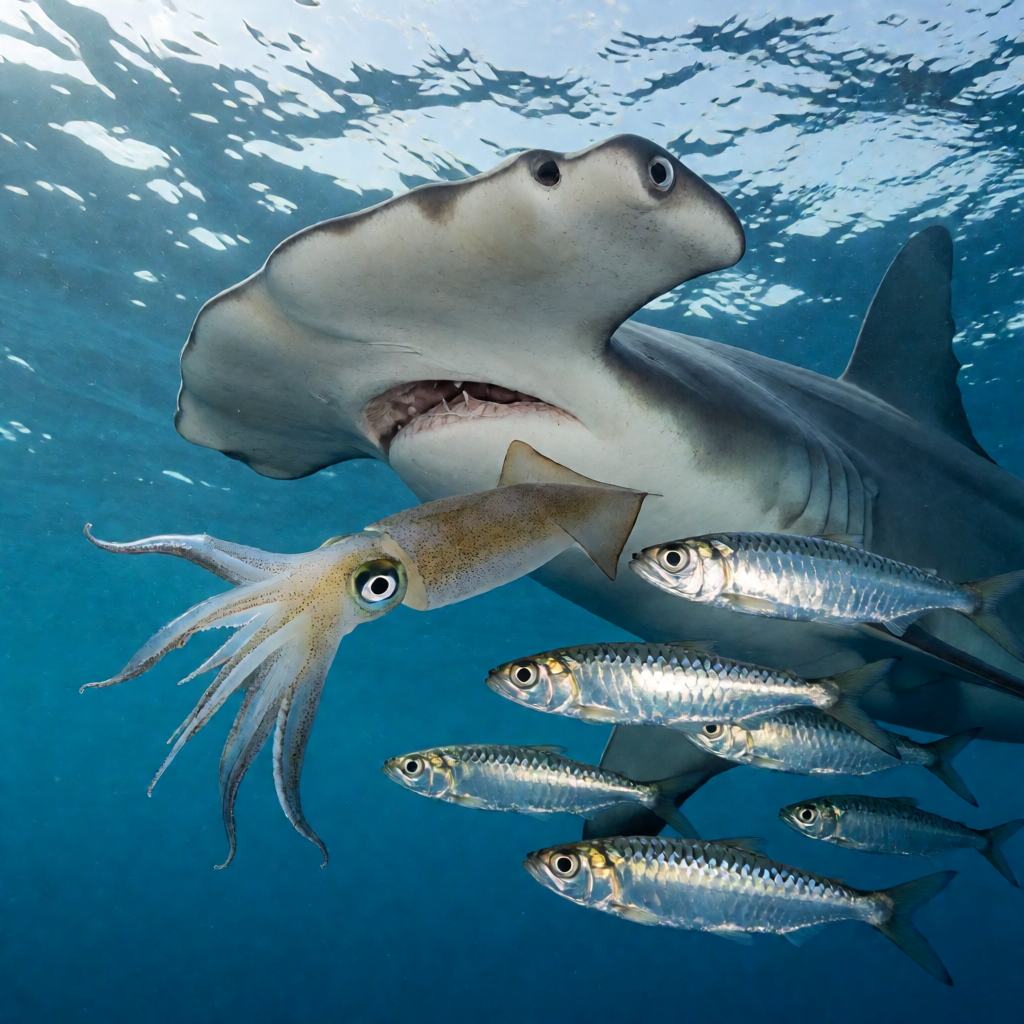
The smooth hammerhead is an active predator of the coastal water. The greater part of its diet is rays and skates and other elasmobranchs. The species has a particular taste for the stingrays and for the eagle rays. It takes a very large number of stingrays. That habit explains the very strong electric sense that the wide cephalofoil provides. Rays lie buried under the sand of the bottom. They reveal themselves by the very small electrical fields that their muscles produce when they breathe. The diet also includes small sharks. It includes the young of the larger species and the dogfish. Cephalopods matter a great deal where squid and octopus are abundant.
Bony fishes are also taken in quantity. Sardines and menhaden and mackerel are all eaten. So are the herring and the sea catfish and the croaker. Crustaceans and shrimps and crabs of the bottom are eaten too. The feeding method of the smooth hammerhead is a rapid strike from below or from the side. The animal uses the speed and the agility that its large and powerful tail provides. It seizes the prey with its small and serrated teeth and swallows it in pieces. The hammerhead is known to hunt in groups when the prey is concentrated. The school of the hammerheads drives the school of the rays over the sand of the bottom. Then it takes the animals one by one.
The species feeds mostly at dusk and in the night. It rests in deeper water in the day. That pattern is thought to follow the behaviour of the prey. It is not a limit of the predator. Few large sharks tie their daily pattern so closely to the tide and to the light. The coastal shark needs a very large quantity of food. Studies of the diet of the species have shown something striking. An adult of the 3 metres takes the several kilograms of the prey in the day. That need is one of the reasons that the species is confined to very productive water. It stays in the water of the coast and of the shelf rather than in the open ocean.
Twenty to forty at a birth
The breeding cycle
The smooth hammerhead is a viviparous shark. The young develop inside the body of the female. They are fed by a placenta. That organ forms from the wall of the uterus and from the yolk sac of the embryo. That arrangement is the most advanced of the several ways that sharks breed. The requiem sharks of the same order breed in the same way. The mating of the species takes place in shallow water in the spring and in the summer. The male holds the female with the teeth. The claspers are used in the transfer of the sperm. The mating of the hammerheads is a vigorous affair. It leaves the marks of the teeth on the skin of the female.
Females of the species are often seen with the scars of the mating on the flanks. The gestation is long and lasts for between 10 and 11 months. The litter is large for a shark of this size. Records show between 20 and 42 young in a single litter. The young are between 50 and 61 centimetres at the birth. The pups are born in the shallow water of the nursery of the coast. The bay gives the young sheltered and warm and food-rich water. The species uses that water as a nursery ground. The adult females move into the shallow water to give birth. The species does not breed until it is at least 5 years old. Males are mature at a length of about 2.1 metres.
Females are mature at a length of about 2.5 metres. Maturity is reached at the age of between 5 and 9 years. The species is known to live for more than 20 years. The oldest recorded individuals have been of the age of more than 20 years. So the species does not breed as slowly as most sharks of the world. The litter is a large one. The species matures at a moderate age. So the smooth hammerhead is one of the more productive of the large sharks. Yet the decline of the species has been very heavy. The reason is the intensity of the fishing rather than any particular weakness of the biology of the animal.
Fins, and a fall of numbers
Conservation
The smooth hammerhead is assessed as Vulnerable on the global Red List. The assessment of 2019 replaced the earlier assessment of the near threatened. It reflects the very heavy decline of the species over the last 3 generations. The species has fallen by a very large share. That loss has come over the half century in most of the range. The greatest of the losses has been in the Atlantic and in the Mediterranean. The trade in the fins of the sharks is the greatest cause of the decline. The fins of the hammerhead are among the most valuable of the whole of the trade. The species is one of the principal targets of the fishery. The fin trade is the reason for the very heavy pressure on the species.
That pressure is greatest where the meat of the animal is of little value. Bycatch is the second great cause of death. The longline and the gill net and the trawl fisheries all take the species. The smooth hammerhead is taken in very large numbers in the coastal fisheries of the whole of the world. A great part of the catch is not recorded in the statistics of the fishery. So the number of deaths is unknown to the management of the species. The loss of the nursery grounds of the shallow bay to development and to pollution is a further pressure. The species is also affected by disturbance and by sport fishing. Both are worst where the species is common. The smooth hammerhead is listed on the appendices of the convention on the international trade in the endangered species.
The trade in the fins and in the other products is now regulated. The rule covers the whole of the world. The species was added to the annex of the convention in 2013. The listing came into effect in 2014. Putting that listing into practice has been one of the most important measures for the family. The species is also protected by the law of a growing number of the countries of the range. The regional fisheries bodies protect it as well. The protection of the nursery grounds is the most urgent of the tasks. The landings and the biology of the species are watched. That work is done in the parts of the range where the fishery is most intensive.
Quick hits
Five things to remember
- The smooth hammerhead is second in size only to the great hammerhead among the family. Its range reaches the furthest into cool water of any of them. It lives off the coast of the British Isles. It also lives in the Mediterranean and in the tropics.
- The front of the great flat cephalofoil is a smooth and curved edge with no central notch. That single character is the most useful mark that separates the species from the great hammerhead.
- The wide head lets the animal read the electric fields of a ray. Such a ray lies buried under the sand of the bottom. The species is an expert predator of buried rays and skates.
- The species gathers in schools of the 10 to the 100 of the animals. The schools of the young fish use the shallow and sheltered water of the bay as a nursery ground.
- The female gives birth to between 20 and 42 young in a single litter. That is one of the largest litters of any of the large sharks. The young are born at a length of between 50 and 61 centimetres.