 By st20113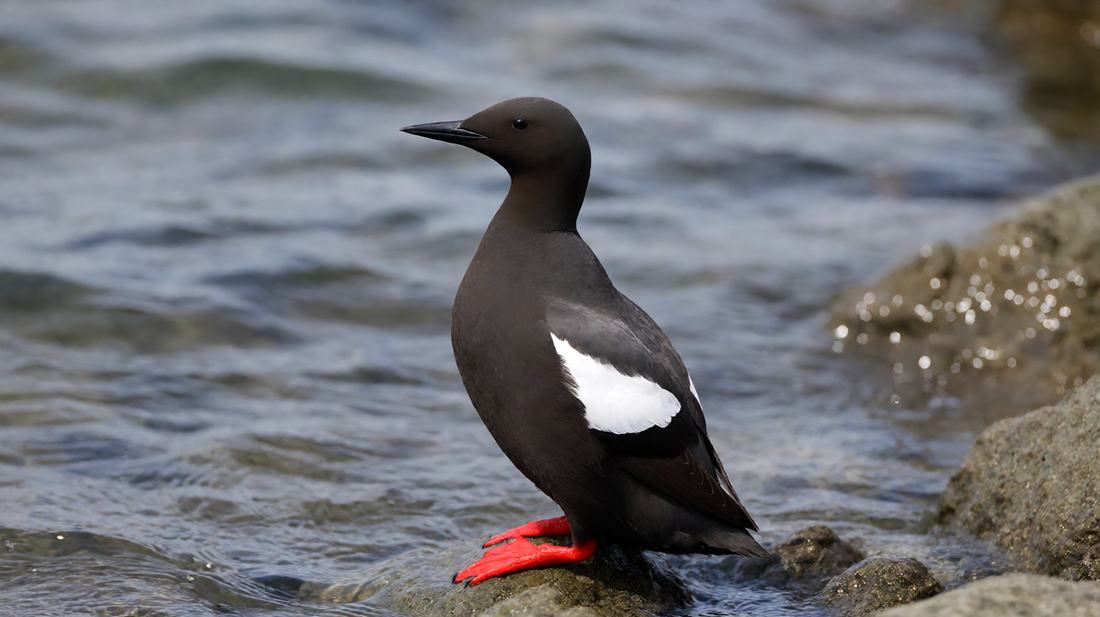
Cepphus grylle | Black Guillemot
Species Profile · Alcidae
Black Guillemot
The only Atlantic auk that turns wholly black in summer and stays within sight of land all year — and whose whole world crowds into the inshore water where oil collects.
IUCN: Least Concern
Range
Length
Weight
Nest
Incubation
The black bird of the shore
The most inshore of the auks
The black guillemot is a small and neat auk. It lives on the rocky coast of the north. It is one of the very few seabirds of the Atlantic that turns wholly black in summer. In winter the same bird turns the palest grey and white. That change is so complete that the 2 seasons look like 2 different species. The bird is the most inshore of all the auks of the region. It is also the most approachable of them. It feeds in the shallow water close to the shore. It nests in the crevices and under the boulders of that same coast.
So you can watch the bird from the land for the whole of its working day. No ocean-going relative of the bird allows that. The species is the only member of the genus Cepphus in the Atlantic. Its closest relatives are the 2 pigeons guillemots of the north Pacific. The group as a whole is a separate and ancient branch of the family Alcidae. It has stood apart from the other auks for a very long time. People of the British coasts know the bird as the tystie. That name comes from its soft and high-pitched whistling call. The call is one of the most typical sounds of the harbour wall in spring.
The black guillemot is not globally threatened. Its world population is large. But the bird is very open to pollution of the sea by oil. It spends the whole of its life in coastal water. So it cannot move away from a spill. The great oil disasters of the last century killed the birds in very large numbers. They cut the numbers of whole regions for decades afterwards. So the safety of the species rests less on its world total than on clean coastal water. The bird is one of the standard signs of the health of the inshore sea.
Family tree
Cepphus, a genus of three
The black guillemot was named by Linnaeus in 1758. Modern work places it in the genus Cepphus. That genus sits in the family Alcidae. The genus holds 3 living species. People call them the guillemots of the Cepphus group. Others call them the sea pigeons. The group stands apart from the other auks in 2 ways. The bill is slender and pointed. The breeding biology is very different as well. Birds of this genus nest in crevices and burrows and rock cavities. The other auks nest on the open ledges of the cliff. The black guillemot is the closest living relative of the pigeon guillemot of the north Pacific. It is also close to the spectacled guillemot of the seas of Japan and Korea. The 3 species form a group that began in the Pacific. The Atlantic member is thought to have crossed the polar sea.
The climate and the geography of the arctic were very different then. The bird is a close relative of the Atlantic Puffin (Fratercula arctica). The 2 share the same family and the same colonies. They also share the same cold and productive water. Yet they differ completely in the place where they nest. They differ in the depth of the water in which they feed too. The puffin digs a burrow in the turf and fishes far out at sea. The black guillemot nests in the rock of the shore. It fishes in the shallows within sight of the land. Modern work accepts 5 subspecies. They differ in average size and in the shade of the plumage. They also differ in the length and the shape of the bill. The nominate form of the Baltic is the smallest. It lives in the brackish water of that inland sea. It is the most distinct of the 5.
People regard it as a relict of the ice age. The Baltic birds were cut off from the ocean birds at the end of the last glaciation. They have been separate ever since. The form of the high arctic and of Greenland is the largest. It is also the most heavily built. The forms of Iceland and of the Faroe Islands sit between the 2 extremes. So do the birds of the north-east of North America. Genetic studies of the modern period confirm the split of the Baltic bird. That difference is great enough to matter. The Baltic group is treated as a separate unit for conservation. The name Cepphus comes from the Greek for a kind of seabird. The name of the species has the same origin. So the 2 names double the same ancient word.
Black body, white wing
How to identify one
An adult black guillemot is between 30 and 32 centimetres long. Its wingspan is between 52 and 58 centimetres. Its mass runs from about 300 grams in the smaller birds of the Baltic. The heaviest birds of the high arctic reach 460 grams. Those birds are fattening in the autumn. The bird is a compact auk with a short neck. Its proportions look much more like a small diving duck. They look nothing like the cliff-nesting birds of the family. The summer plumage is wholly black. The body and the head and the neck are all black. One large oval patch of pure white sits on the upper wing. That patch is the most obvious field mark of the bird. It shows at a very long distance against the black. The black body and the white wing patch make one effect.
So do the bright red feet and the bright red gape of the open mouth. Together they make one of the most striking colour combinations of the north. The winter plumage is completely different. It is a mixture of pale grey and white above and white below. Dark mottled markings cover the crown and the nape. The wings and the tail stay black through the year. A bird in winter plumage is much less obvious than a bird in summer. It is easily overlooked among the rocks and the weed of the shore. A complete moult of the body feathers brings the change in the autumn. A partial moult brings it in the spring. The bird cannot fly for a period during each of the 2 moults. That is a real risk for a bird that must fly to the fishing grounds. The bill is slender and pointed and wholly black. The mouth lining of the adult turns bright red in summer.
The iris is dark brown. The eye carries no clear ring in the summer plumage. The legs and the feet are bright vermilion red. That red is much brighter in summer than in winter. It is one of the signals of the breeding condition. The feet are webbed and the legs are set far back on the body. That helps the bird push through the water. The bird walks on land with a waddling gait. The whole of the family walks that way. The sexes look alike. They differ only a little in average size. A bird of the first winter looks much like an adult in winter. Its head and back carry more mottled marks. Its white wing patch is smaller and less sharp.

1
2
3
Rocky coast and harbour wall
Where it lives
The black guillemot is the most inshore of all the auks. It spends the whole of its life within a few kilometres of the shore. The bird needs the rocky coast of the north. It needs crevices and boulders for the nesting sites. It needs shallow clear water for the food. It is commonest on the coasts of the mainland and of the small offshore islands. There the rock is broken and the water is sheltered from the worst of the swell. It is common in harbours and on breakwaters. It also uses the other structures of the human coast. It is one of the very few seabirds that has gained from the building of piers and sea walls. The species stays in one area for the whole of the year.
It does not make the long migrations of the other auks. The birds stay close to the breeding colony all year. They simply move a short distance offshore in winter. So the bird is on the coast of the north in every month of the year. It is one of the most dependable birds of the harbour wall. The species is spread across the whole of the north Atlantic and the arctic and the Baltic. It runs from the north-east of the United States and the Canadian Maritimes in the west. It runs to Scandinavia and the Baltic and the north of Russia in the east. The bird reaches its northern limit in the high arctic. That means Greenland and Svalbard and the Canadian islands. The Baltic group is the southernmost and the most isolated of all.
The bird feeds in the shallow water of the inshore zone. It rarely goes beyond the depth of about 30 or 40 metres. It usually fishes within a few hundred metres of the nesting site. That need for shallow water explains its great weakness to pollution. A single spill of oil in a sheltered bay can destroy the whole local group for many years. The bird roosts on the water in flocks in winter. It returns to the land only for the nesting and for the moult. The winter flocks gather in the sheltered parts of the coast. They also gather in the mouths of the harbours. The size of those winter flocks is a useful index of the local population.
A diver of shallow water
What it eats
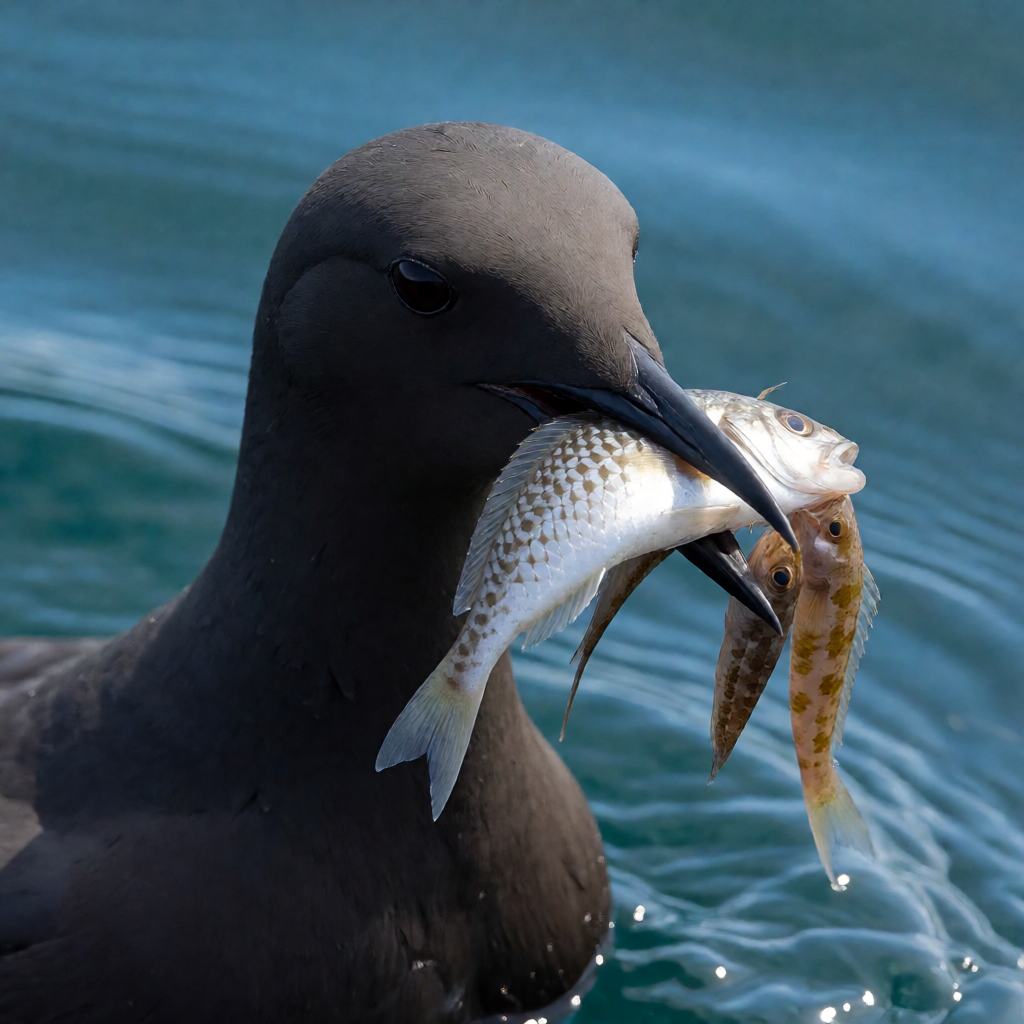
The black guillemot feeds chiefly on the fish of the bottom of the inshore zone. It is one of the few auks that takes its prey from the sea bed. Most auks feed in the water column instead. The diet includes butterfish and blennies and sculpins. Sandeels are important. So are the young of the cod and of the other gadoid fishes. Crustaceans and molluscs of the bottom are taken in a considerable quantity. So are the polychaete worms. The mix varies a great deal with the locality and the season. It varies with the nature of the sea bed as well. The bird is a generalist. It takes whatever the inshore environment provides. The feeding method is a short and shallow dive from the surface.
The bird does not use the pursuit technique of the guillemot and the razorbill. It simply swims down from the surface with the wings and the feet. It searches the rock and the weed of the bottom for prey. The dives last between 20 and 40 seconds as a rule. They rarely go beyond the depth of 30 metres. The bird prefers clear water where it can see the prey against the bottom. It often feeds in shallow water that a diver can watch. The bird brings the whole of the prey to the surface before it swallows. It carries the fish crosswise in the bill for the chick. The chick in the crevice is fed with whole fish. It is not fed with the oil that the guillemot and the puffin produce. That difference follows from the short distance over which the food is carried. It follows from the sheltered nature of the nesting cavity as well.
The bird feeds mostly by day. The pattern of the feeding follows the tide. The bird is most active in the hours around the low water. Then the shallowest part of the sea bed comes within reach. The bird feeds alone or in small parties. It does not gather in the great feeding flocks of the other auks. Both parents feed the young bird for between 30 and 40 days. Then the young leaves the crevice without help. It makes its own way to the sea. It can fly at the departure. It does not need an escort to the water as the chick of the guillemot does.
A crevice instead of a ledge
The breeding cycle
The black guillemot returns to the breeding colony in the spring. Birds of the southern part of the range begin to visit in March. Birds of the high arctic arrive in June. The bird is very faithful to the site and to the mate. The same pair holds the same crevice for many years in succession. That pair bond is one of the most lasting of any of the auks. The nest sits in a crevice of the rock or under a boulder. It also sits in a cavity of the wall of the harbour or in a burrow in the turf. The bird makes no nest of any kind. The eggs are laid on the bare surface of the cavity. Sometimes they lie on a small collection of pebbles and shell fragments. The cavity is chosen for its shelter and not for its height above the water. The bird will nest at the level of the tide if the rock gives the cover.
The clutch holds 1 or 2 eggs. The clutch of 2 is the usual one in the south. The clutch of 1 is commoner in the north. The eggs have a pale ground with dark brown and black marks. The shape is much more oval than the pointed egg of the guillemot. That shape follows from the sheltered site. An egg laid in a cavity needs no shape to stop it rolling off an open ledge. Both parents sit. Incubation lasts between 28 and 32 days. The bird sits tightly on the eggs. It will stay in the cavity until the observer is very close. A bird disturbed at the nest does not fly at once. It runs or swims away from the site before it takes to the air.
The chick is covered in down. Both parents feed it for between 30 and 40 days. It is almost at the weight of the adult when it leaves the cavity. The departure takes place in the night. The bird makes its own way to the sea with no escort. It can dive and feed itself from the first days. So the young bird is independent much earlier than the chick of the guillemot. That chick is still fed at sea by the male for several weeks after it leaves the ledge. The bird does not breed until it is at least 3 or 4 years old. It may live for more than 20 years. The mix of low output and high survival is the same as in the rest of the family. So the species is slow to recover from any rise in the death rate of the adults.
A bird in the path of oil
Conservation
The black guillemot is assessed as Least Concern on the global Red List. The world population is large. It is estimated to run to several hundred thousand pairs. The species has a very extensive range. It is not thought to be near the thresholds of the threatened categories. The most serious threat is pollution of the sea by oil. The bird is the most open of all the auks of the Atlantic to a spill. The bird never leaves the coastal water. Its whole population is packed into the shallow inshore zone where oil collects. The story of the spills of the last century is a story of the loss of local groups.
The recovery of the birds of the affected coasts took decades. In some of the cases it never took place at all. The bird is also open to attack by introduced mammals. Rats and mink have reached the islands and the coasts. They have destroyed the colonies of this species. They have done the same to the colonies of the other seabirds. So the removal of the introduced predators is now a standard measure. The species is affected by disturbance of the coast as well. Recreation and development both matter. Birds of the harbour and of the sea wall put up with people far better than birds of the remote coast.
That tolerance makes the species one of the best subjects for the study of the auks. The group of the Baltic is the most open to loss of the whole species. It is small and it is shut inside an inland sea. That sea is ringed by the industry and the shipping of the north of Europe. The Baltic bird is affected by the enrichment of the water too. That enrichment has changed the community of the fish. The species is protected across the whole of the European Union. It is included in the agreements that cover the seabirds of the north-east Atlantic. The key colonies are protected as reserves and as special protection areas. The watching of the species has become one of the standard tests of the coastal environment of the north.
Quick hits
Five things to remember
- People of the north call the bird the tystie. The name comes from the soft and high-pitched whistle that the bird gives at the colony. That whistle is one of the most typical sounds of the rocky shore in spring.
- The black guillemot nests in the crevices of the harbour wall and of the breakwater as readily as in the rock of the wild coast. It is one of the very few seabirds that has gained from the building of the human coast.
- The bird turns from wholly black to pale grey and white in the autumn. The 2 plumages differ so much that the same bird can look like 2 species in the 2 halves of the year.
- The bird cannot fly for a period during each of its 2 yearly moults. It must survive the weeks of the spring and of the autumn without flying to the fishing grounds.
- The Baltic group of the species is a relict of the ice age. It has been apart from the birds of the ocean for many thousands of years. People now treat it as a separate group for conservation.