 By st20113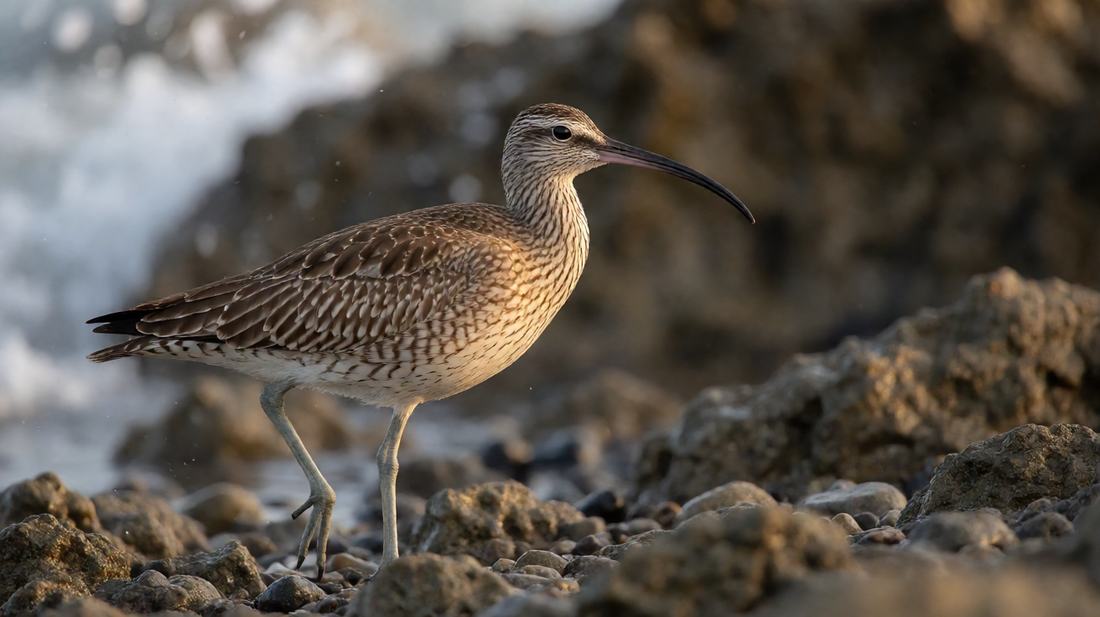
Numenius phaeopus | Whimbrel
Species Profile · Scolopacidae
Whimbrel
A curlew of the far northern tundra whose seven rising whistles carry across the estuary in spring — and whose separate groups are quietly slipping away in number.
IUCN: Least Concern
Range
Length
Weight
Nest
Incubation
The bird of the seven whistles
A curlew of the far north
The whimbrel is a medium-sized curlew. It nests on the arctic tundra. It winters on the coast. It is one of the most widespread of all waders. It breeds across the whole of the north of the world. It winters on the coasts of every continent except Antarctica. Most people see it only on migration. It nests in the remote and boggy country of the far north. It spends the winter on estuaries and rocky shores in the south. You know the bird at once by its call. The call is a rapid series of 7 whistles. It is one of the most evocative sounds of spring and autumn.
You hear it on the coasts of the North Sea and the Atlantic. That call gave the species its English name. It is so clear that a good observer can pick the bird out. The bird can be found in a mixed flock of waders. It shows up long before it comes into view. The bird is a generalist of the shore. It probes mud and wet sand with its bill. The bill is long and curves down. It takes a very wide range of prey. It eats the marine worms and small crabs of the estuary. It also eats the berries of the tundra. That flexible diet explains its huge range.
Many other waders have become narrow specialists. The whimbrel is not globally threatened. Its numbers run into the millions. Several of its groups are falling all the same. One subspecies lives on the central Asian steppe. That bird is now among the rarest waders of the region. The species is a good example of a common bird. Its safety rests on many separate and very different places. So its future is hard to predict from the world total alone. It is a bird of the long journey. Its migration has been studied by ringing schemes for the whole of the last century.
Family tree
Numenius, the curlews
The whimbrel was named by Linnaeus in 1758. Modern work places it in the genus Numenius. These are the curlews. They belong to the family Scolopacidae. The genus is a small and old group of large waders. All of the members share one clear character. The bill is long and slender and usually curved down. The whimbrel is the smallest of the living members. It is also the most widespread of them. The bird is a close relative of the Eurasian Curlew (Numenius arquata). That curlew is clearly larger. Its bill is much longer. Its call is very different. People compare the 2 all the time. Both birds use the same estuaries.
The whimbrel passes through on migration. The curlew stays for the winter. So the 2 are often seen in one flock. Modern work accepts 4 subspecies. The differences between them are large. That is odd in birds that look so much alike. The nominate form lives in Scandinavia and the north of Europe. It is medium in size with a fairly long bill. A larger and darker form lives in Iceland and the north-west. Its bill is longer still. Its underparts carry more marks. A pale and sandy form lives on the steppes of Kazakhstan and the south of Russia. It is the rarest of the 4. It holds a very small breeding area. The fourth form lives around Hudson Bay and the Canadian arctic.
It is the most distinct of all. Its plumage is darker and more heavily marked. Its migration route differs from every Old World bird. Other things make the taxonomy harder still. Young birds look very like adults. Adults moult slowly after breeding. Part of that moult happens on the wintering grounds. So a bird in autumn looks different at each age. The subspecies are hard to tell apart in the field. Observers rely on bill and wing measurements. They also check the tone of the underparts. The name Numenius comes from the Greek for the new moon. It refers to the crescent shape of the bill. People have noted that likeness since the time of Aristotle.
Long bill, striped head
How to identify one
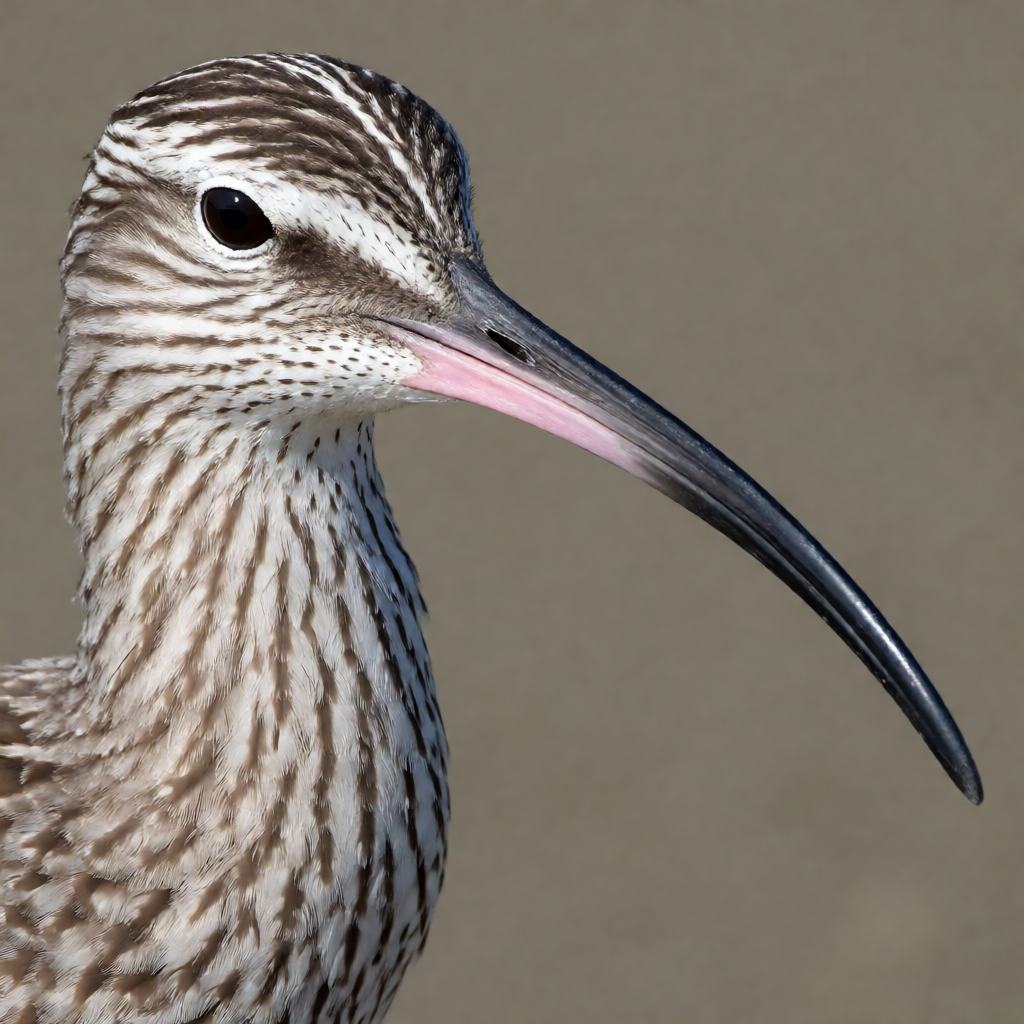
An adult whimbrel is between 37 and 47 centimetres long. Its wingspan is between 75 and 89 centimetres. Its mass runs from about 270 grams in a small male. A heavy female can reach 490 grams. Such a bird is fattening for the migration in autumn. The bird is slim and long-legged and long-billed. Its proportions look graceful. The related curlew looks far heavier. The bill is the clearest difference. It is slender and slightly curved down. It measures between 6 and 9 centimetres. The tip is dark and the base is paler. The bird probes soft ground with the whole bill. The plumage is a fine mixture of dark brown and pale buff. The upperparts are heavily streaked and mottled.
Dark feathers are edged with pale buff and white. The effect matches dead grass and seaweed and broken shell. The underparts are pale with fine dark streaks. The streaks are heaviest on the breast. They fade towards the belly. The flanks are barred with dark brown. The rump and the lower back are pale. They stand out when the bird flies. The head pattern is the most useful of all. A dark crown is split by a narrow pale stripe. A broad dark stripe runs through the eye. A pale stripe sits above it. The chin and the throat are pale. The neck is finely streaked. The curlew has a plain crown with no stripe.
The legs are long and slender and dull grey-blue. The hind toes are very short. The front toes are partly webbed at the base. The wing is long and pointed. The flight is fast and direct with steady wing beats. It never flaps slowly like the bigger waders. The iris is dark brown. The bill is dark horn with a pinkish base. The sexes look alike. The female is usually the larger and the longer-billed bird. A bird of the first winter looks much like an adult. Its bill is shorter and its plumage is more worn. You can tell a young bird by its wing coverts. Its upperparts look very fresh and very even.
1
2
3
Tundra and estuary
Where it lives
The whimbrel wants open and treeless country in the breeding season. It wants the wet and muddy shore in winter. Those 2 needs are so different that people call it 2 birds. The breeding habitat is the tundra and the moor and the bog of the north. The bird is commonest where dwarf birch grows. Willow and moss and lichen grow there too. The ground is wet and the insects are abundant. The arctic summer is short. The nest sits on open ground. The birds rely on their own pattern. They also rely on clear sight lines across the tundra. So they avoid dense forest and bare rock.
They nest most densely on the low hummocky ground between the 2. In winter the bird moves to the coast. It uses estuaries and sandy beaches. It also uses rocky shores and mudflats. It is common on the mangrove creeks of the tropics. It is also common on coral island shores of the Indian and Pacific Oceans. Few waders feed by day on the open beach. This bird does, and it also feeds by night on the mudflat. The tide governs its pattern of activity. It roosts in the high saltmarsh at the top of the tide. It also roosts on rocky islets. It returns to the flats as the water falls.
The species is a bird of the migration. Its journeys are among the longest of any wader of its size. Birds of Hudson Bay fly south-east across the whole Atlantic. They first make landfall in the Caribbean or South America. Then they move on to the coast of Brazil and the Guianas. Birds of Iceland and Scandinavia travel down the coasts of Europe and West Africa. One bird ringed in Iceland was found in Senegal and in Mauritania. The American birds cross the Atlantic in a single flight. That flight covers several thousand kilometres. It takes them over open water for several days. The birds lay down a great deal of fat before they leave. The mass of the bird rises by a third or more in the weeks before the migration.
A prober of mud and sand
What it eats
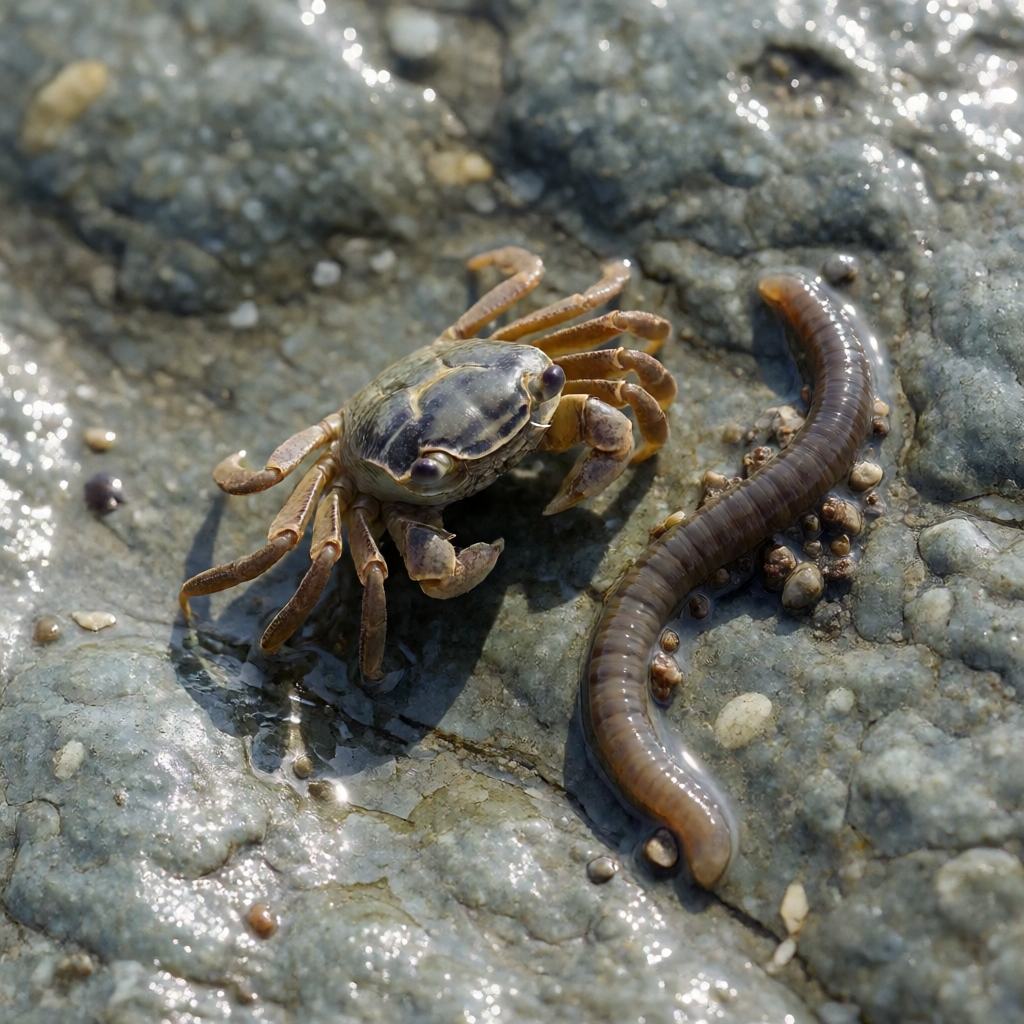
The whimbrel is a generalist feeder. It takes a very wide range of small prey. A bird wintering on the coast eats marine worms. It also eats small crabs and molluscs and shrimps. Fiddler crabs of the mangrove matter a great deal. They are important in West Africa and in the Americas. Few waders take the larger and harder crabs. This bird does. It breaks them open on a hard surface. It also shakes them and hammers them with the bill. The bill is not strong enough for the biggest crabs.
So the bird picks the smaller and softer animals. It picks the ones that have recently moulted. The bird probes the soft mud for worms and shrimps. It holds the bill almost upright for that. It often works in water deep enough to cover the whole bill. On the breeding grounds the diet changes. It eats the insects of the arctic summer. Crane flies and beetles and sawflies are all taken. So are their adults and their larvae. Spiders and small snails add to the list. Plant food matters a great deal in late summer.
The bird feeds heavily on crowberry and bilberry and bearberry. That shift to fruit helps it lay down fat. The migration needs that fat. The berries of the tundra are very rich in sugar. Both parents feed the chicks for the first days. After that the chicks find their own food. The bill of a chick is short and straight. It grows and curves as the bird develops. The full length is not reached in the first year. So a young bird holds a poorer tool. It can only reach the prey near the surface of the ground.
A scrape on the tundra
The breeding cycle
The whimbrel arrives on the breeding grounds in late spring. Northern birds reach the tundra in the middle of May. Southern birds arrive a little earlier. Males hold territories and advertise them. They sing and they perform a song flight. The bird rises above the territory. Then it glides down on stiff raised wings. The head is thrown back and the bill points up. The whole display comes with a repeated song. It is one of the most striking displays of the northern waders. Birds perform it in the early morning and in the evening. They also perform it in the middle of the night. Birds of high latitudes are active for the whole 24 hours of the arctic day. The nest is a shallow scrape in the ground.
It is lined with a little dry grass and moss. It sits among the low tundra plants or on bare stony ground. The clutch holds 4 eggs. They are laid at intervals of about a day. The eggs are pale olive or buff. Heavy dark brown and black marks cover them. That pattern hides them against the dead grass and the lichen. The female does most of the sitting. Incubation lasts between 24 and 28 days. The male guards the territory and the sitting bird. The alarm call is a loud and rapid series of notes. Both parents answer it. The call draws the intruder away from the eggs. The chicks are precocial and covered in mottled down.
They leave the nest within a day or 2 of the hatching. Both parents lead them to the wetter ground. Insects are most abundant there. The young can fly at between 35 and 40 days of age. The family stays together for a while after the young fledge. Then it breaks up as the birds move towards the coast. The species raises a single brood across the whole of its range. A lost clutch is rarely replaced. So the northern groups produce few young. The adults survive well instead. The birds are long-lived. Some have reached an age of more than 15 years in the wild.
Widespread, but falling
Conservation
The whimbrel is assessed as Least Concern on the global Red List. The world population is large. It runs into the millions of individuals. The species has an enormous range. It is not close to the thresholds of the threatened categories. The picture looks much worse for each single group. Studies of the last 30 years show several groups in decline. Birds of Hudson Bay and the Canadian arctic have fallen in number. Those losses are linked to the loss of the coastal habitat. Birds lose feeding grounds on the migration route. They also lose the feeding grounds of the winter. Mangrove and mudflat have been built over across the tropics and the south. That has removed a very large area of habitat. The birds need that habitat outside the breeding season.
The rarest subspecies is the pale bird of the steppes. It lives in the south of Russia and in Kazakhstan. Its numbers have fallen to a very small number of pairs. It is now one of the most threatened waders of central Asia. The cause is the ploughing of the virgin steppe. Wet meadow has been lost. Low ground has been flooded for reservoirs. The bird now holds a few small areas. A special effort works on its conservation. Other threats affect the species as a whole. The breeding habitat is drained and built on. The arctic climate is changing as well. A warmer tundra will change the plants. It will also change the insects that the chicks need.
The insects may now appear at the wrong time. That mismatch is one of the feared losses for the northern waders. The bird is also shot in some parts of the world. It is a quarry species in the Caribbean and in South America. Shooting is heaviest on the migration. It adds a significant pressure. The species is protected across the whole of the European Union. It is listed under the African-Eurasian Waterbird Agreement. Key sites are protected by the Ramsar Convention. Others are special protection areas of the European network. Site protection does not stop the loss of habitat elsewhere. It also does not stop the pressure of a changing climate in the far north.
Quick hits
Five things to remember
- Its English name comes from its own voice. The bird gives a rapid series of 7 whistles. The whole series takes less than 2 seconds to deliver.
- The birds of Hudson Bay make one of the longest sea crossings of any wader. They fly from the Canadian arctic across the whole Atlantic. They then reach the coast of South America and the Caribbean.
- The bird is one of the very few waders that eats berries. It takes the crowberry and the bilberry of the tundra in late summer. That fruit helps it lay down the fat for the long flight.
- A young bird has a short and a straight bill at the hatching. The bill grows and curves over the first year of the life. So you can judge the age of a young whimbrel from the shape of the bill.
- The nest is no more than a shallow scrape in the open tundra. Nothing hides it. The clutch depends on the pattern of the eggs and on the display of the parents.