 By st20113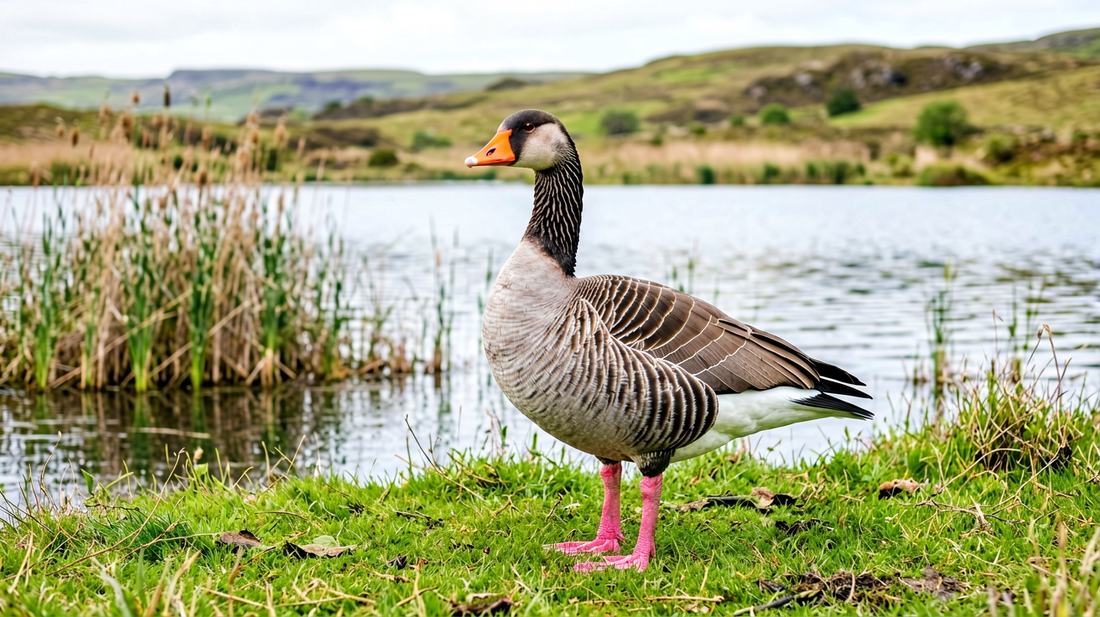
Anser anser | Greylag Goose
Species Profile · Anatidae
Greylag Goose
The largest wild goose that breeds in Europe, and the ancestor of almost every domestic goose in the West.
IUCN: Least Concern
Range
Length
Weight
Clutch
Moult
The goose in the park
Familiar and overlooked
The greylag is the largest wild goose that breeds in Europe. It is also the ancestor of almost every domestic goose in the West. That makes it both very familiar and rather overlooked. People know it from park lakes and village ponds. They pay it less attention in its truly wild state. It is a heavy bird with a broad grey-brown body.
It has a thick neck, a large orange bill and pink legs. Its names are simple. Anser is the Latin word for a goose. The species name repeats it. The word lag in greylag is an old dialect term for a laggard. It refers to the fact that these geese are the last to leave their northern breeding grounds in autumn.
In the far north it is still a true migrant. Its journeys to and from Iceland have been studied for over a century. In the lowlands of western Europe it is now often resident. It has also become far more numerous. Numbers are now managed as an agricultural and aviation issue.
Family tree
Anser, the grey geese
The greylag is in the family Anatidae. That family holds the ducks, geese and swans. Within it, it sits in the subfamily Anserinae, the true geese and swans. Its genus is Anser, the grey geese. That genus holds about 10 species across the northern hemisphere. It is split from the genus Branta, the black geese. Branta has a black bill. Anser has an orange or pink bill.
The plumage differs too. Branta is black and white, Anser largely grey and brown. The bill is a grazing tool. It is quite unlike the flatter bill and comb-like lamellae of the dabbling mallard. Two subspecies are usually accepted. The nominate form lives in northern and western Europe. The eastern form lives in eastern Europe and Asia. The eastern bird averages larger and has a pink bill.
The species is also the main wild ancestor of the western domestic goose. People tamed it in Egypt at least 4,000 years ago. People selected for size, calm temper and earlier laying. The result lost the urge to migrate. The domestic geese of eastern Asia come from the swan goose instead. The two can be told apart by the bill knob and the neck stripe.
Bill, legs and heavy flight
How to identify one
An adult greylag is 76 to 89 cm long. Its wingspan is 147 to 180 cm. It weighs 2.5 to 4.1 kilograms. Males are always heavier than females. The heaviest birds are males in late autumn. By then they have laid down fat for winter. This makes the greylag the largest surviving wild goose of the western Palaearctic. Its wing loading is high. It takes off with a heavy pattering run. On water it slaps across the surface before lifting. Its wingbeats are slow, deep and powerful.
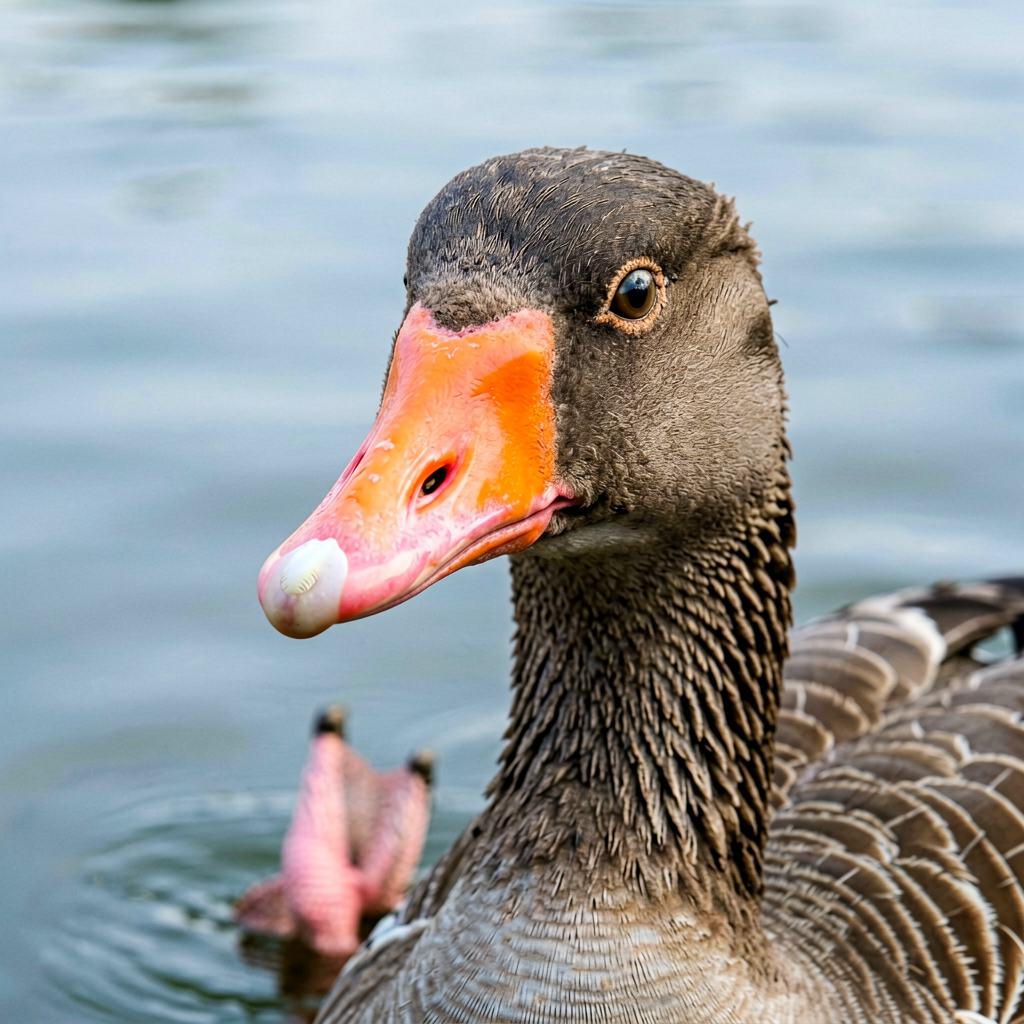
Barnacle and pink-footed geese look much lighter in flight. The body is a uniform grey-brown. The mantle and flanks carry strong pale grey bars. The breast and belly are paler grey with scattered black spots. The rear, vent and undertail coverts are white. A flying bird shows a broad pale band at the tail end. That helps place it. The head and neck are soft ash-grey. They are paler than the body. There is no dark crown or dark neck stripe. The bill is large and thick-set.
It narrows slightly in the middle. It is orange to pinkish-orange. The tip carries a distinct pale nail. The legs and webbed feet are pink. That splits it from the black-legged bean goose. Adults have a flabby fold of skin on the belly. It is said to be whiter and larger in males. Field workers use it to sex birds at a distance. Juveniles are duller, with less barring on the mantle.
1
2
3
Lakes, marshes and stubbles
Where it lives
The greylag breeds from Iceland and Scotland east through Scandinavia and the Baltic states to western Siberia. A further population reaches Mongolia. The bird has been widely reintroduced within its old range. Feral and semi-feral flocks now live in lowland England, the Netherlands, Belgium and Germany. The wild bird had been lost from those areas by the mid-nineteenth century. In the far north it breeds on shallow, vegetated lake margins. It also uses marshes and wet meadows beside slow rivers and coastal lagoons.
In Iceland it is the commonest breeding goose. It nests in dense numbers in the lava-field birch scrub. In July and August the birds gather on remote lakes to moult. For about four weeks they cannot fly. In winter the migrants move south and west. They use low-lying grassland, estuary marsh and flooded meadow. They also graze stubbles in Britain, the Low Countries and northern France.
Smaller numbers reach the Mediterranean, the Nile delta and Mesopotamia. Some British marshes now hold geese at very high density. The species wants fresh water for drinking and bathing even when feeding on salt marsh. It increasingly grazes winter cereals and grass leys. That has brought it into conflict with farmers.
Almost wholly a plant eater
What it eats
The greylag is almost wholly a plant eater. It lives on the leaves, stems, roots and tubers of grasses and sedges. It also takes water plants, cereal grain and a little invertebrate food. Its bill is a grazing instrument rather than a filter. It crops grass blades with a side-to-side action. That motion gives a feeding flock its own look and sound. It can pull up the rootstocks of bulrush and common club rush.
It does this on soft mud or in shallow water. It often upends like a dabbling duck to reach submerged plants. It grazes on land through much of the day. It feeds mainly in the early morning and late afternoon. It rests on open water in the middle of the day. That rhythm is not strict. Disturbance or plenty of food soon breaks it.
In winter it takes winter wheat, barley and oilseed rape. It also grazes improved grass leys. Large flocks can strip a field of young plants in days. That damage is the main reason for the present conflict. Farming change has helped the bird at the same time. The switch from spring to autumn sowing has increased its winter food. So did the fertilising of pasture.
Pairs that last a lifetime
The breeding cycle
Greylag geese can breed at three years old. Most do not succeed until a year or two later. Pair bonds usually form in the second winter of life. They then last for the life of the partnership. That may be a decade or more. Re-pairing happens after a partner dies. It is the exception, not the rule. The family party stays together through the first winter. It often stays into the following spring. Nesting starts in late March in the south. In Iceland it starts in late May.
The female picks a site on the ground within a few metres of water. Small islands and marsh hummocks are favourites. She builds a large nest of dead grass, reeds and stems. She lines it with down from her own breast. The clutch is normally 4 to 6 eggs. Clutches of 2 and of 8 have been recorded. Incubation takes 27 to 28 days. The female does it alone. The male stays on the water nearby. He escorts her on her short feeding trips. The goslings are precocial.
They leave the nest within a day of hatching. Both parents lead them to water and grazing. They fledge at 8 to 9 weeks. Non-breeding adults moult in June and July. They are flightless for about four weeks. They gather on open water far from shore. Successful breeders moult later, after the young have flown. So the flightless period is spread across the summer. A local population is never grounded all at once.
From rarity to crop pest
A conservation success story
The greylag is Least Concern worldwide. Its recent history is one of strong increase. That sets it apart from most European wetland birds. The north-west European population has grown several times over in fifty years. Legal protection was the first cause. So was the creation and management of reserves. The spring hunt that once took a heavy toll has stopped. Farm food has also improved. This success has brought a new problem.
Wintering and resident greylags are now among the commonest geese in Britain and the Low Countries. Large flocks damage cereal crops and improved pasture. That is now a serious economic issue. Big numbers on and around airfields also threaten aircraft. There have been serious incidents. Control measures are now used. Birds are scared off vulnerable crops. Set-aside feeding areas are given as a sacrifice. Some countries allow shooting under licence.
In a few places breeding numbers are cut by oiling eggs. That works but raises welfare objections. On the continent the deeper worry is habitat. The shallow, vegetated wetlands the bird needs are shrinking. Drainage and nutrient pollution have cut them across much of the range. Breeding success in the Baltic and parts of Scandinavia has fallen. Wintering numbers have kept rising at the same time.
Quick hits
Five things to remember
- Almost every domestic goose in Europe, the Middle East and North Africa descends from this wild bird, while the domestic geese of eastern Asia come from the swan goose instead.
- The lag in greylag is an old dialect word for a laggard, and it refers to these being the last wild geese to leave their northern breeding grounds in autumn.
- A greylag takes off by running or pattering across the water, slapping the surface with its feet until it gains enough speed to lift.
- The male guards the nest from the water rather than from the nest itself, and he escorts his sitting mate whenever she leaves to feed.
- Some Icelandic greylags fly well over a thousand km to winter in Scotland and Ireland, and they return to the same fields each year.