 By st20113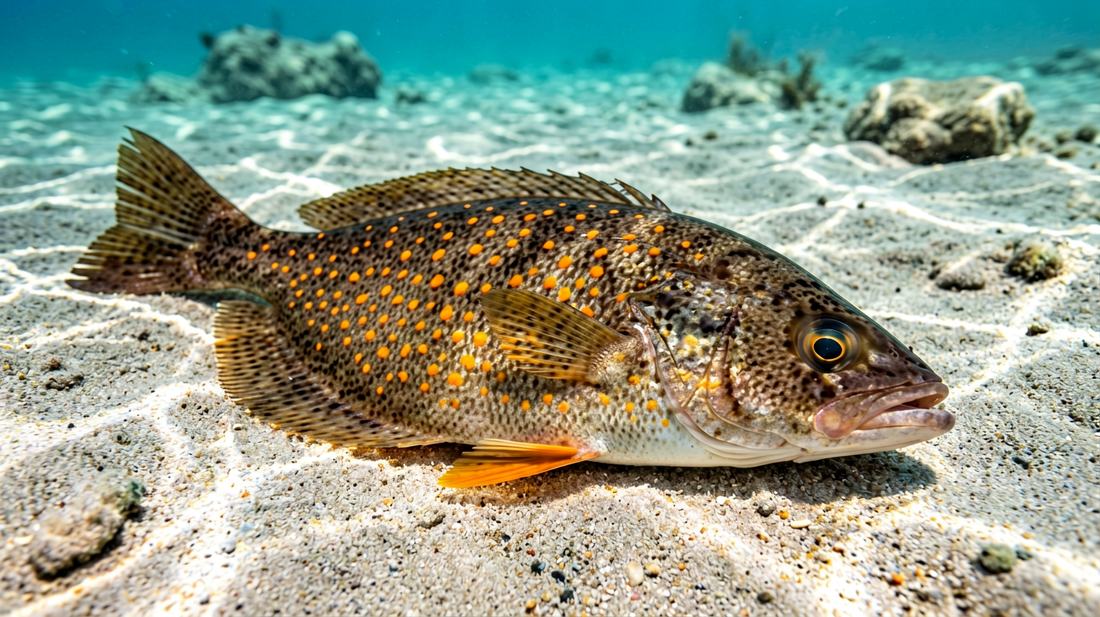
Pleuronectes platessa | European Plaice
Species Profile · Pleuronectidae
European Plaice
A right-eyed flatfish of sandy ground, marked by bright orange spots and fished across the North Sea for more than a century.
IUCN: Least Concern
Range
Length
Weight
Depth
Spawning
The flatfish on the slab
The European plaice
The European plaice is the flatfish most often seen on a fishmonger’s slab in northern Europe. It starts life as an ordinary upright fish. It ends it lying flat on the seabed. Both its eyes end up on one side of the head.
Adults live on sandy and gravelly ground. They are found from the shoreline down to about 200 metres. Their mottled brown top and bright orange spots hide them well. They lie half buried in the sediment for much of the day.
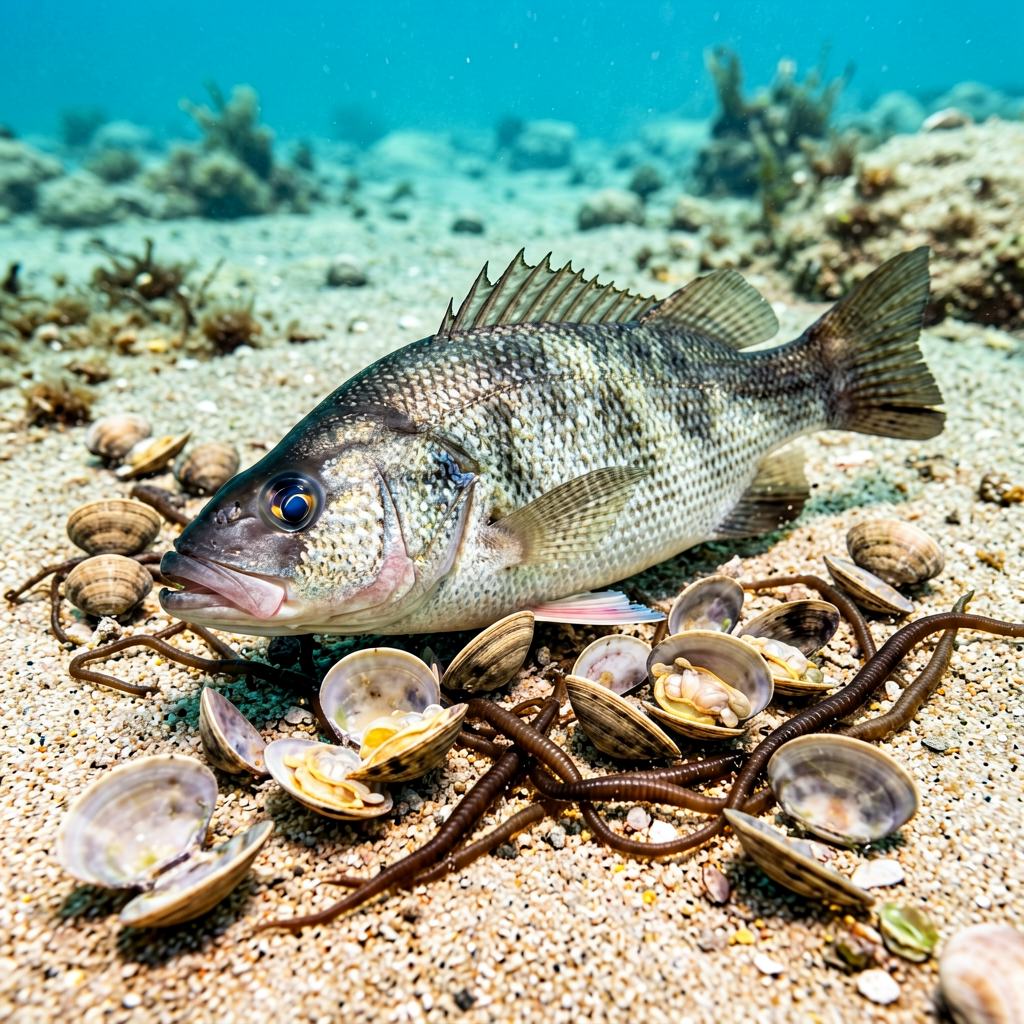
There they wait for small clams, cockles and worms. The species supports important fisheries in the North Sea, the Irish Sea and around Iceland. But it grows slowly and matures late. Heavy fishing has cut the size at which some stocks first spawn.
Family tree
A righteye flounder
The European plaice is in the family Pleuronectidae, the righteye flounders. In that family the eyes sit on the right side of the head in adults. The genus Pleuronectes holds only a few species. A Swedish naturalist described the plaice in 1758. Its scientific name refers to its flattened, plate-like body. Flatfishes form the order Pleuronectiformes with the soles, turbots and halibuts. All of them share one odd change in development.
The skull twists. One eye migrates across the top of the head. In the plaice the left eye moves to the right side. The fish then settles with its pale blind side down. The group is related to the perch-like fishes. So a plaice is a bony fish that evolved a flat way of life. It is not a relative of the rays and skates.
One fish of the same cold northern seas shares its fishing grounds. That is the Atlantic Cod. It is a large predator with a very different body. It hunts in midwater and near the seabed. Young flatfish are among its many prey.
Spots, eyes and smooth skin
How to identify one
An adult plaice is flat, oval and diamond-shaped. It is usually 25 to 50 cm long. Large fish reach 70 cm or more. Females grow much larger than males. A big fish can weigh more than 3 kilograms. The upper side has smooth, slippery skin. It has no scales that can be seen or felt. The colour runs through browns, greys and olive. Bright orange or red spots scatter across it. Those spots are the clearest feature of the species.
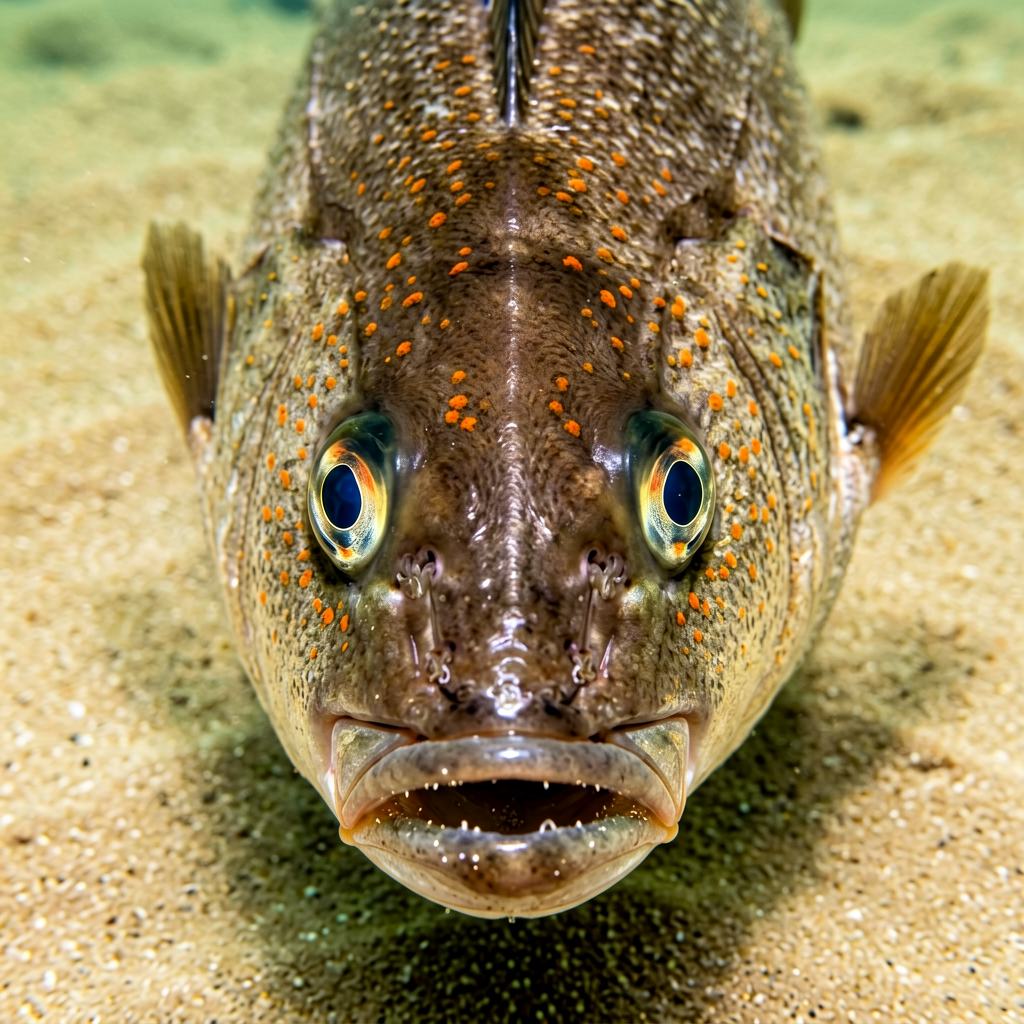
They appear early in life. The blind side is white or creamy. The fins of the upper side are patterned. Those of the blind side are pale. Both eyes sit on the upper side. They are close together. A raised bony ridge separates them. The eyes move independently. They can be lifted above the sediment. So the fish can watch for danger while almost fully buried.
Its mouth is small. Its teeth are blunt and few. That suits a diet of soft animals and shelled prey. Adults have no swim bladder. That is why they live on the seabed. It is also why they cannot hover in midwater like a cod. Growth is slow and varied. Females grow faster and live longer. The oldest plaice recorded were more than 40 years old. Few fish in fished stocks reach that age.
1
2
3
Sandy and gravelly seabed
Where it lies
The plaice lives in the north-east Atlantic. Its range runs from the White Sea and Iceland south along Scandinavia, Britain and Ireland. It continues past the Low Countries, France and Iberia to the western Mediterranean and the Adriatic. It is one of the commonest flatfishes of the southern North Sea and the Irish Sea. It favours shallow shelf water. It is most abundant between about 10 and 60 metres. It has been recorded deeper than 200 metres. It lives on sand, muddy sand and gravel.
It avoids rock, coral and deep fine ooze. Young plaice spend their first 2 or 3 years in very shallow water. They use sandy beaches, estuaries and coastal nurseries. Small fish need warm, food-rich water to grow. Those nurseries are also very vulnerable. Land-claim, dredging and pollution all damage them. Adults move offshore as they grow. The general movement is from the coast into deeper water.
There is also seasonal movement. Fish move away from the shore in winter. They move back towards shallow water in spring. Tagging shows the species is not a long-distance migrant. Most fish stay within a small area all year. A few travel more than 100 kilometres. But most spend their lives on a limited stretch of seabed.
What it eats
Crushing shellfish
Plaice are bottom feeders. They eat almost anything they can crush or swallow. Thin-shelled bivalves are their favourite food. Young fish in shallow water feed mostly on small crustaceans. These include amphipods, small shrimps and the young of larger animals. Small worms and tiny fish are eaten too. Larger plaice shift to bivalve molluscs. Cockles, tellins and small clams are the main prey.
Thin-shelled mussel-like species buried in the sand are taken as well. So are polychaete worms, brittle stars, small sea urchins and small crabs. The teeth are blunt. They crush rather than cut. A feeding plaice often leaves a cloud of shell fragments on the seabed. The fish has no swim bladder, so it cannot chase prey. It cannot hover in the water either. So its feeding is slow and settled.
It relies on camouflage and on staying in a small area. Individual fish stay within a small patch for weeks. They may move only a few metres a day. That way of life saves energy. But it makes the species very vulnerable to change. Anything that kills the animals in the sediment hits the fish that feed on them.
Batches of eggs in winter
Spawning on deep ground
Plaice spawn in winter and early spring. The exact timing varies between stocks. Fish in the southern North Sea start in December and January. Northern fish spawn later. The spawning grounds are particular areas of deeper water. They are often 20 to 70 metres deep. The seabed and the currents must both be right. The fish gather there in large numbers. Females release eggs in batches over several weeks. The number of eggs rises sharply with size.
A small fish may produce fewer than 100,000 eggs. A female of 50 cm or more can release several hundred thousand. The biggest may produce more than half a million. The eggs float in the upper layers. They hatch after 10 to 20 days. The new larvae are small and symmetrical. They have one eye on each side of the head. They drift for weeks and feed on small plankton. At 10 to 17 mm the change begins. The left eye migrates across the top of the head.
The body flattens. The fish starts to swim on its side. It then settles on the seabed. Young fish move into very shallow coastal water for their first years. Plaice mature at 3 to 7 years old. They mature later in colder water. Females mature at a larger size than males. Heavy fishing removes the largest and oldest fish. That has cut the average size at maturity in several stocks.
One species, many troubled stocks
A century of fishing
The European plaice is Least Concern worldwide. It is widespread and abundant over a very large area. But several stocks have been fished hard for more than a century. The species shows the difference between the status of a species and the state of its populations. Landings from the North Sea, the Irish Sea and the eastern Channel have swung widely. International assessments have repeatedly found catches above sustainable levels. So quotas and sometimes closures of spawning grounds have been needed.
The main pressures are the same ones that affect other bottom-living fish. Growth is very slow and maturity is late. So a stock can be fished down quickly and recovers slowly. Plaice is landed alongside soles, cod and rays. So it is hard to catch one species without affecting the others. Large numbers of undersized fish are caught and thrown back. Beam trawls also disturb the seabed itself.
That matters for a species that depends on animals living in the sediment. Flatfish nurseries in shallow coastal water face land-claim, dredging and pollution. The warming of the southern North Sea has pushed the species north and into deeper water. Management now sets catches in line with scientific advice. It also protects spawning and nursery areas and cuts the discarding of small fish.
Quick hits
Five things to remember
- A plaice starts life with one eye on each side of the head and ends it with both eyes on the same side, after one eye moves across the skull.
- The bright orange spots on its upper surface are unique among northern European flatfish.
- Adults have no swim bladder, which is why the fish lives on the seabed and cannot hover in midwater.
- A large female can release more than half a million eggs in a season, while a small one may produce fewer than 100,000.
- Tagging studies show that most plaice live their whole lives within a few kilometres of where they settled as young fish.