 By st20113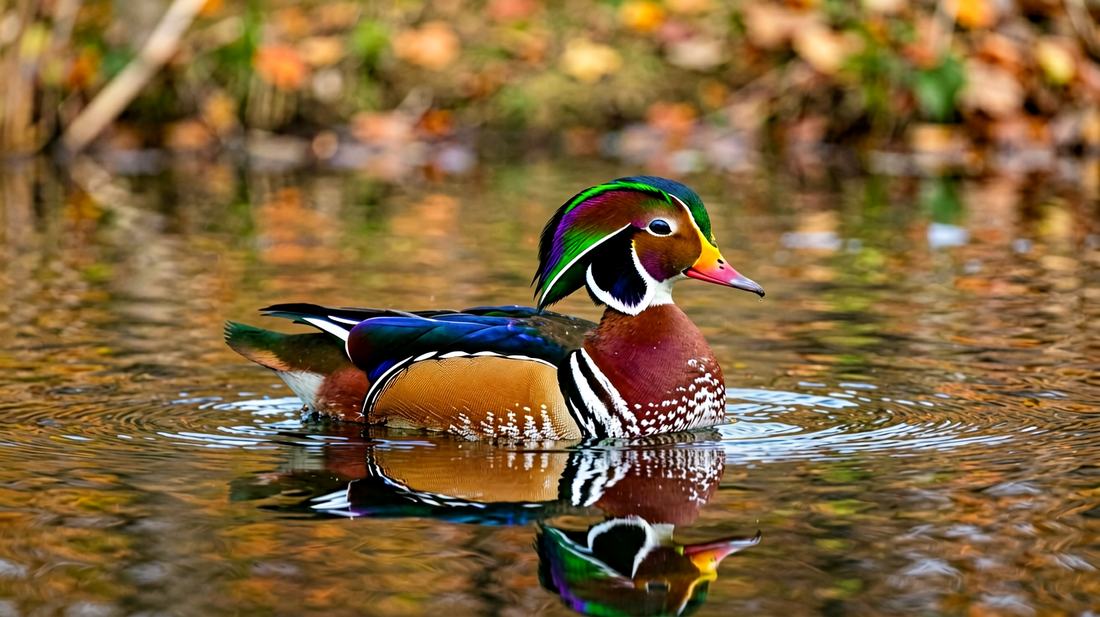
Aix sponsa | Wood Duck
Species Profile · Anatidae
Wood Duck
The most colourful duck in North America, at home in wooded swamps and nesting in holes high above the water.
IUCN: Least Concern
Range
Size
Weight
Eggs
Status
The bride of the woodland
The wood duck
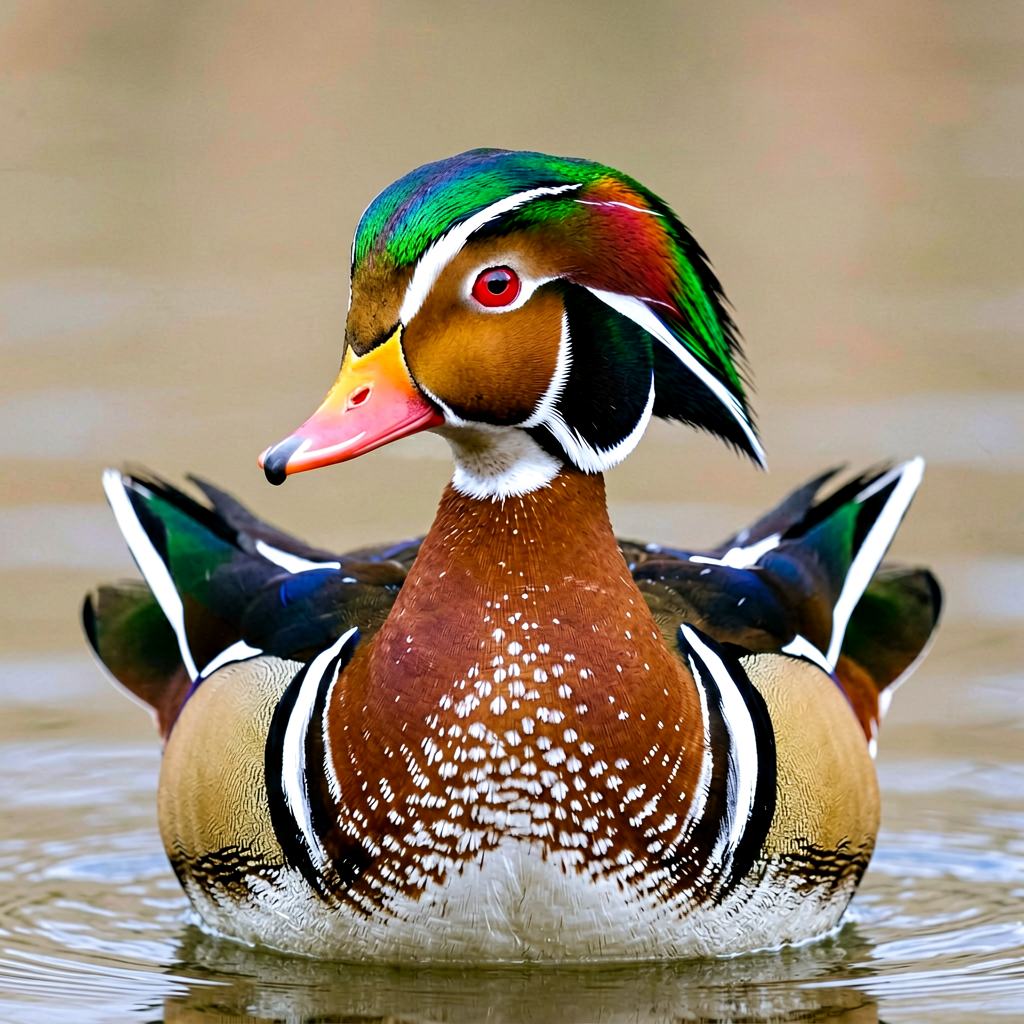
The wood duck is widely seen as the most beautiful duck in North America. The male has a crested head. It is dark green and purple, slashed with white. His breast is chestnut and flecked with white. His flanks carry two odd overlapping flaps.
They look like sails. The female is quieter in colour. She has a white teardrop around the eye. Unlike most ducks, wood ducks perch in trees. They nest in holes high above the water.
Their ducklings jump from the nest on their first day. They live in wooded swamps, slow rivers and beaver ponds. They have also adapted well to parks and golf courses. A century ago they were hunted almost to extinction. They recovered after legal protection and nest-box schemes.
Family tree
Among the ducks and geese
The wood duck belongs to the family Anatidae. This is the family of ducks, geese and swans. It is in the order Anseriformes. Its closest familiar relative on this site is the Mallard. They share the same family and many habits. The mallard nests on the ground.
The wood duck nests in a tree. The wood duck is one of only two species in the genus Aix. The other is the mandarin duck of East Asia. It looks remarkably similar. It too is a tree-nesting perching duck. Early European naturalists thought they were related.
They do sometimes hybridise in captivity. The name Aix is Greek for an unknown diving bird. Sponsa is Latin for bride. It refers to the bird’s bridal colouring. Linnaeus described it in 1758 as Anas sponsa. It was later given its own genus.
Sails and shining colours
The plumage of the male
An adult wood duck is 47 to 54 centimetres long. Its wingspan is roughly 70 to 75 centimetres. It weighs 450 to 800 grams. Males are heavier than females. The male’s head is crested. It is glossed green, purple and blue. It is marked with bold white lines. His eye is bright red. His bill is short and bright.
It is patterned with red, yellow and black. The chest is dark chestnut with white spots. The flanks end in two long feathers. They are white and black and called sails. They are actually modified wing coverts. The back is dark and olive. The sides are a warm buff. The female is grey-brown. She has a white patch around the eye.
It looks like a teardrop. She has a white throat and a dark, plain back. She is darker and duller than the female mallard. She is slimmer, with a smaller bill and a longer tail. Wood ducks have strong claws. These grip bark so they can perch in trees. Their legs sit slightly forward. This sets them apart from dabbling ducks.
1
2
3
Wooded swamp
Where wood ducks live
The wood duck is native to North America. It breeds across the eastern United States and southern Canada. This runs from the Great Lakes and the Maritimes southwards. A separate group lives along the Pacific coast. It stretches from British Columbia to California. Birds from the north migrate south for winter. Southern birds are largely resident.
Introduced birds now breed in western Europe. This includes Britain. They are also kept widely in collections. The species needs wooded wetland. It likes flooded forests, swamps, marshes, sluggish rivers, beaver ponds and wooded lakes. Trees must stand in or beside the water. It also uses farm ponds, reservoirs, city parks and golf-course water.
Nest boxes stand in for tree cavities that are scarce. Wood ducks are fast, agile fliers. They slip through woodland without hitting branches. They need this skill because nests are often far from water. They prefer water with dead trees and overhanging branches. They avoid large open lakes with bare shores.
What it eats
Acorns, seeds and insects
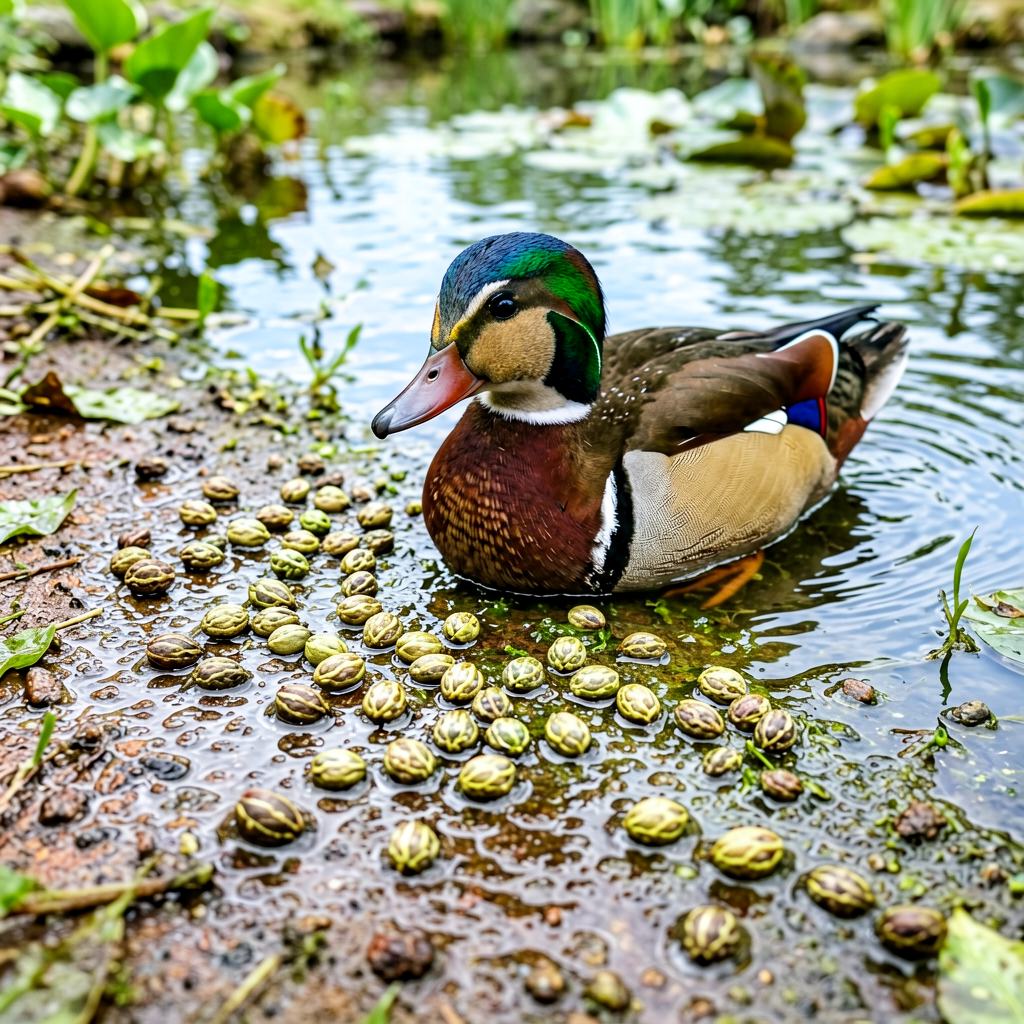
The wood duck is an omnivore. It has a strong taste for plants. It eats seeds, acorns, nuts, water plants, duckweed and grasses. It also takes insects, aquatic invertebrates, snails and tadpoles. Small fish and crustaceans are eaten too. Ducklings rely on aquatic insects.
These give the protein they need to grow fast. Adults feed by dabbling. They tip forward with the tail in the air to reach plants below. They also graze on land. In autumn they eat acorns on the forest floor. They happily take grain from fields.
Acorns matter so much in autumn. The size of the oak crop can shape how well the birds face winter. They feed mainly at dawn and dusk. They rest in cover during the middle of the day. Because they eat acorns, they need mature oak woodland near water. A shortage of such trees is one reason they do less well in some areas.
A jump from the nest
Ducklings on day one
Wood ducks pair in winter. The pair bond lasts a single season. The female chooses the nest. It is a natural tree cavity, a woodpecker hole or a nest box. It is usually 3 to 15 metres above the ground. It is often close to water. She lines the cavity with down from her own breast.
She lays 9 to 14 white or cream eggs. Dump nesting is common. Several females lay in the same box. This can push clutch size above 20 eggs. Incubation still takes about 28 to 37 days. The ducklings hatch with down and open eyes. Within a day they climb to the entrance.
They jump to the ground or water below. Their light bodies save them from harm. The female leads them to water. They can swim and feed at once. They fledge in about eight to nine weeks. Young females often nest near where they hatched.
Saved by protection
Back from the brink
Wood ducks were hunted heavily in the nineteenth century. People wanted their meat and feathers. By the early twentieth century they were close to vanishing. Protection under the Migratory Bird Treaty of 1918 stopped the slaughter. Later, beaver numbers boomed. A huge nest-box programme helped numbers recover.
Today they are assessed as Least Concern. They have a large, healthy population. They remain an important game bird. Hunting seasons are regulated. The main pressures now are the loss of bottomland hardwood forest. Dead trees are cleared, so nest sites are lost.
Birds also hit vehicles and glass. Wildlife managers check and clean the nest boxes. Box designs have been refined. This cuts dump nesting and raccoon predation. It also limits competition from starlings and squirrels.
Quick hits
Five things to remember
- Ducklings leave the nest on their first day, jumping up to 15 metres to the ground without injury.
- The male’s two flank “sails” are modified wing feathers, not part of the tail.
- The wood duck is one of only two species in the genus Aix, the other being the mandarin duck.
- A shortage of old trees is the reason nest boxes are so important to the species today.
- The wood duck was nearly lost to the plume trade, and only legal protection and nest boxes saved it.
[…] with the other hole-nesting birds of the family. The mandarin duck is a close relative of the Wood Duck (Aix sponsa). The 2 are very alike in the look of the female. They are also alike in their anatomy and in their […]