 By st20113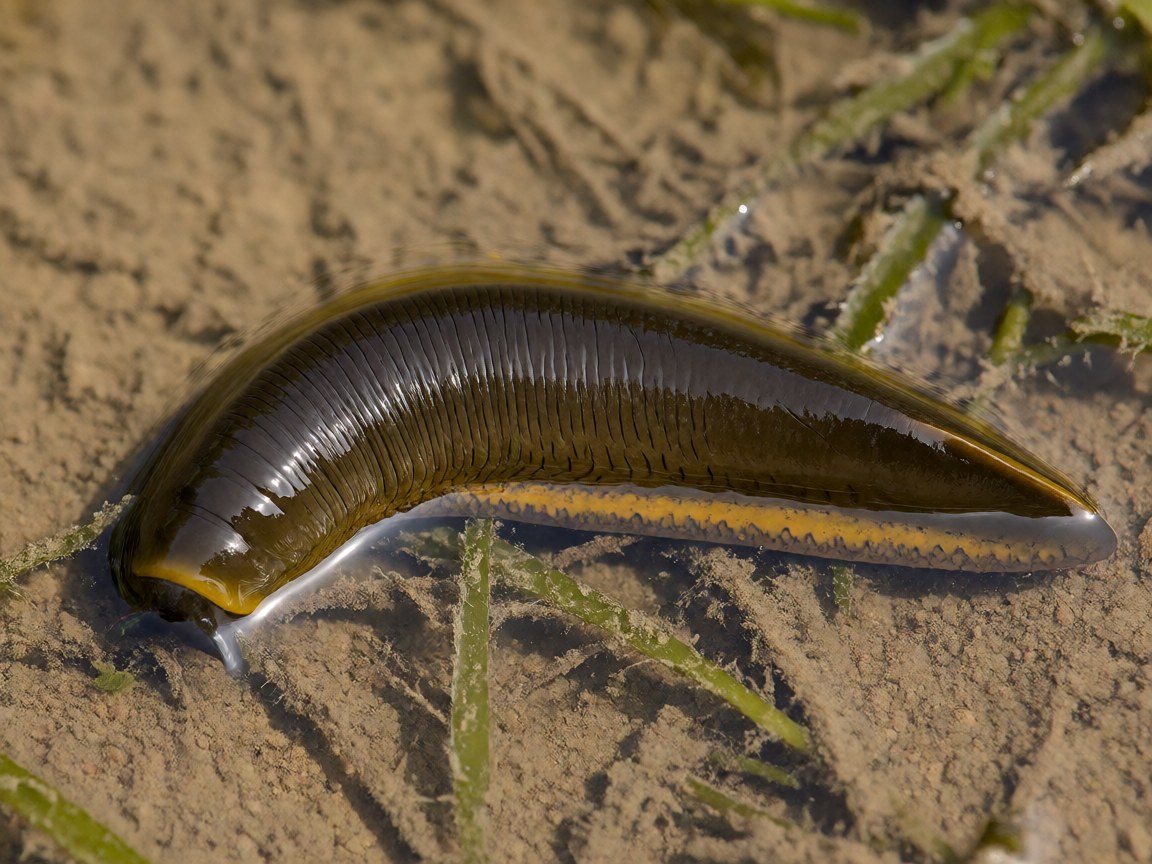
Haemopis sanguisuga | Horse Leech
Introduction
The horse leech (Haemopis sanguisuga) is the largest leech in Britain and one of the most frequently seen, a heavy, dark, muscular animal that lives in ponds, ditches, and slow rivers and can reach fifteen centimetres or more when extended. Despite the name and despite a fearsome reputation inherited from its blood-sucking relatives, it does not suck blood and cannot bite people: it is a predator and a scavenger, swallowing worms, insect larvae, molluscs, and carrion whole. Its confusion with the medicinal leech, Hirudo medicinalis, is ancient and persistent, and it is one of the main reasons people fear farm ponds. In practice it is a useful and harmless animal that clears up dead matter and helps control the invertebrates of the pond margin, and it is one of the few freshwater animals large enough to be unmistakable.
Taxonomy
Haemopis sanguisuga is an annelid worm, a member of the class Clitellata and of the leeches, the Hirudinea, in the family Haemopidae. The leeches are a specialised offshoot of the oligochaetes, the group that contains the earthworms, and they share with them the fundamental features of a segmented body, a clitellum that secretes the cocoon, and the absence of parapodia. Haemopis belongs to the arhynchobdellid leeches, the jawless, toothless group, which separates it at a stroke from the medicinal leech and other blood-feeders that carry cutting jaws. Its closest relatives are the other large, predatory, jawless leeches of ponds and slow water. It is a leech rather than an earthworm, but it is a clitellate annelid in the same broad group as Lumbricus terrestris, and the two share the same basic plan of a segmented, hydrostatic body with a glandular clitellum.
Physical Characteristics
The body is elongated and muscular, somewhat flattened, and widest behind the middle, tapering towards both ends; at rest it may be only five or six centimetres long but fully extended it can reach fifteen centimetres, making it by a wide margin the largest leech in the British fauna. There are thirty-two external segments, each of which is subdivided into several superficial rings, and the animal has the two suckers characteristic of leeches: a small anterior one surrounding the mouth and a large, powerful posterior one used for attachment. It has no jaws and no teeth. The colour is usually dark: olive-brown, greenish-black, or almost black above, often with a paler, yellowish or brownish stripe or a series of faint spots along the sides, and paler, dirty yellow to grey beneath; the underside is sometimes marked with dark blotches. The surface is smooth and slightly slimy. Like other leeches it moves by looping, alternately attaching the front and rear suckers and drawing the body up in a series of measured, caterpillar-like steps, and it swims with a slow, undulating motion of the whole body.
Habitat
It lives in freshwater: ponds, ditches, marshes, canals, the slow reaches of rivers and streams, lake margins, and wet ground at the edge of water, and it is particularly characteristic of small, still, muddy water bodies with plenty of organic matter and dense vegetation. It is often found under stones, among plant roots, and in the damp mud and leaf litter at the pond margin rather than in open water, and it will leave the water to hunt in wet ground and damp grassland nearby, which is one reason it is so often encountered by people working at the edge of a pond. The species is distributed across Europe and into parts of Asia and North Africa, and it is widespread, though local, throughout Britain and Ireland. It is most often noticed in spring and summer, and in the breeding season, when it emerges to deposit cocoons at the water’s edge.
Diet
The horse leech is a predator and scavenger, not a parasite. Unlike the medicinal leech and its relatives, it has no jaws with which to cut skin, and it cannot pierce a mammal at all; claims of it attacking horses or livestock arise from confusion with other species. It feeds by seizing prey in its mouth and swallowing it whole, and its diet includes earthworms, insect larvae such as those of dragonflies, midges, and caddisflies, snails, freshwater shrimps, tadpoles, and the larvae and adults of other aquatic insects, as well as carrion and any soft-bodied animal it can overpower. It is guided largely by touch and chemical senses, and it will investigate anything that disturbs the water nearby. By taking both live prey and dead animals, it plays a significant part in the economy of a small pond, and its large size makes it one of the top invertebrate predators in water bodies too shallow for fish.
Reproduction
Leeches are hermaphrodites, and this species is no exception: two individuals mate, usually in spring or early summer, and exchange sperm, which is transferred directly rather than simply deposited on the skin. After mating, the clitellum — the glandular saddle that becomes conspicuous in the breeding season — secretes a cocoon into which the eggs are laid along with a supply of nutritive albumen. The cocoon is oval, tough, and usually yellowish or brownish when first formed, and the animal leaves it in damp soil, mud, or among vegetation at the margin of the water, above the waterline but where it will remain moist. Development is direct: there is no free-living larval stage, and the young leeches emerge as small but complete versions of the adult. Growth takes several years, and the animals are long-lived for an invertebrate. Because the young have no dispersal stage and the adults move mainly by crawling, populations are often rather local and tied to individual ponds.
Conservation
The species is widespread, and although it is local and rarely abundant, it is not considered threatened. Its dependence on small, unpolluted, well-vegetated water bodies makes it sensitive to the same pressures that affect the rest of freshwater life: drainage and infilling of ponds, agricultural runoff and nutrient enrichment, the clearance of marginal vegetation, and the modification of ditches and slow watercourses. One particular problem is the presence of fish in formerly fish-free ponds, since introduced fish both compete for and eat the invertebrates that make up its food supply and may take juvenile leeches directly. Conversely, the species benefits from the creation and sympathetic management of farm ponds, which are one of its characteristic habitats. Several related leeches are scarcer, and confusion in the field means records are often uncertain, so verified records are valuable.
Fun Facts
- It is the largest leech in Britain, reaching fifteen centimetres when fully extended.
- It cannot bite people or suck blood; it has no jaws and swallows its prey whole.
- It is frequently mistaken for the medicinal leech, which does feed on blood.
- It will leave the water to hunt for earthworms in damp soil at the pond margin.
- Like other leeches it is a hermaphrodite, and it lays its eggs in a tough cocoon above the waterline.