 By st20113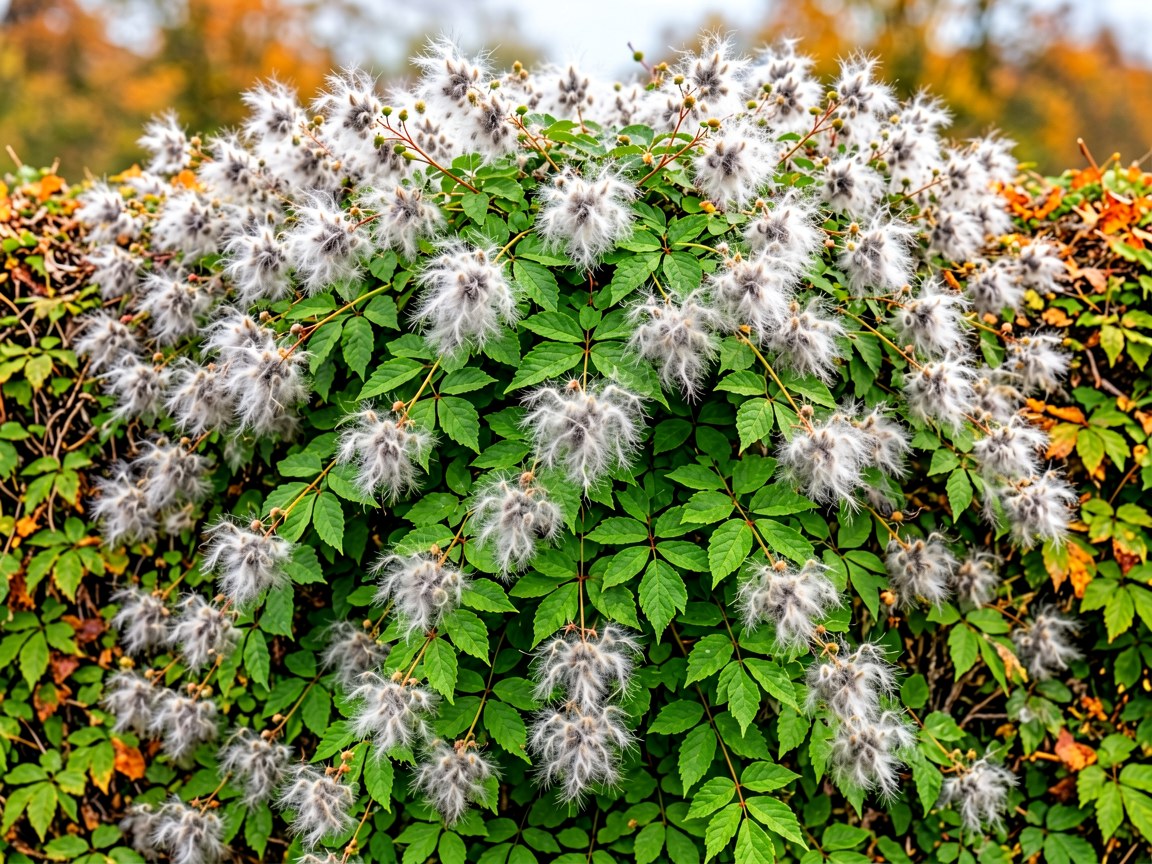
Clematis vitalba | Traveller’s Joy
Introduction
Traveller’s joy (Clematis vitalba) is the only woody climber native to Britain that climbs by twining leaf stalks, and in late summer and autumn it is unmistakable: a great grey beard of feathery, silky seed heads draped over hedges, scrub, and the edges of woodland. In high summer it is far less conspicuous, a tangle of pale green leaves and small, greenish-white, honey-scented flowers, but by September every hedgerow on chalk and limestone seems to be wearing a soft grey fleece. The English name refers to those fluffy seed heads, which were supposed to cheer the traveller on his way. It is a vigorous, fast-growing, and sometimes aggressive plant, and it is one of the most characteristic sights of the chalk downland and limestone scrub of lowland Europe.
Taxonomy
Clematis vitalba belongs to the family Ranunculaceae, the buttercup family, which makes it a relative of the buttercups, anemones, aconites, and hellebores and, more distantly, of the marsh marigold. The genus Clematis is large, with some three hundred species distributed through the temperate and subtropical world, and it includes many of the most popular garden climbers; nearly all of them are woody vines that climb by means of sensitive, twining leaf stalks. The specific epithet vitalba means “white vine”, a reference to the pale, vine-like stems. Like the rest of its family it produces the acrid, irritant compound protoanemonin when its tissues are damaged, which is why handling the plant can cause blistering and why it is left alone by most grazing animals. As a green plant it depends on Photosynthesis, and its entire architecture is a device for getting its leaves up into the light as fast and as far as possible.
Physical Characteristics
It is a large, deciduous, woody climber, capable of reaching twenty metres or more up into the canopy of a tree, with stems that become thick, fibrous, and pale grey-brown with stringy, shredding bark; the young shoots are green to purplish, ridged, and slightly hairy. The leaves are opposite and pinnate, usually with five oval to heart-shaped leaflets, each two to seven centimetres long, coarsely toothed or sometimes shallowly lobed, dull green above and paler beneath with a scattering of hairs; the leaf stalks are sensitive and twist around anything they touch, which is how the plant climbs. The flowers are small, about two centimetres across, with four narrow, greenish-white to creamy-white sepals and no true petals, and they are arranged in loose, branched clusters from the leaf axils; they are slightly fragrant, with a scent often described as like hawthorn or honey, and they lack nectar. The fruit is the famous feature: each of the many small, flattened seeds carries a long, feathered, silky plume, and together they form the grey, woolly, beard-like heads that persist on the plant well into winter.
Habitat
It grows in hedgerows, scrub, woodland edges and clearings, on railway and road embankments, on rough ground, and along the margins of fields, and it climbs over hedges, fences, walls, banks, and trees with equal enthusiasm. It strongly favours base-rich soils and is a characteristic plant of chalk and limestone, though it is tolerant of a wide range of conditions and will grow on clay and on disturbed ground. It is light-demanding and needs its head in the sun even if its roots are shaded. Native to central, southern, and western Europe, north-west Africa, and western Asia, it has been introduced to North America and New Zealand, where it is regarded as an invasive weed in some districts. In Britain it is native and abundant in the south and east and becomes scarcer towards the north and west.
Diet
Traveller’s joy is autotrophic, and its strategy is speed: the stems can grow several metres in a season, and the plant invests in rapid vertical extension rather than in thick, long-lived wood, which is why old stems are light, fibrous, and easily torn. It takes up water and nutrients through a fairly deep and extensive root system, and it does best on well-drained, base-rich soils where there is a good supply of calcium and of nitrogen. It is a strong competitor once established, since a plant that has reached the top of a hedge or a tree can shade out the vegetation beneath it, and a heavy infestation can smother a hedge or a small tree completely. Its tissues are acrid and irritant, so it is rarely browsed by mammals, and it is largely left alone by insects until it flowers. The plant’s growth is strongly seasonal: the shoots that appear in spring grow fast and soft, and by late summer they have hardened, so that the framework that carries the seed heads is already woody before the plumes have finished developing. On good ground the plant can be remarkably long-lived, and a large specimen climbing through a mature hedge may be several decades old, with a woody base as thick as a wrist.
Reproduction
The flowers open from July to September and are unusual among British wild flowers in producing no nectar: they offer pollen only, and they are visited by bees, flies, and a range of other insects that come to collect it. The flowers are protogynous, the stigmas being receptive before the stamens of the same flower shed their pollen, which encourages cross-pollination. Once fertilised, the long feathered plumes develop, and the whole head becomes the familiar silky grey mass. The plumes are not parachutes in the dandelion sense alone: they also allow the seeds to be carried along the ground by wind, to float on water, and to cling to fur and clothing, and they help the seed to orient itself and to lodge in a crevice of bark or soil where it can germinate. The plant also spreads vegetatively, since trailing stems root where they touch the ground, and a single plant can form a substantial thicket.
Conservation
It is common, widespread, and not threatened, and in some places it is regarded as a nuisance: it can smother hedges, young trees, and scrub, and it is controlled in conservation areas where it threatens more valuable vegetation or where it overwhelms the hedges it grows on. It is invasive in parts of North America and New Zealand, where it forms dense mats over native vegetation and is difficult to eradicate because the plant resprouts vigorously after cutting. Within its native range, it is valued as a nectar and pollen source late in the season, as a food plant for the caterpillars of several moths, and as nesting cover for birds. Its clearest conservation role is as a component of chalk and limestone scrub, where it helps to define the character of the habitat and to bind the often-fragile soils of steep slopes.
Fun Facts
- The long silky plumes on the seeds give the plant its other common name, old man’s beard.
- It is the only native British woody climber that climbs by twisting its leaf stalks rather than by tendrils.
- The flowers produce no nectar and reward their visitors with pollen alone.
- The stems are so fibrous that they were once used for tying and for making rough cordage.
- Handling the plant can blister the skin, because like other buttercups it contains an acrid irritant.