 By Iris
Pavo cristatus | Peacock
Species Profile · Phasianidae
Peacock
A bird that turns a woodland clearing into a stage, and the fan that wins him mates is not a tail at all.
Least Concern
Train
Weight
Diet
Range
Genus
Rating
A bird on every temple wall
A fan that people have admired for millennia
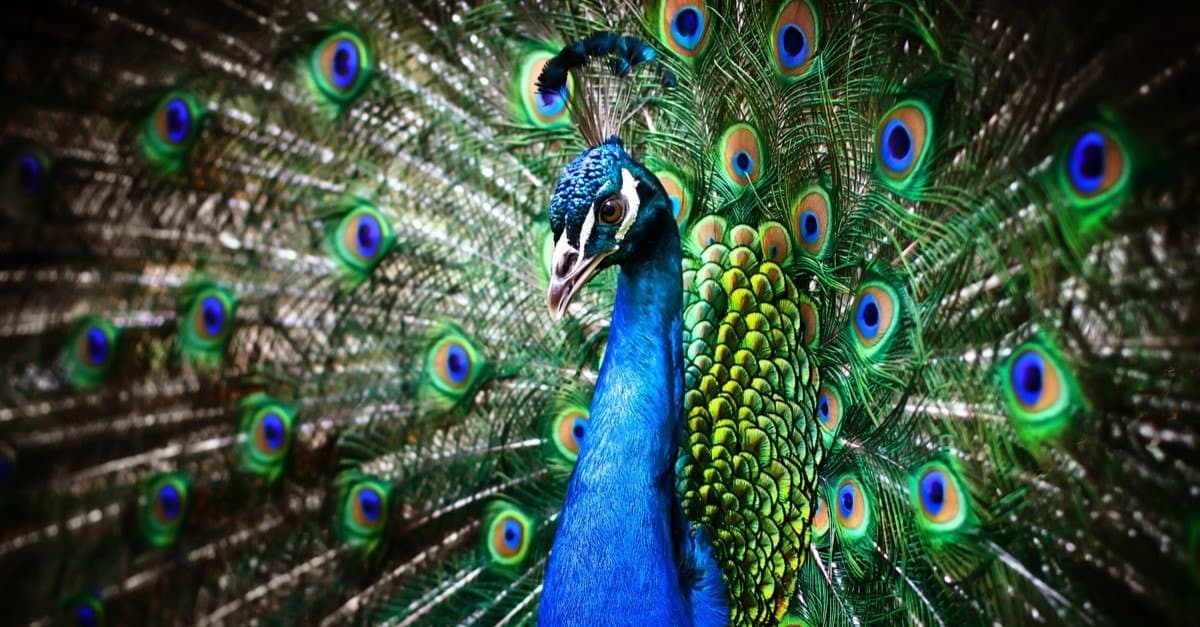
A peacock is the male of a bird that people have admired for thousands of years. His long train of eyed feathers turns a woodland clearing into a stage. Few birds are so easy to name. Peafowl live wild across South Asia.
People carried them to parks far beyond Asia, because the bird travels well and breeds in captivity. Males do the showing. Females do the choosing. Wild flocks also matter to the plants around them.
The birds scatter seed, and they eat insects that damage leaves. Birds of the open edge rarely enter deep shade. That habit puts it close to farms, roads and temples, where people see it often.
Two Asian species, one African cousin
Where the peafowl sits in the family
The Indian peafowl is the best known member of its family. Its scientific name is Pavo cristatus, and the male alone carries the train. Two species sit in the genus Pavo, and both of them live in Asia. The green peafowl is the other one, and it has lost most of its lowland forest.
A third peafowl, the Congo bird, lives in African rainforest far from both. Peafowl sit with pheasants, partridges and junglefowl in a large family of ground feeding birds. They scratch for food on foot. Most of the family flies only in short bursts.
Unlike the Guineafowl, which wears a bony helmet and white spots, the peacock carries colour on his train. The train is not a tail but a set of upper tail coverts, although visitors call it a tail. Old names for the bird survive in heraldry, in temple carving and in the art of two empires.
Colour without pigment
Train, eye spots and structural shine
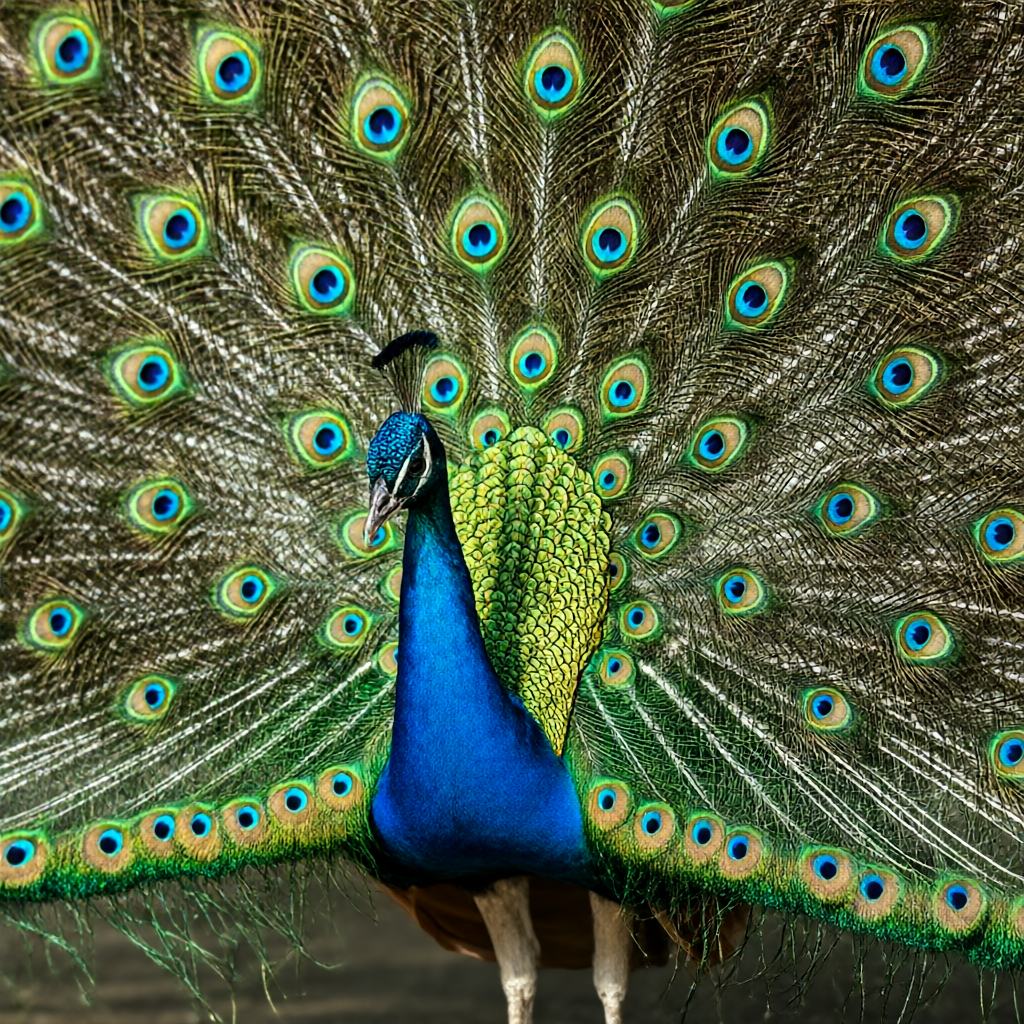
A male carries a train that can reach 2 m in length. Each long feather ends in an eye spot, and the spots shine in blue, green, gold and bronze. No pigment gives that colour.
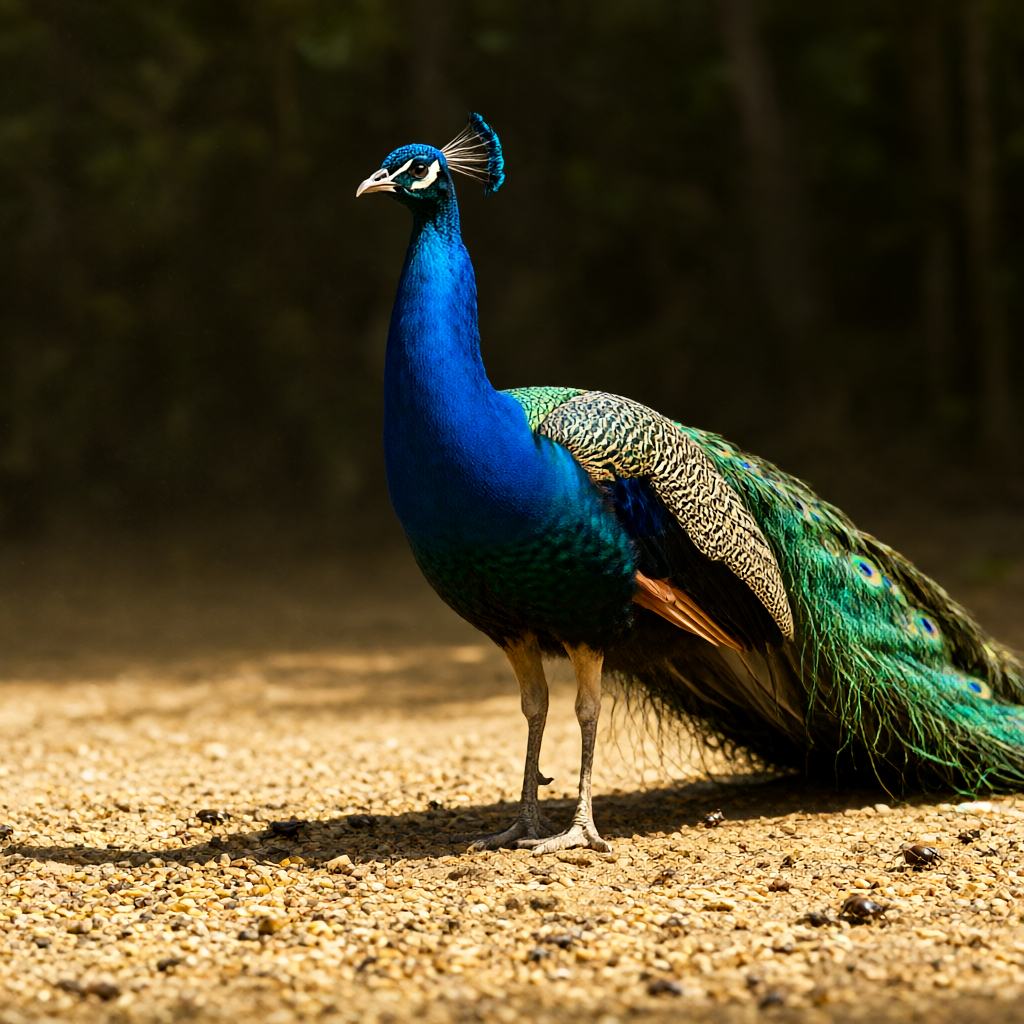
Tiny ridges bend the light, so shade shifts as the bird turns. A hen is smaller and plainer. Brown and grey feathers hide her against dry grass, while the cock advertises himself from far off.
Her dull coat costs little to build, yet it keeps her hidden in grass. Two birds of one species can look like two different species.
1
2
3
Woodland edge, never deep shade
The ground a peafowl needs
Forest and open woodland near water hold most wild birds. Tall trees give a safe roost at night, since a bird on a high branch has little to fear. Dawn finds them on the ground again.
Scrub, field edge and village garden all suit the bird, because it eats almost anything it can catch. Hilly country does not stop it, and neither does thin soil. People have carried the bird far past its native range.
Groups now live in parks on several continents where winters stay mild. A tame bird near a village loses its fear quickly, and it soon learns where grain falls. Wild or feral, the bird needs trees to sleep in and open ground to feed on.
Seeds, beetles and frogs
What the bird eats
Peafowl eat seeds, fruit, insects, small reptiles and amphibians. Because moving birds peck all day, none passes loose soil. Insects form much of the catch, since the bird hunts on foot. Small reptiles and frogs take more effort.
Running beats flying when a frog bolts for cover. Seeds and fruit keep the bird going when insects are scarce. Because the bird eats so widely, it can live beside people without much trouble. Seed passes through the gut and comes out ready to grow, so the bird plants what it eats.
The Capercaillie crops conifer needles, while this bird takes seeds, fruit and insects. Insects it takes carry pollen from flower to flower, though the bird never means to help.
The fan as a test
How a peacock wins a mate
Breeding brings the train into use. A cock shakes his long feathers, then fans them into a half circle wider than he is tall. Shaking makes a rustling sound, and the noise carries across open ground.
He struts while he keeps the fan between her and everything else. Hens walk round the display and look. Eye spots count.
A fan with more spots wins more mates, while size, symmetry and shine all count too. Hens pick the bird whose fan is largest, most even and most bright. That choice is sexual selection at work, and the train is the trait under it.
One bird safe, one bird in trouble
Conservation and status
The Indian peafowl is not globally threatened, and its numbers stay high across South Asia. Its relative, the green peafowl, sits in a far worse place. That bird is listed as Endangered, because forest and wetland in Southeast Asia keep shrinking. Hunting adds to the loss, and it hits the green bird hardest.
Work to save it centres on the wet forest and marsh that the bird needs. Drain a marsh and the birds leave for the next wet patch. India made the peacock its national bird. That choice shows how deeply the bird sits in local culture.
Persian cloth, Byzantine mosaic and Buddhist painting carry the same fan. Such status protects a bird that people could otherwise hunt without much thought. Common birds still need cover, water and a roost, and none of those survive without trees.
Side by side
How It Compares
| Trait | Peacock | Helmeted Guineafowl |
|---|---|---|
| Male mass | 4-6 kg | 1.3-1.6 kg |
| Display | 2 m fan of coverts | none |
| Plumage | blue neck, eyed fan | grey with white spots |
| Head | bare crown crest | bony casque |
| Range | South Asia native | Africa south of Sahara |
| Standing | Least Concern | Least Concern |
Common misreadings
What People Get Wrong
- Most visitors call the fan a tail, yet every one of those feathers grows from the back. The true tail sits behind the fan, and its short stiff quills merely hold it open.
- People assume the blue comes from pigment, though the feather holds no blue at all. Fine ridges in the barbs bend light, and the colour shifts as the bird turns.
- Many accounts say the bird shuns closed forest, yet it roosts in tall trees every night. It feeds on open ground by day and climbs before dark for safety.
Going further
Sources and Further Reading
Five things to remember
Quick hits
- Only the male grows the long fan.
- The shimmer comes from structure, not from pigment.
- Females lack the train entirely.
- Females judge the fan, not the bird.
- India treats the bird as a national symbol.
peacock belongs to a very different bird order. Its colours come from feathers, not from diet. Both birds