 By st20113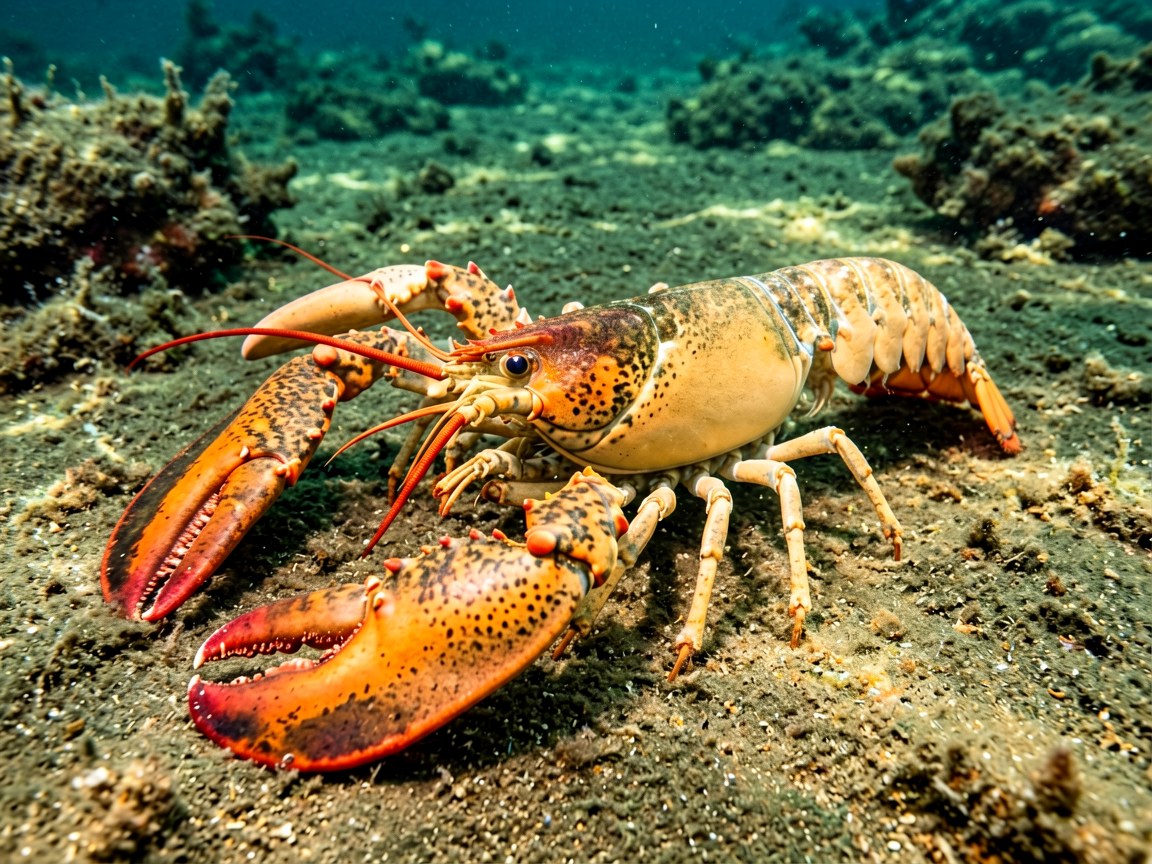
Nephrops norvegicus | Norway Lobster
Introduction
The Norway Lobster (Nephrops norvegicus)—better known on the plate as langoustine or scampi—is a slender, pale-orange lobster of the muddy seabed, prized across Europe as one of the finest shellfish. Typically 20–25 cm long, it is a burrowing, nocturnal crustacean that spends its days in a chimney-like tunnel in the silt and its nights prowling for food.
Though smaller and more delicate than the familiar clawed lobster, the Norway lobster supports some of the most valuable fisheries of the north-east Atlantic, and its story is bound up with the health of muddy seabeds and with the difficult business of fishing sustainably on the deep shelf.
Taxonomy
Nephrops norvegicus was described by Linnaeus in 1758; the genus name Nephrops means “kidney-eye” (for the kidney-shaped eye lobe), and norvegicus records its northern, Norwegian range. It belongs to the family Nephropidae, within the order Decapoda (“ten-footed”), the class Malacostraca, and the phylum Arthropoda.
Like the common mussel (Mytilus edulis), described in our article on Mytilus edulis (Common Mussel), the Norway lobster is a staple of European shellfish fisheries, though a crustacean rather than a bivalve mollusc. The two represent opposite ends of the shellfish world—one a stationary filter-feeder, the other an active, burrowing hunter—yet both end up on the same seafood tables.
Physical Characteristics
The Norway lobster has a slender, compressed body and a pale orange carapace, with long, slender claws (the first pair of legs) used for feeding and defence, and three pairs of walking legs behind. Its eyes sit on small lobes, and very long, paired antennae sweep forward as sensory whips. The tail fan (telson and uropods) is used for rapid backward escape.
Unlike the true clawed lobsters it is often confused with, it is more delicate and lighter in build, and the claws are slender rather than massively heavy. A mature animal reaches 20–25 cm, and the whole body is adapted to a life spent largely inside a burrow, darting out to seize prey and retreating at the first sign of danger.
Habitat
The Norway lobster lives on soft mud and muddy sand at depths of roughly 20–800 m across the north-east Atlantic, from Iceland and Norway south to the Mediterranean, wherever the sediment is fine enough to dig. It is a burrower, excavating a branching burrow with a raised chimney entrance in the seabed, and it is most abundant where vast muddy plains spread across the continental shelf.
It avoids hard rock and strong currents, and the extent of suitable muddy ground sets the map of the fishery: famous grounds include the Scottish west coast, the Irish Sea, and the Bay of Biscay. Because it depends on intact sediment, trawling that tears up the seabed can damage both its burrows and its food supply.
Diet
The Norway lobster is an omnivorous predator and scavenger, feeding on small crustaceans, worms, and other bottom invertebrates, and readily taking carrion and discarded fish. It forages mainly at night, emerging from its burrow to hunt and scavenge across the mud, and uses its claws to seize and manipulate food.
As both hunter and scavenger it helps run the ecology of the muddy floor, recycling dead organic matter and controlling populations of smaller invertebrates. In turn it is prey for fish such as cod and monkfish and for seals, and above all for humans, who take it in purpose-built trawls across its range.
Reproduction
Norway lobsters mate after the female has moulted and is soft-shelled, the male guarding her and transferring sperm; the female then carries a mass of eggs attached under her tail for many months until they hatch into tiny planktonic larvae. The young drift and develop through several stages before settling to the bottom and digging their first burrows.
This planktonic phase scatters the offspring widely but exposes them to heavy losses, so only a fraction reach the seabed. Fisheries are sustained by enough adults surviving to breed year after year, which is why management limits the catch and protects the muddy nursery grounds where the next generation starts life.
Conservation
The Norway lobster is heavily fished and is the target of some of Europe’s largest shellfish fisheries, managed through catch quotas, closed areas, and restrictions on gear. The main concern is not outright collapse but the damage of bottom trawling—both to the seabed and through bycatch of other species, including endangered rays and sharks.
Because it depends on healthy muddy habitat and on leaving enough breeders in the water, sustainable management emphasises protecting nursery grounds, reducing discards, and avoiding the most damaging trawl practices. Well-managed stocks can support a valuable fishery indefinitely, but the species is slow to recover once its seabed home is degraded.
Fun Facts
- On menus it is “langoustine” or “scampi,” and a single animal yields the tender tail meat prized by chefs.
- It digs a permanent burrow in the mud with a little chimney at the entrance, and defends it.
- It is mostly nocturnal, emerging from its burrow at night to hunt and scavenge.
- Its larvae drift in the plankton for months before settling and digging their first burrow.
- It is caught in trawls designed to skim the muddy seabed with minimal damage to the habitat.
[…] animal shares the order with the Norway Lobster. That animal has 2 large front claws. It digs a burrow in soft mud. Our animal has no large claws […]