 By st20113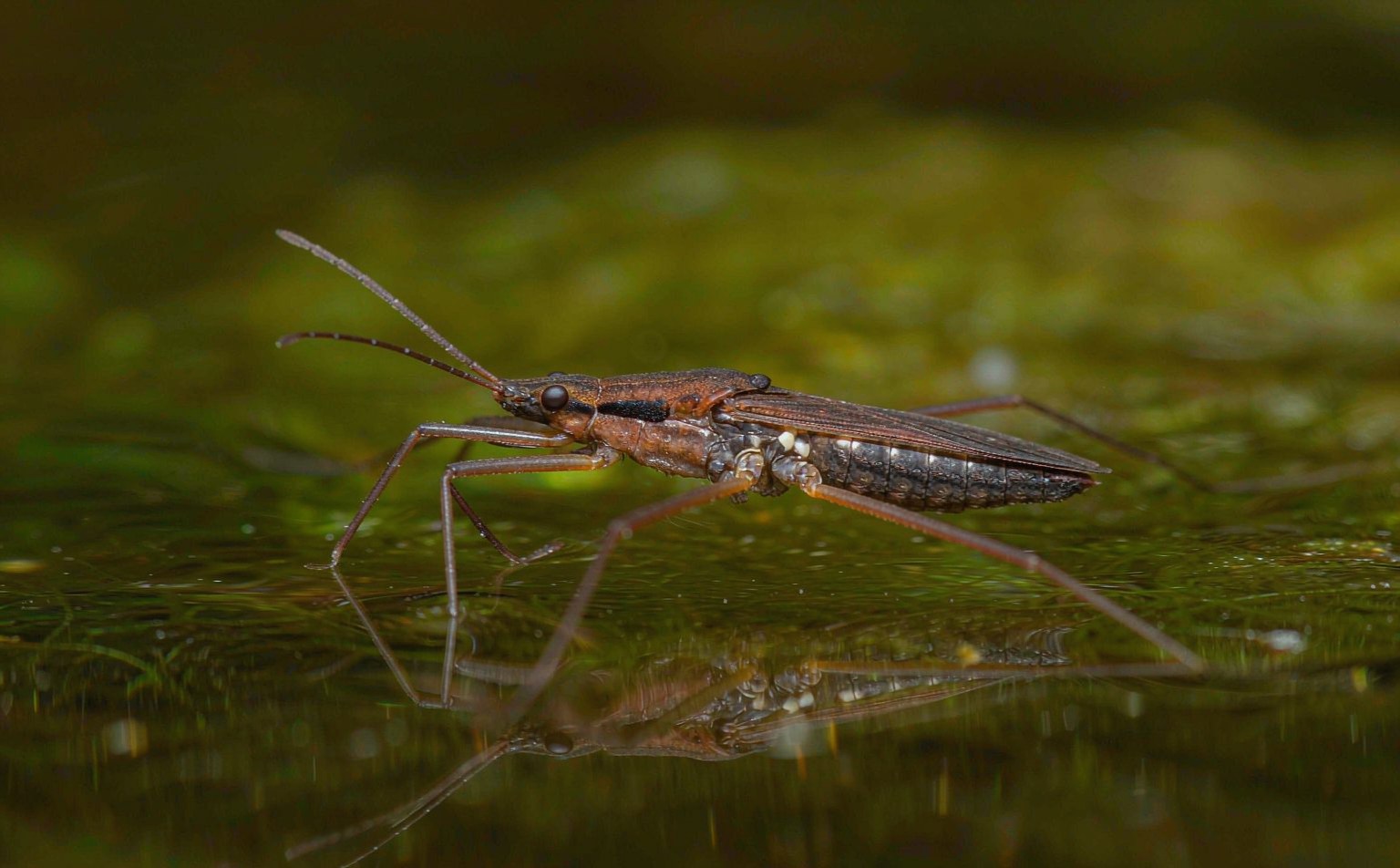
Gerris lacustris | Pond Skater
Introduction
The Pond Skater (Gerris lacustris), also called the common water strider, is a slender, long-legged bug that lives on the surface film of ponds, lakes and slow streams across Europe and much of the temperate world. It is famous for appearing to walk on water, skating across the skin of a pond in search of struggling insects. Its effortless glide and predatory dart are a familiar sight on any calm stretch of freshwater in summer.
A true surface-dweller, the Pond Skater never enters the water but exploits the tension at its boundary. Sensitive to the faintest ripple, it locates prey and mates by reading vibrations that travel across the meniscus, making it one of the most specialised inhabitants of the pond’s skin.
Taxonomy
The Pond Skater was described by Carl Linnaeus in 1758 and belongs to the genus Gerris within the family Gerridae, the water striders. The family is large and worldwide, but G. lacustris is among the commonest European species, recognised by its broad body and short front legs. It is an insect of the order Hemiptera, the true bugs.
In the freshwater community it shares the surface with other predators and prey, and its young develop alongside the larvae of the Common Frog. Adults are also found where the Smooth Newt and the Common Toad breed, feeding on the same small invertebrates that fall to the water.
Physical Characteristics
The Pond Skater is 8 to 16 millimetres long, with an elongate, flattened dark-brown or black body and a covering of fine water-repellent hairs. Its most striking feature is its legs: the middle and hind pairs are very long and slender, spreading its weight so it rests on the surface without breaking the film, while the short front legs are folded forward as grasping organs. The body is widest across the middle and tapers to a pointed rear.
The eyes are large and the antennae short. Specialised leg hairs trap air and repel water, and the middle legs act as oars while the hind legs steer. A dark stripe along the body and a slightly velvety sheen help identify it. The adult can also produce a faint scent when handled, a defence against predators.
Habitat
Pond Skaters inhabit still or slowly flowing fresh water: garden ponds, lakes, canals, ditches and the margins of rivers where the surface is sheltered from strong wave action. They need open water with some nearby vegetation for cover and for the arrival of terrestrial insects that fall in. They are absent from fast, turbulent streams and from heavily polluted water.
They are strong fliers and colonise new ponds readily, often appearing within a season of a pond being dug. In winter they shelter in bankside vegetation and leaf litter, becoming active again as temperatures rise in spring.
Diet
The Pond Skater is a carnivorous predator and scavenger of the water surface. It detects the struggles of drowning insects, small spiders and other arthropods that have fallen onto the film, and rushes over to pierce them with its slender proboscis, injecting saliva that liquefies the tissues before sucking them dry. It also takes mosquito larvae and other tiny prey trapped at the surface.
Far from being a passive filter, it is an active hunter that can tackle prey nearly its own size. By reading the ripples a victim makes, it pinpoints the source with precision, a neat example of vibration-based sensing in a world measured in waves.
Reproduction
Pond Skaters mate on the surface film in spring and summer. The female lays her eggs above the waterline on emergent plants, stones or the underside of leaves, where they are safe from aquatic predators. The nymphs that hatch are minute versions of the adult, already able to skate, and they pass through several moults before reaching full wing.
There may be one or two generations in a year in cooler climates. The young feed on the same surface prey as the adults and grow quickly through the warm months, joining the skating population that patrols the pond through late summer.
Conservation
The Pond Skater is widespread and common, with no conservation concern across its range. Its fortunes are tied to the health of small fresh waters: garden ponds, revived wetlands and unpolluted ditches all support healthy populations. Because it is sensitive to surface contaminants, it is a useful indicator of clean water.
The creation and care of garden ponds, the reduction of pesticide and herbicide runoff, and the protection of bankside vegetation all help maintain the pond-skater community. Leaving some open water free of blanket weed also gives the insects room to skate and hunt.
Fun Facts
- A Pond Skater literally stands on water, supported by surface tension rather than by floating.
- It “hears” with its legs, feeling the ripples made by struggling prey across the pond skin.
- The leg hairs are so water-repellent that the bug stays dry even in heavy rain.
- It can skate backwards as easily as forwards, steering with its long hind legs.
- Despite its delicate look, it is a bold predator that tackles insects its own size.