 By st20113
 The snow leopard (Panthera uncia) is one of the rarest and most elusive big cats on Earth. Inhabiting the harsh, remote mountains of Central Asia, this magnificent predator has evolved a suite of extraordinary adaptations that allow it to thrive in an environment few other large mammals can survive. Nicknamed the “ghost of the mountains,” the snow leopard moves through its icy realm with a quiet grace that has earned it deep reverence among the human cultures that share its habitat. Yet despite its iconic status, the snow leopard remains one of the least-studied of all the world’s big cats, its secretive nature making accurate population counts extraordinarily difficult.
If you are interested in high-altitude Himalayan wildlife, you may also enjoy reading about the Red Panda (Ailurus fulgens), another endangered species native to the same mountain ecosystems.
Scientific Classification
For many years, taxonomists debated the snow leopard’s relationship to other big cats. Molecular genetic studies have now confirmed that it belongs to the genus Panthera—the same genus as lions, tigers, jaguars, and leopards—but represents a distinct evolutionary lineage that diverged from the common ancestor of all Panthera species approximately 4.6 to 4.1 million years ago. This ancient lineage has led some researchers to argue that the snow leopard deserves its own genus, Uncia, though the scientific consensus currently favors Panthera uncia.
The snow leopard’s closest relative is the tiger (Panthera tigris), and genetic evidence suggests they share a common ancestor from which the snow leopard’s lineage split off as it adapted to high-altitude, cold environments. Despite sharing the genus with other roaring cats, the snow leopard cannot roar—a trait it shares with cheetahs—producing instead a distinctive, high-pitched yowl known as a “puff” sound when disturbed.
Physical Description
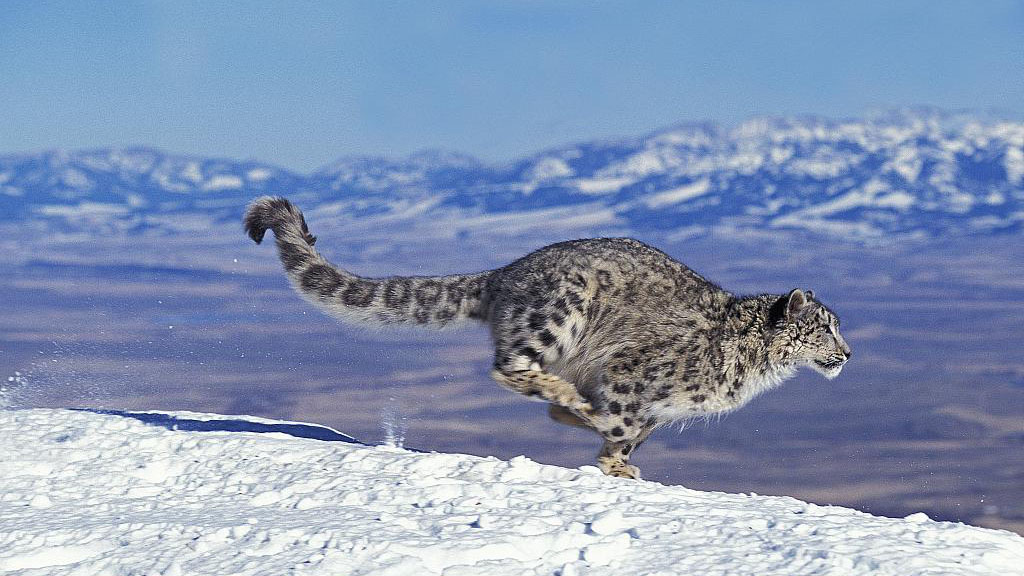
The snow leopard is a medium-sized big cat, with adults weighing between 22 and 55 kilograms and measuring 75 to 130 centimeters in body length, plus a tail of 80 to 100 centimeters. Its most distinctive feature is its extraordinarily long, thickly furred tail, which serves multiple vital functions: it provides counterbalance while navigating rocky terrain, can be wrapped around the body for warmth during freezing nights, and may even be used as a visual signal in communication with other leopards.
The snow leopard’s fur is pale gray to cream-colored, marked with irregular dark gray to black rosettes and spots that provide exceptional camouflage against the rocky, snow-dusted mountain backdrop. Its base fur is incredibly dense—possibly the densest of any cat—with up to 26,000 hairs per square centimeter, providing insulation against temperatures that can plunge below minus 40 degrees Celsius. The snow leopard’s eyes are a distinctive pale green or gray, an unusual color among big cats. Its small, rounded ears are framed by long, grizzled cheek ruffs that channel snow and wind away from the face and help muffle sound while stalking prey.
Its paws are broad and heavily furred, distributing the leopard’s weight over soft snow like natural snowshoes and protecting the footpads from sharp rocks and ice. The snow leopard’s nasal passages are unusually large, allowing it to breathe more efficiently at high altitudes where oxygen is scarce, and its chest capacity is proportionally larger than that of other Panthera cats, enabling greater oxygen intake during pursuits at altitude.
Habitat and Distribution
The snow leopard inhabits the high mountain ranges of Central Asia, ranging across 12 countries: Afghanistan, Bhutan, China, India, Kazakhstan, Kyrgyzstan, Mongolia, Nepal, Pakistan, Russia, Tajikistan, and Uzbekistan. Its range covers approximately 1.8 million square kilometers of alpine and subalpine zones, typically at elevations between 3,000 and 4,500 meters, though it has been sighted as high as 5,859 meters near Mount Everest.
These harsh, remote mountain ecosystems encompass alpine meadows, subalpine forests, and rocky terrain above the treeline. Snow leopards prefer terrain with rocky outcroppings and steep cliffs that provide denning sites and natural vantage points for spotting prey. Climate change is progressively shifting tree lines upward, compressing the snow leopard’s habitat and increasingly forcing it into closer contact with human settlements as livestock grazing pressures intensify at higher elevations.
Hunting and Diet
The snow leopard is a formidable apex predator capable of taking prey three to four times its own body weight. Its primary prey includes blue sheep (bharal), Himalayan tahr, argali wild sheep, ibex, marmots, and small rodents. In some regions, it supplements its diet with domestic livestock such as sheep, goats, horses, and yak—when wild prey becomes scarce, often due to overhunting by humans further down the mountainside.
Like other big cats, the snow leopard is an ambush predator, relying on stealth and the element of surprise rather than speed over distance. Its powerful limbs enable it to leap up to 15 meters horizontally and 6 meters vertically—extraordinary distances relative to its body size. After a successful hunt, a snow leopard may drag its kill to a secluded spot and feed from it over several days, returning to the carcass periodically. Its large nasal passages also help it detect carrion from considerable distances in the thin mountain air.
Behavior and Social Life
Snow leopards are predominantly crepuscular and nocturnal hunters, active during the dawn and dusk hours when their prey is most active and the temperatures are less extreme. They are largely solitary animals, with males and females coming together only during the breeding season. Each individual maintains a large home range that may span 12 to 40 square kilometers, with males’ territories typically overlapping the smaller ranges of two or three females.
Communication between snow leopards is achieved through scent marking, scrape marks, and vocalizations. The snow leopard’s characteristic “chuffle”—a short, puffing breath sound—is used by females in estrus and during mother-cub interactions. Like other big cats, they scrape the ground with their hind paws after marking territory, leaving visual and olfactory signals for other leopards. Cubs remain with their mothers for up to two years, learning to hunt and survive in one of Earth’s most demanding environments before dispersing to establish their own territories.
Conservation Status
The snow leopard is classified as Vulnerable on the IUCN Red List, with wild population estimates ranging from 4,000 to 6,500 individuals—a figure that is notoriously difficult to verify given the cat’s extreme elusiveness. Populations are believed to be declining across most of the species’ range, driven by a combination of habitat loss, declining prey base, human-wildlife conflict, poaching for fur and bones, and the impacts of climate change.
Perhaps the greatest immediate threat to snow leopards is retaliatory killing by herders whose livestock have been preyed upon. Compensation programs that reimburse herders for livestock losses have shown promising results in reducing conflict killings in several range countries. Organizations such as the Snow Leopard Trust and the World Wildlife Fund work with mountain communities across Central Asia to implement conservation strategies that protect both the leopard and the livelihoods of local people. International trade in snow leopard parts is banned under CITES Appendix I, but illegal poaching continues to threaten isolated populations.
Fun Facts
- The snow leopard’s tail is nearly as long as its body and contains exceptionally dense fat reserves, which the cat can live off of during particularly harsh winters.
- Unlike most other big cats, snow leopards do not roar. Instead, they produce a distinctive, haunting yowl and a puffing sound known as a “chuffle.”
- A snow leopard’s footprints in snow can measure up to 10 centimeters long—impressive traction for a predator navigating icy, vertical terrain.
- Local communities in Nepal and Tibet call the snow leopard “Sah” in Nepali and “Shan” in Ladakhi, words that reflect deep cultural respect for this mountain guardian.
The snow leopard embodies the wild, untamed spirit of the high mountains like no other creature on Earth. Protecting this remarkable cat means protecting an entire ecosystem—one of the last truly wild places on our planet.
lion, Panthera leo, of the savannas. Closer relatives adapted to cold mountain habitats include the snow leopard, Panthera uncia, while the open plains are home to the supremely fast cheetah, Acinonyx