 By st20113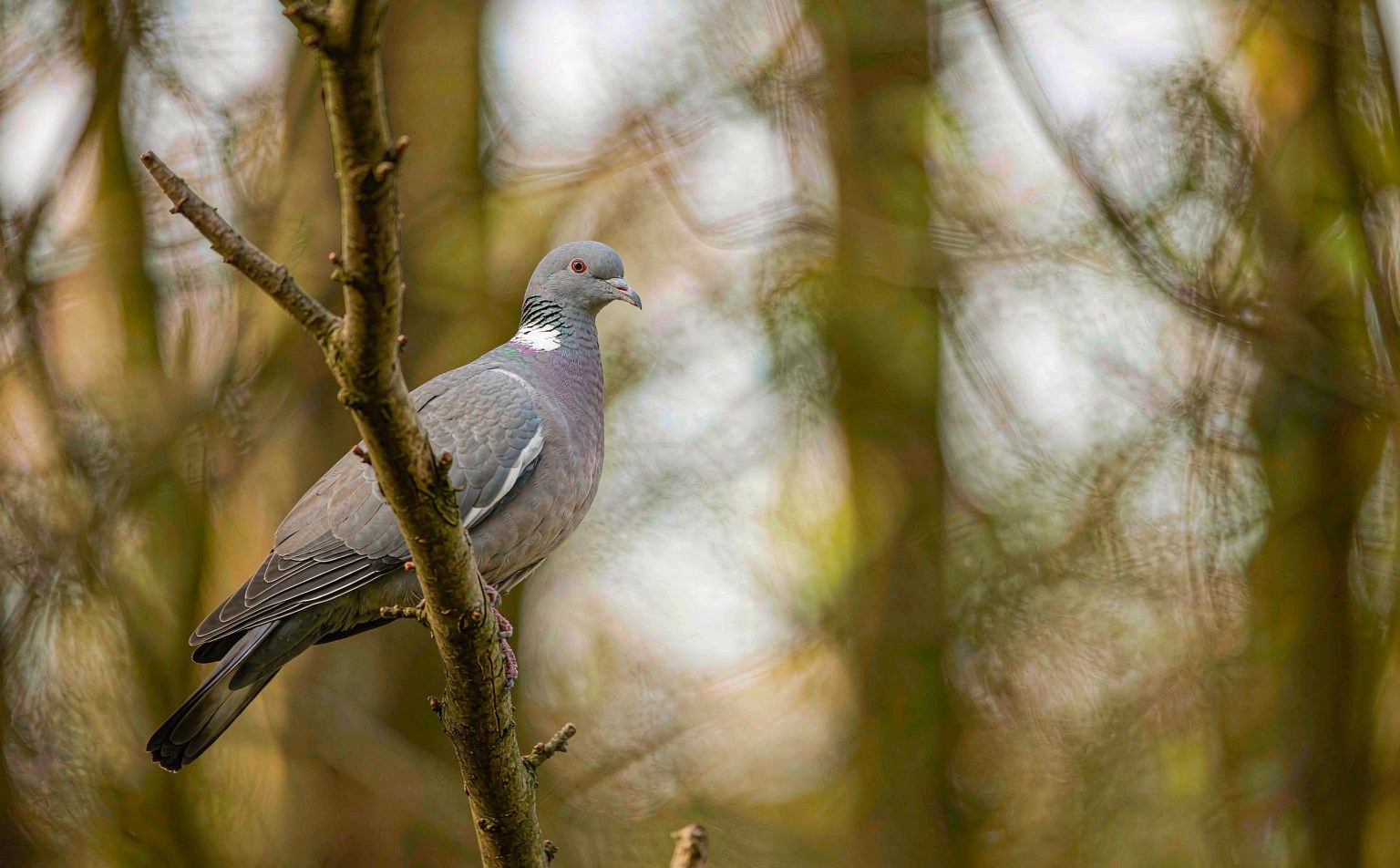
Columba palumbus | Common Wood Pigeon
Introduction
The Common Wood Pigeon (Columba palumbus) is the largest and most widespread member of the pigeon and dove family found across Europe. A familiar sight in woodlands, parks, gardens, and farmland, it is easily recognised by its plump body, broad wings, and the striking white neck patch that flashes as the bird shifts position. Unlike the smaller, more secretive pigeons of dense forest, the wood pigeon thrives close to human settlement and has become one of the most numerous birds in many European towns.
Its loud, rhythmic cooing is a characteristic sound of the countryside, often carrying across fields at dawn and dusk. The species is highly adaptable, feeding on seeds, leaves, and berries, which has allowed it to expand its range and numbers even as some other farmland birds have declined. For readers interested in other woodland birds, the Common Blackbird shares many of the same habitats.
Taxonomy
The Common Wood Pigeon belongs to the genus Columba, which includes the typical pigeons, and the family Columbidae. It was first formally described by the Swedish naturalist Carl Linnaeus in 1758 in the tenth edition of his Systema Naturae, where he assigned it the binomial name still used today. Within its genus, it is most closely related to other Eurasian pigeons such as the stock dove and the rock dove, the ancestor of the domestic pigeon.
Several subspecies are recognised across its broad range, differing slightly in size and the tone of their plumage. The nominate form, Columba palumbus palumbus, occupies most of Europe, while others extend into North Africa and western Asia. Genetic studies confirm that the wood pigeon forms a tight cluster with its close relatives, separate from the smaller Streptopelia doves such as the collared dove.
Physical Characteristics
An adult Common Wood Pigeon measures between 38 and 44 centimetres in length, with a wingspan of roughly 68 to 80 centimetres, making it noticeably larger than the collared dove and roughly comparable in bulk to a feral pigeon. The body is rounded and heavy, supported by short pinkish-red legs. The plumage is generally slate grey across the head and underparts, with a pinkish breast that gives the bird a soft, muted appearance.
The most distinctive marking is the white patch on either side of the neck, bordered by a thin crescent of iridescent green or purple feathers. In flight, the wood pigeon reveals broad, pale grey wings crossed by a single bold white bar, and a dark band along the trailing edge of the tail. The bill is yellowish at the tip with a small white cere at its base, and the eye is a deep orange-red surrounded by a narrow pale ring.
Juvenile birds lack the clean white neck patches and show a browner, more uniform plumage, only acquiring adult markings after their first moult. Despite their size, wood pigeons are strong, fast fliers, capable of rapid take-off with a loud clatter of wings produced by the beating primaries.
Habitat
The Common Wood Pigeon occupies an exceptionally wide range of habitats. It favours deciduous and mixed woodland, particularly where tall trees provide nesting sites and open ground below offers feeding opportunities. Historically a bird of mature forests, it has colonised agricultural land, orchards, town parks, churchyards, and suburban gardens, often nesting in ornamental conifers and broadleaved trees close to houses.
In rural landscapes it is commonly found along hedgerows, field margins, and shelterbelts, where it moves between feeding areas and roosting woods. During winter, flocks gather in sheltered valleys and lowland forests, sometimes joining other pigeon species. The species is tolerant of cold and occurs from sea level to subalpine woodland, though it generally avoids treeless steppe and intensively managed arable land without nearby trees.
Diet
Wood pigeons are primarily vegetarian, though they will occasionally take small invertebrates, especially when feeding young. Their staple foods are plant matter: seeds of agricultural crops such as wheat, barley, maize, and oilseed rape form a major part of the diet in farmland areas. They also eat clover, weeds, buds, shoots, and the leaves of brassicas, which sometimes brings them into conflict with gardeners and farmers.
In autumn and winter the diet shifts toward berries and fallen fruit, including those of ivy, hawthorn, holly, yew, and orchard trees. The bird swallows grit and small stones to help grind food in its muscular gizzard, a common adaptation among seed-eating birds. Like other pigeons, it can drink by immersing its bill and sucking water directly, rather than tilting its head back as most birds do.
Reproduction
Breeding begins early in the year and may continue through to late autumn in mild regions, allowing two to three broods per season. The nest is a flimsy platform of twigs, loosely woven and often so thin that the single egg can be seen from below. It is placed on a branch, in a fork, or against a trunk, sometimes in conifers but frequently in deciduous trees.
Both sexes share incubation of the one or two white eggs, which lasts about 17 days. The chicks are fed a protein-rich secretion known as crop milk, produced in the parents’ crop, alongside regurgitated seeds. Young fledge at roughly 33 to 37 days but remain dependent on the adults for a short period afterward. The extended breeding season, combined with multiple broods, helps the species maintain high populations despite significant hunting pressure in some countries.
Conservation
The Common Wood Pigeon is classified as a species of Least Concern by the International Union for Conservation of Nature. Its overall population is large, widely distributed, and, in many regions, increasing. The expansion of planted woodlands, the abundance of agricultural seed, and the growth of suburban greenery have all favoured the bird across much of its range.
Local pressures include legal shooting during the hunting season in several European nations, and occasional control measures where flocks damage crops. These are not considered to threaten the global population. The species’ adaptability and high reproductive output mean it is well buffered against habitat change compared with more specialised woodland birds such as the Great Tit or the Common Chaffinch, both of which depend on more specific nesting conditions.
Fun Facts
- The wood pigeon’s familiar five-note coo is often written as “take two cows, take two cows”, and is produced by the male to defend territory and attract a mate.
- Unlike most birds, pigeons can drink by sucking continuously with their bill submerged, rather than scooping and tipping their head back.
- A nesting wood pigeon may raise as many as three broods between early spring and late autumn in a single year.
- The white neck patch looks like a single patch when viewed from the side but is actually one on each side of the neck.
- Juvenile wood pigeons are browner and lack the adult’s white neck markings until they moult into their first adult plumage.