 By st20113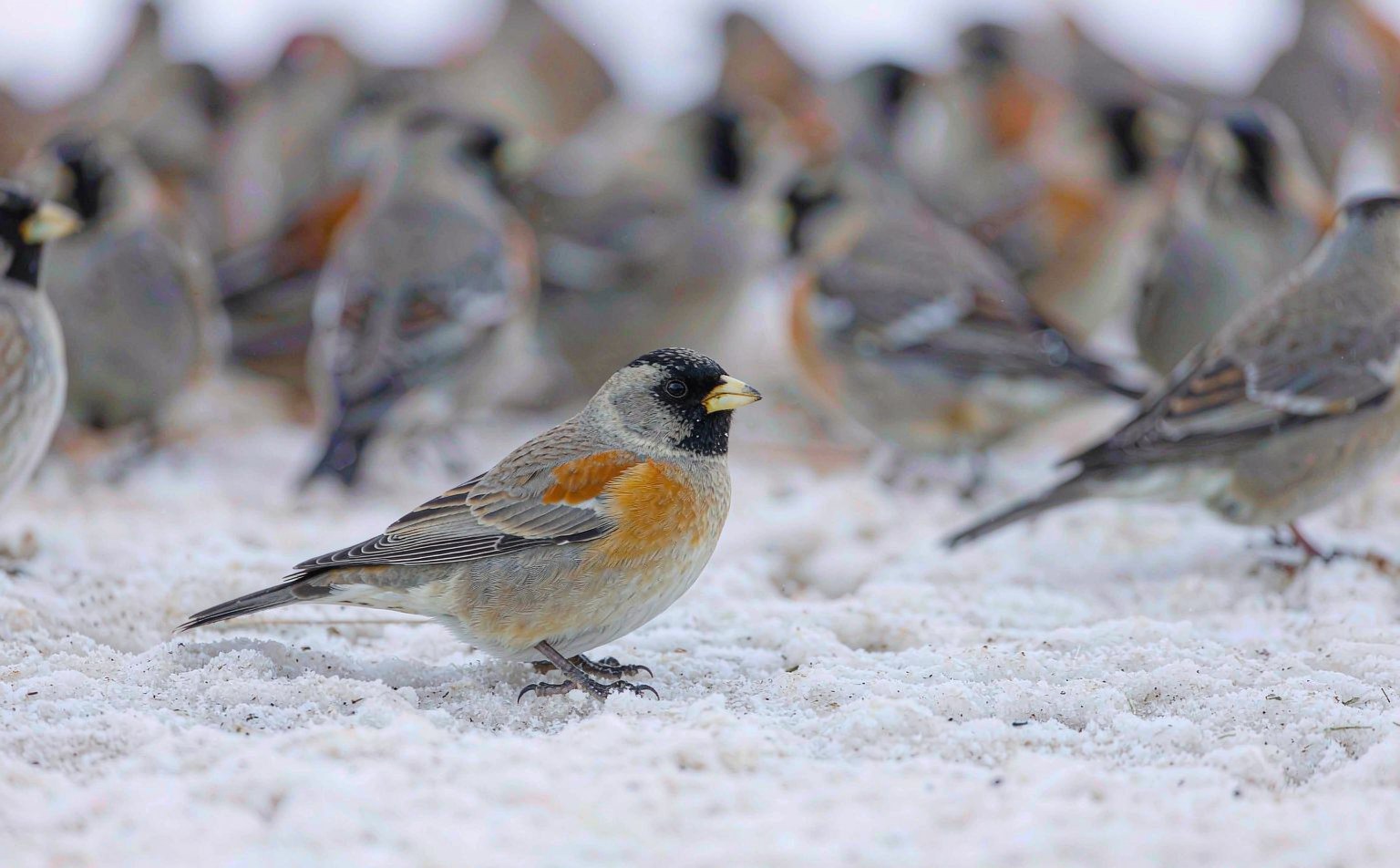
Fringilla montifringilla | Brambling
Introduction
The brambling, Fringilla montifringilla, is a small migratory finch of the northern forests, closely related to the chaffinch yet distinct in its autumn colours and breeding ecology. In summer it inhabits the birch and conifer woods of subarctic Eurasia; in winter it descends in huge flocks to farmland and beech woods of central and western Europe. A flash of orange on the shoulder and a white rump in flight make it one of the most attractive winter visitors to European fields.
Often encountered in mixed flocks with chaffinches and other finches, the brambling is celebrated by birdwatchers for the enormous, chattering concentrations it can form at productive feeding sites.
Taxonomy
Fringilla montifringilla was described by Carl Linnaeus in 1758 and is the only species in its genus besides the chaffinches. It is most closely linked to the Common Chaffinch and the European Goldfinch, all members of the diverse family Fringillidae. The genus name Fringilla is the classical Latin term for a small finch.
Physical Characteristics
An adult brambling is 14–16 cm long with a wingspan of 25–28 cm and a weight of 20–29 g. In breeding plumage the male shows a black head, warm orange breast and shoulders, and a white belly, while the back is dark with pale streaks. A key identification feature in all plumages is the bright white rump, visible in flight, and the orange bar on the shoulder.
The bill is yellowish in winter, darkening to blackish in the breeding season. Females and first-winter birds are duller, with brownish heads and streaked underparts, but they retain the white rump and orange wing patches. The flight is undulating and flock-bound, typical of finches.
Habitat
During the breeding season bramblings occupy the boreal and subalpine forest belt, favouring open birch woodland and the edges of coniferous taiga, often near wetlands or forest clearings. In winter they move south and west to arable land, stubble fields, beech and hornbeam woods, and orchard edges, where they forage on the ground in large restless flocks.
They are highly nomadic within the winter range, shifting in response to food availability, particularly the mast crops of beech and hornbeam. Proximity to both open feeding ground and woodland roost sites structures their winter distribution.
Diet
The brambling is primarily a seed-eater. In summer it takes insects and larvae, especially to feed nestlings, but for most of the year it relies on seeds — of birch, alder, and grasses in the north, and of beech, hornbeam, and arable weeds in winter. Flocks can cause noticeable depletion of spilt grain and seed crops in farmland.
Foraging is almost entirely terrestrial, with birds hopping and scratching through leaf litter and snow to reach seeds. The strong, conical bill is well suited to cracking hard seeds, and the species’ movements are largely dictated by the location of abundant mast.
Reproduction
Bramblings nest in the northern forest zone, building a cup of lichen, moss, and grass, lined with feathers, usually low in a birch or conifer. The female lays five to seven pale blue eggs speckled with brown and incubates them for about twelve days. Both parents feed the chicks, which fledge after roughly two weeks.
A single brood is typical, timed to the brief subarctic summer. The species’ breeding success is closely tied to the abundance of caterpillars and other insects available when chicks are growing, as well as to the condition of the boreal forest habitat.
Conservation
Listed as Least Concern, the brambling remains abundant across its vast range, though its numbers fluctuate markedly with beech mast cycles and the extent of suitable boreal breeding habitat. Climate-driven changes to northern forests and agriculture could affect both breeding and wintering grounds over time.
Because it depends on natural seed crops and insects, the brambling benefits from the preservation of mature beech woods and the maintenance of semi-natural farmland with weedy field margins. Continued monitoring of winter flocks helps track population trends across Europe.
Fun Facts
- The brambling’s white rump flashes conspicuously as the flock twists in flight.
- Its scientific name pairs Fringilla (finch) with montifringilla, “mountain finch.”
- Winter flocks can number in the tens of thousands during a good beech-mast year.
- Males turn almost entirely black-headed and orange in breeding plumage.
- It is the closest relative of the familiar chaffinch, despite looking quite different in winter.