 By st20113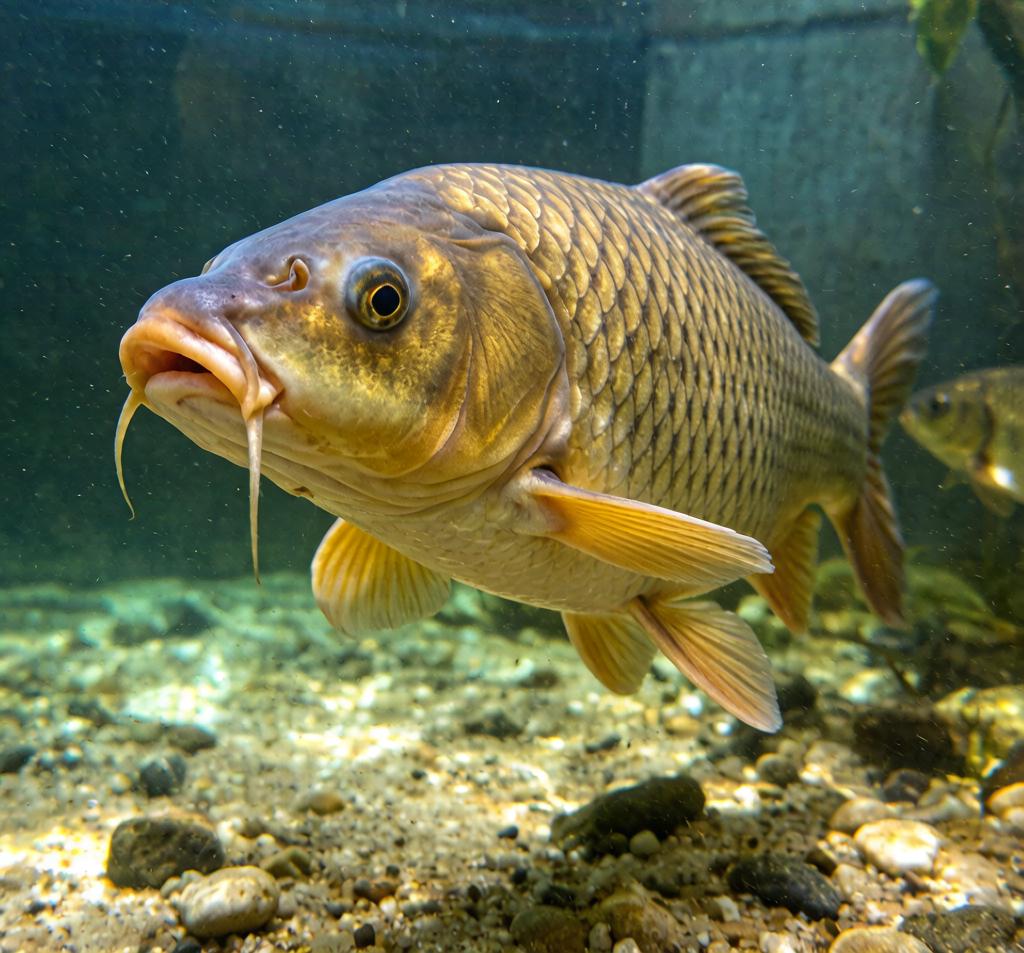
Introduction
The common carp is one of the most widely cultivated and ecologically significant freshwater fish in the world, native to Asia but introduced across Europe for food and sport over centuries.
Its characteristic deep body, large scales, and barbels around the mouth make it unmistakable in European lakes and slow rivers, where it can live more than 40 years.
An omnivorous bottom feeder, it shapes aquatic plant communities and nutrient cycles through its rooting behaviour, profoundly influencing entire lake ecosystems.
Like the tench and the northern pike, it is a cornerstone of European freshwater ecology and fisheries.
Its presence affects water clarity, plant growth, and the abundance of other fish species across its vast introduced range.
Taxonomy
The common carp belongs to the family Cyprinidae, the largest family of freshwater fish, containing more than 3,000 species across Asia, Europe, Africa, and North America.
Its scientific name Cyprinus carpio comes from the Greek and Latin, both meaning carp, and was formally described by Linnaeus in 1758 as one of the founding species of modern ichthyological taxonomy.
The genus Cyprinus contains approximately 20 species, with the common carp being the most widespread and ecologically influential.
Three subspecies are recognized: the wild European carp, the Eastern carp, and the domesticated koi form selectively bred over centuries.
Physical Characteristics
The common carp is a large, deep-bodied fish, with wild specimens typically reaching 60 to 90 centimetres in length and weighing 4 to 12 kilograms.
The body is covered in large, heavy scales arranged across 35 to 38 lateral line scales, and wild-type colouration is a warm golden-brown on the back and flanks.
The subterminal mouth bears two pairs of sensitive barbels used for detecting food in substrate, and the dorsal fin is long and slightly convex with a serrated first spine.
Domestication has produced scale variants including fully scaled, leather-skinned, and mirror carp with irregular scale arrangements.
Habitat
The common carp is native to temperate freshwater systems across Europe and Asia, favouring large, shallow, well-vegetated lakes, oxbow lakes, floodplain ponds, and slow rivers.
It thrives in eutrophic waters with warm summer temperatures where its omnivorous feeding habit and tolerance of low oxygen levels allow it to outcompete many other fish.
Dense beds of submerged plants provide spawning substrate and refuge for juveniles, while open muddy areas offer foraging grounds.
Introduced populations have established across North America and Australia, where they are considered invasive due to their habitat-modifying feeding behaviour.
Diet
The common carp is a versatile omnivore whose feeding ecology has a profound impact on the structure and function of freshwater ecosystems.
Primary feeding involves rooting through soft bottom sediments with its barbels, extracting chironomid larvae, worms, bivalves, crustaceans, and detritus rich in microorganisms.
Its rooting behaviour turbates bottom sediments, releasing nutrients into the water column, increasing turbidity, and altering the structure of aquatic plant communities.
Juveniles feed primarily on zooplankton and benthic invertebrates, shifting to adult omnivory as they grow.
Reproduction
Reproduction in the common carp is tied to seasonal flooding and warming water temperatures, with spawning typically occurring in spring or early summer.
A single large female may be followed by multiple males in elaborate spawning events, releasing 300,000 to 1.5 million eggs that stick to submerged vegetation.
Hatching occurs within three to eight days, with larvae initially absorbing their yolk sac before becoming free-swimming.
Growth is rapid in warm, productive waters, with juveniles reaching 15 to 30 centimetres in their first year.
Conservation
The common carp is assessed as Least Concern globally, with a vast native range and a global population including huge numbers of farmed and stocked individuals.
In its native European range, habitat protection and sustainable fisheries management that maintain natural genetic diversity are primary priorities.
Across North America and Australia, where it has been introduced, the common carp is considered invasive due to habitat-modifying feeding behaviour.
Captive breeding programs have been developed for ornamental koi strains, while management plans for wild carp focus on protecting floodplain connectivity.
Fun Facts
The common carp was one of the first fish species to be domesticated by humans, with records of carp cultivation dating back more than 2,000 years.
Ornamental koi carp selectively bred for colour and pattern can fetch prices of thousands of euros for individual show-quality specimens.
In the wild, carp can live more than 40 years and exceed 25 kilograms, with the oldest known individual reaching 65 years of age.
Their rooting behaviour, often considered a nuisance, creates and maintains a mosaic of open muddy patches and vegetated areas that benefits a wide range of other aquatic species.