 By st20113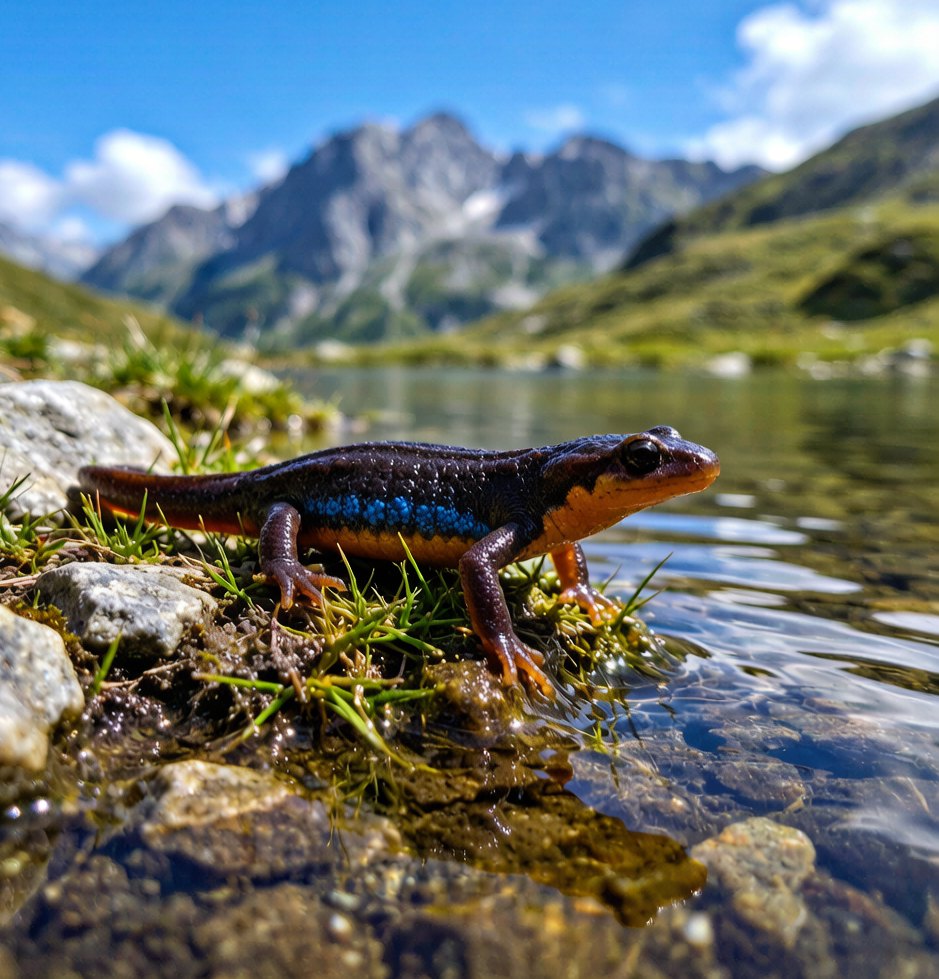
Introduction
The Alpine Newt (Ichthyosaura alpestris) is a colorful montane newt found across the hills and mountains of central and southern Europe, from the Pyrenees to the Balkans. Famous for the brilliant blue flanks and crested back of breeding males, it is one of the most attractive European amphibians and a favorite subject of pond naturalists. Like other newts it leads a double life, splitting the year between aquatic breeding habitat and terrestrial woodland shelter, and its larvae are vulnerable to stocked fish such as the goldfish.
Taxonomy and Evolution
The Alpine Newt belongs to the family Salamandridae, the true salamanders and newts, and is the sole species of the genus Ichthyosaura. It was formerly placed in the large genus Triturus until genetic studies in the 2000s confirmed its distinct status. Several subspecies are recognized across its range, differing in size and coloration. The genus name Ichthyosaura means fish lizard, referring to its fish-like aquatic form during the breeding season. Its closest relatives are the crested newts of the genus Triturus, from which it diverged during the Miocene.
Physical Characteristics
Alpine newts measure 7 to 12 cm in total length, with males larger and more ornate than females. In the breeding season males develop a continuous wavy crest along the back and tail, and their flanks turn a vivid blue with black spots, while the belly is orange-red. Females are duller brown or olive with smaller spots and no crest. Outside the breeding season both sexes revert to a subdued terrestrial eft form, brown above with a yellow-orange belly. The skin is smooth and the tail is laterally compressed for swimming, with a fine dorsal fin along the crest in males.
Habitat and Distribution
Alpine newts occupy mountain lakes, ponds, and slow streams from low hills up to 2,500 m elevation, favoring cool clear water with abundant vegetation. After the breeding season they disperse into adjacent woodland, meadows, and rocky terrain, where they hide under logs, stones, and leaf litter. Their range spans the Pyrenees, Massif Central, Alps, Apennines, Carpathians, and Balkans. They require both aquatic breeding sites free of fish predation and terrestrial habitat rich in cover for the long non-breeding period, making them sensitive to pond stocking.
Diet and Feeding Behavior
In the aquatic phase, adults and larvae feed on small crustaceans such as daphnia and cyclops, insect larvae, and tadpoles, capturing prey with a quick flick of the tongue or a snap of the jaws. Terrestrial efts prey on small invertebrates including slugs, worms, springtails, and mites found in leaf litter and soil. They are sit-and-wait predators that ambush passing prey. In captivity they readily take provided live food, but in the wild their diet shifts with the season and habitat as they move between water and land through the year.
Reproduction and Life Cycle
Alpine newts migrate to breeding ponds in spring. Males perform an elaborate courtship display, waving the tail to waft pheromones toward the female before depositing a spermatophore that she picks up with her cloaca. Females lay 100 to 300 eggs individually, folding each into the leaf of an aquatic plant for protection. Larvae hatch in 2 to 3 weeks and metamorphose after 3 to 4 months, though some high-altitude populations may overwinter as larvae. Sexual maturity is reached at 2 to 3 years, and adults return to water each spring with remarkable precision.
Conservation Status
Listed as Least Concern but with localized declines across its range. Major threats include the stocking of breeding ponds with fish that eat eggs and larvae, drainage and pollution of mountain water bodies, and habitat degradation from forestry and recreation. In some lowland parts of its range it has disappeared entirely. Because it requires both aquatic and terrestrial habitats, landscape fragmentation is particularly damaging, and terrestrial adults are taken by the red fox and hedgehogs. Protected under various national amphibian laws, with pond restoration and fish removal used as conservation tools.
Fun Facts
Alpine newts make a remarkable annual migration between their terrestrial hiding places and breeding ponds, sometimes traveling hundreds of meters over land to return to the same water body each spring. In cold high-altitude lakes they may remain larval for more than a year, a strategy called paedomorphosis that lets them breed without completing metamorphosis. Breeding males can change color within days as hormones trigger the blue flank and crest development. Their skin can absorb oxygen directly from water, allowing them to remain submerged for long periods during the aquatic phase.