 By st20113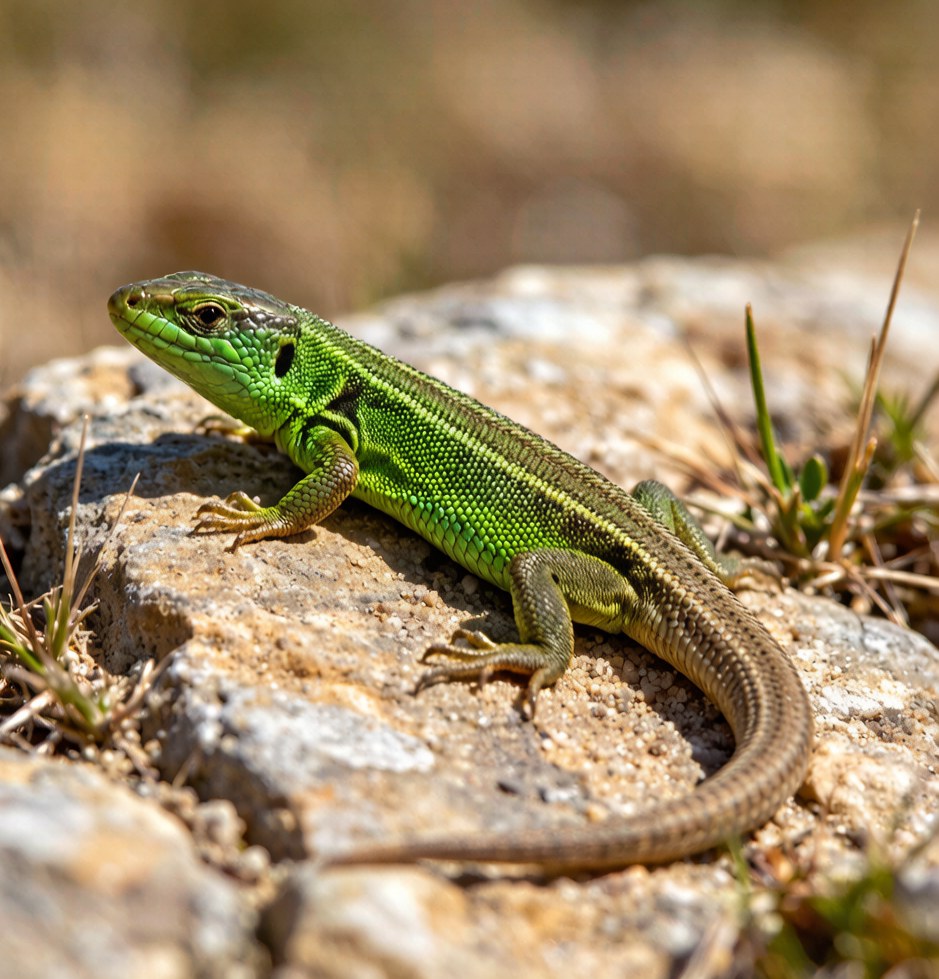
Introduction
The Sand Lizard (Lacerta agilis) is one of the most striking reptiles found in Europe and the only lizard species widely distributed across the British Isles, where it survives in a handful of isolated heathland populations. The males display vivid emerald green flanks during the breeding season, transforming what might appear to be a dull brown lizard into one of the continent’s most colourful vertebrates. This seasonal transformation is one of the most dramatic colour displays of any European reptile and has
Taxonomy
Scientifically classified as Lacerta agilis within the family Lacertidae, the family of true lizards, the Sand Lizard belongs to the order Squamata which encompasses all lizards and snakes. The genus Lacerta contains over 40 species of lacertid lizards found across Europe, Asia and Africa, with the Sand Lizard representing one of the most widespread and northerly distributed members of this genus. Several subspecies are recognised across its wide range, with subspecies in Britain, southern Europe and various populations in between showing subtle
Physical Characteristics
Adult Sand Lizards typically measure 18 to 22 centimetres in total length, with the tail accounting for about two-thirds of this measurement. Males in breeding condition display brilliant emerald green flanks and sides, a pattern that is largely absent outside the breeding season when both sexes become more uniformly brownish. The dorsal surface is brownish with lighter stripes or rows of spots, often forming distinctive parallel lines running along the body. The scales are keeled, giving the skin a slightly rough texture
Habitat
Sand Lizards are strongly associated with open, sunny habitats that provide both abundant basking sites to raise their body temperature and nearby shelter from predators. Key habitats include lowland heathland, coastal sand dunes, rocky south-facing slopes, woodland clearings and railway embankments. They require loose, sandy or friable soil in which to dig their burrows, and they are particularly associated with areas that combine open sandy patches ideal for egg-laying with nearby dense heather or scrub vegetation for cover. In Britain, Sand Lizards
Diet
The Common Lizard (lizard-lacerta-agilis) is the widespread close relative with which the Sand Lizard shares many ecological traits and habitats. As an opportunistic predator of invertebrates, the Sand Lizard feeds primarily on large insects such as beetles, grasshoppers, caterpillars and moths, as well as spiders, earthworms and other soil invertebrates. Prey is typically located by sight and captured with a quick lunge followed by a rapid swallow. Larger individuals may occasionally take small vertebrates including nestling lizards, and cannibalism has been documented
Reproduction
Sand Lizards mate in April and May following emergence from winter hibernation, with males engaging in ritualized combat dances to establish dominance and win access to receptive females. Rival males rear up on their hind legs and attempt to wrestle each other to the ground, interlocking jaws and grappling until one individual retreats. Females lay between three and fourteen eggs in a shallow burrow excavated in loose sandy soil in June or July, covering them carefully with substrate before departing. Eggs incubate
Conservation
The Sand Lizard is classified as Least Concern globally, but it is listed as an endangered or protected species in several northern European countries where it has declined significantly from its historical range. In Britain, the Sand Lizard is listed as a Priority Species under the UK Biodiversity Action Plan and populations are the subject of intensive conservation management. The primary threats include the loss of heathland and sand dune habitats to development, agricultural intensification, afforestation with conifers, and outdoor recreation. Conservation
Fun Facts
Sand Lizards are accomplished burrowers that can rapidly disappear into loose sand within seconds when threatened by predators such as birds and mammals. They achieve this by undulating their body from side to side while pressing against the sand with their keeled scales, effectively swimming into the substrate. During the breeding season, rival males engage in spectacular physical combat, with individuals interlocking their jaws and wrestling each other to establish dominance. The vivid green flank coloration displayed by breeding males is thought
[…] the breeding season, males develop bright blue throats, enhancing their striking appearance. The sand lizard is a smaller relative found in similar […]
[…] The species has smooth scales and a relatively flat head adapted for hiding in crevices. The sand lizard is a larger relative with more spiny […]
[…] European glass lizard coexists with the sand lizard across southern European habitats, with both species occupying Mediterranean […]