 By st20113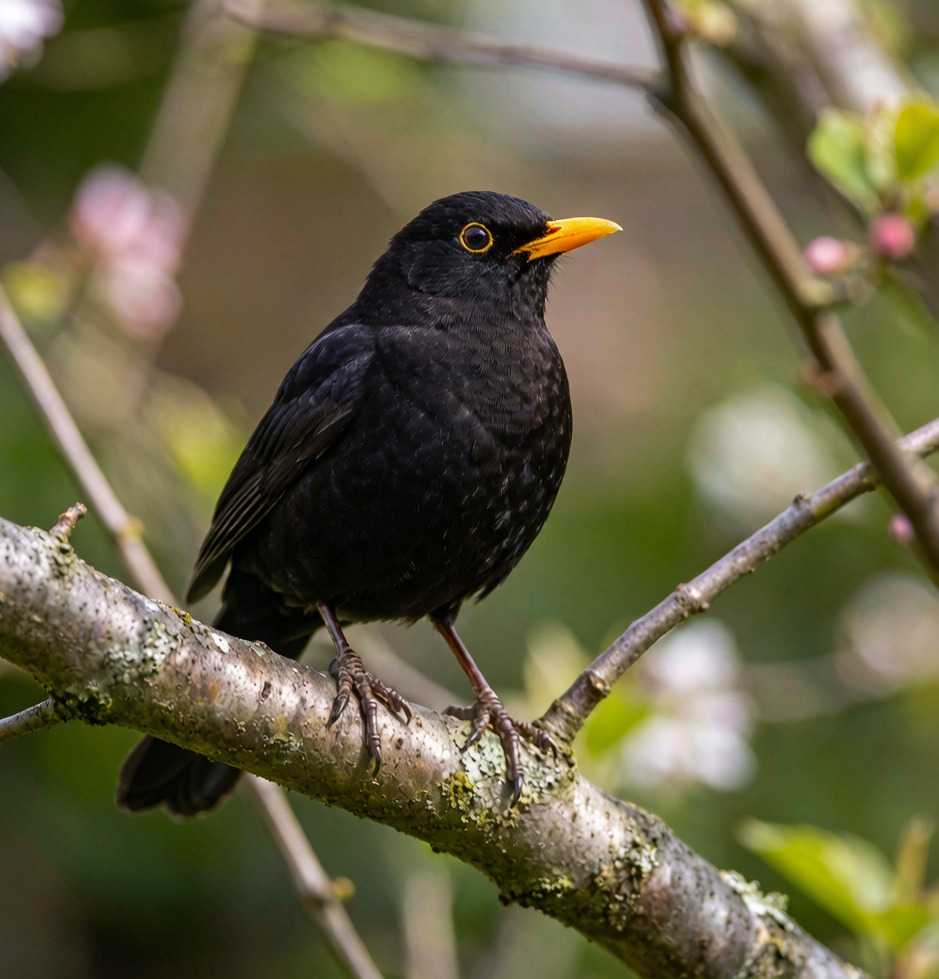
Introduction
The Blackbird (Turdus merula) is one of the most familiar and widely distributed birds in Europe and parts of Asia and North Africa. The male’s jet-black plumage and bright orange bill make it unmistakable, while its rich, melodious song is a staple sound of gardens, woodlands, parks and hedgerows across its range. The Blackbird has been celebrated in poetry, literature and music for centuries, and its arrival in spring has been noted by observers of nature throughout Europe, making it one of
Taxonomy
Belonging to the family Turdidae, the family of true thrushes, the Blackbird is classified as Turdus merula within the genus Turdus, a genus that contains about 80 species distributed across the world. Its closest relatives include the Song Thrush (Turdus philomelos) and Redwing (Turdus iliacus), with which it sometimes hybridises where their ranges overlap. The genus Turdus contains some of the world’s most familiar songbirds, including the American Robin (Turdus migratorius). The Blackbird is considered a member of a group sometimes called
Physical Characteristics
The adult male Blackbird is uniformly jet black with a distinctive bright orange to yellow-orange bill and a narrow ring of pale eyering that contrasts sharply with the black facial plumage. The legs are dark brown to black, and the inside of the mouth is yellow. Females are more cryptically coloured, with dark brown upperparts, paler underparts with faint streaks and spots, and a duller brownish bill. Juveniles resemble females but are more rufous above with lighter streaking. The species is medium-sized
Habitat
Blackbirds occupy a remarkably broad range of habitats, from dense woodlands and scrub to gardens, parks and hedgerows. They are strongly associated with areas of moist, loose soil where they can forage for earthworms and other invertebrates using their well-developed sense of sight. In urban areas, they have adapted remarkably well to parks and gardens, often becoming bold enough to feed in close proximity to humans and even to nest on building ledges and in hanging baskets. The Blackbird prefers areas with
Diet
The Blackbird is an omnivore with a diet that shifts dramatically with the seasons and local food availability. In spring and summer it feeds primarily on earthworms, snails, caterpillars, beetles and other invertebrates, which it locates by sight on the ground, often flicking aside leaf litter and soil with its bill. In autumn and winter, fruit and berries become increasingly important in the diet, including rowan berries, hawthorn berries and fallen apples. The Blackbird is a significant disperser of many wild and
Reproduction
Blackbirds typically raise two to three broods per breeding season, with the first nests often built in March or April following a period of singing by males to establish territories. The nest is a substantial cup of grass, leaves and mud, usually placed in dense vegetation, a hedge, a climbing plant on a wall, or even a building ledge. The clutch of three to five eggs is incubated by the female alone for about 13 to 14 days. Both parents feed the
Conservation
The Blackbird is classified as Least Concern by the IUCN, reflecting its large and stable global population estimated at over 300 million individuals. However, populations in parts of northern Europe have shown declines in recent decades, possibly linked to changing agricultural practices, pesticide use reducing earthworm abundance, and the loss of hedgerows and suitable nesting habitat in farmland. Urban populations in many cities appear to be stable or increasing, suggesting that the Blackbird is adapting well to urban environments where food from
Fun Facts
The Bald Eagle (bald-eagle-haliaeetus-leucocephalus) shares with the Blackbird a place as a flagship species in its natural environment, representing the apex of its respective avian food chain. Individual Blackbirds can be remarkably long-lived, with records of wild birds surviving to over 20 years of age, though the average lifespan is considerably shorter at about two to three years due to high juvenile mortality rates. The Blackbird’s song has been extensively studied and contains remarkable regional dialects, with birds in different areas developing