 By st20113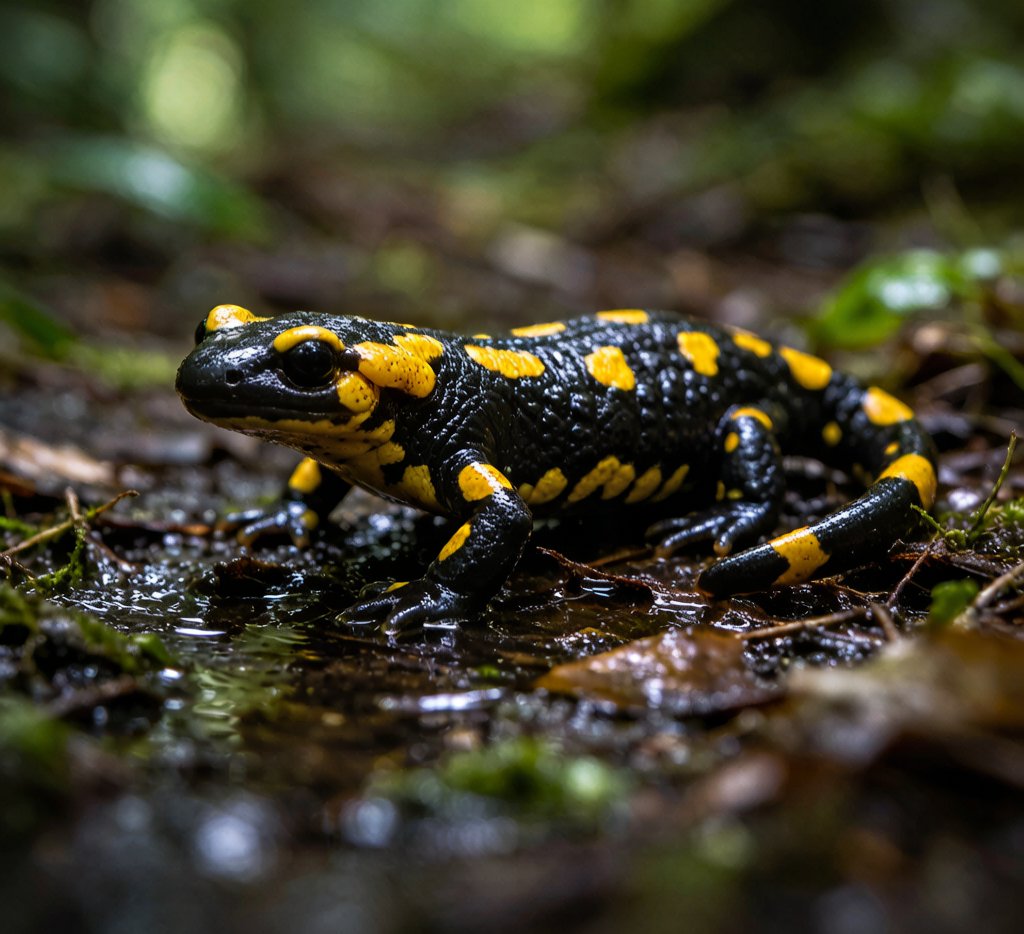
Introduction
The Fire Salamander (Salamandra salamandra) is the most iconic amphibian of European woodlands, instantly recognisable by its vivid black and yellow aposematic colouring. This medium-sized salamander inhabits cool, damp forests across central and southern Europe, leading a secretive, predominantly nocturnal life. Revered in folklore as a creature associated with fire and magic, the Fire Salamander has fascinated naturalists for centuries. Its bold warning colours signal potent skin toxins to predators, making it one of the most chemically defended European amphibians. As a species dependent on old-growth forests and clean freshwater, it serves as an important indicator of ecosystem health.
Taxonomy
The Fire Salamander belongs to the family Salamandridae, a diverse group of true salamanders distributed across Europe, Asia, and North America. Its full scientific classification is: kingdom Animalia, phylum Chordata, class Amphibia, order Urodela, family Salamandridae, genus Salamandra, and species S. salamandra. Carl Linnaeus formally described the species in 1758. Numerous subspecies are recognised across its range, distinguished by variations in pattern, size, and reproductive strategy. The genus Salamandra comprises approximately 12 species, all sharing the characteristic stout body and vivid warning colouration.
Physical Characteristics
Fire Salamanders typically reach 15 to 25 centimetres in length, with exceptional individuals growing to 30 centimetres. Their glossy black bodies are adorned with bold yellow or orange irregular patches, creating a pattern that varies considerably between subspecies. This striking coloration functions as aposematism, warning predators that the skin secretes potent alkaloid toxins including samandarin and samandarotoxin. The skin is smooth and moist, reflecting the species’ dependence on humid environments. The salamander has a broad head with large protruding eyes, four short sturdy limbs, and a long thick tail. It breathes through both lungs and skin, the latter being a critical supplementary respiratory surface in damp conditions.
Habitat
Fire Salamanders inhabit deciduous and mixed forests across Europe, with a strong preference for temperate woodlands dominated by beech and oak. They require cool, humid microclimates with abundant cover such as fallen logs, leaf litter, and rock piles. Proximity to clean, well-oxygenated freshwater is essential for reproduction, as females give birth to fully developed larvae in water. The salamanders are most active during high humidity, particularly at night and during rainfall. During the day they shelter in crevices, underground cavities, and beneath logs. In mountainous regions they may ascend to elevations exceeding 2,000 metres.
Diet
Fire Salamanders are opportunistic carnivores feeding on small invertebrates including earthworms, slugs, snails, spiders, beetles, and caterpillars. Prey is detected using a combination of visual and chemical cues, with an excellent sense of smell particularly important after dark. The salamander captures prey with a rapid lunge and grips it with its jaws. Unlike some related newt species, it does not use projectile tongue feeding. Larger individuals tackle proportionally larger prey. Feeding is concentrated on humid nights and during overcast, rainy weather when desiccation risk is lowest.
Reproduction
Fire Salamanders exhibit viviparity with gestation in the female’s oviducts. Mating occurs on land in autumn, involving a complex courtship with nudging, chin rubbing, and tail undulation. The male transfers a spermatophore to the female, who stores sperm for months before internal fertilisation. After a gestation of several months, the female gives birth to 10 to 80 live aquatic larvae in a freshwater pool. The larvae possess external gills and metamorphose into terrestrial juveniles over two to four months. Metamorphosed young emerge from water with fully formed lungs and live independently on land.
Conservation
The Fire Salamander is classified as Least Concern by the IUCN, though populations are declining in parts of its range. The greatest emerging threat is the chytrid fungus Batrachochytrium salamandrivorans, which has caused catastrophic die-offs in the Netherlands and Belgium. Climate change also threatens by reducing cool, humid microhabitats. Conservation measures include habitat protection, disease monitoring, and captive breeding programmes. Several European countries have enacted legal protections banning collection from the wild.
Fun Facts
Despite its association with fire in folklore, the Fire Salamander is highly intolerant of heat and direct sunlight, which rapidly cause fatal dehydration. Its name likely arose from the myth that it could walk through fire unharmed, perhaps inspired by animals emerging from damp logs placed on fires. Fire Salamanders can live over 30 years in captivity. Their toxins are so potent that a single salamander can render a small pond lethal to fish and invertebrate predators. Unlike most amphibians, they may occasionally be active during daylight following heavy rainfall.
[…] salamanders, within the order Urodela (the salamanders and newts). It is a close relative of the Salamandra salamandra (Fire Salamander) and other caudates, but it represents a far more primitive body plan. The genus Andrias contains […]