 By st20113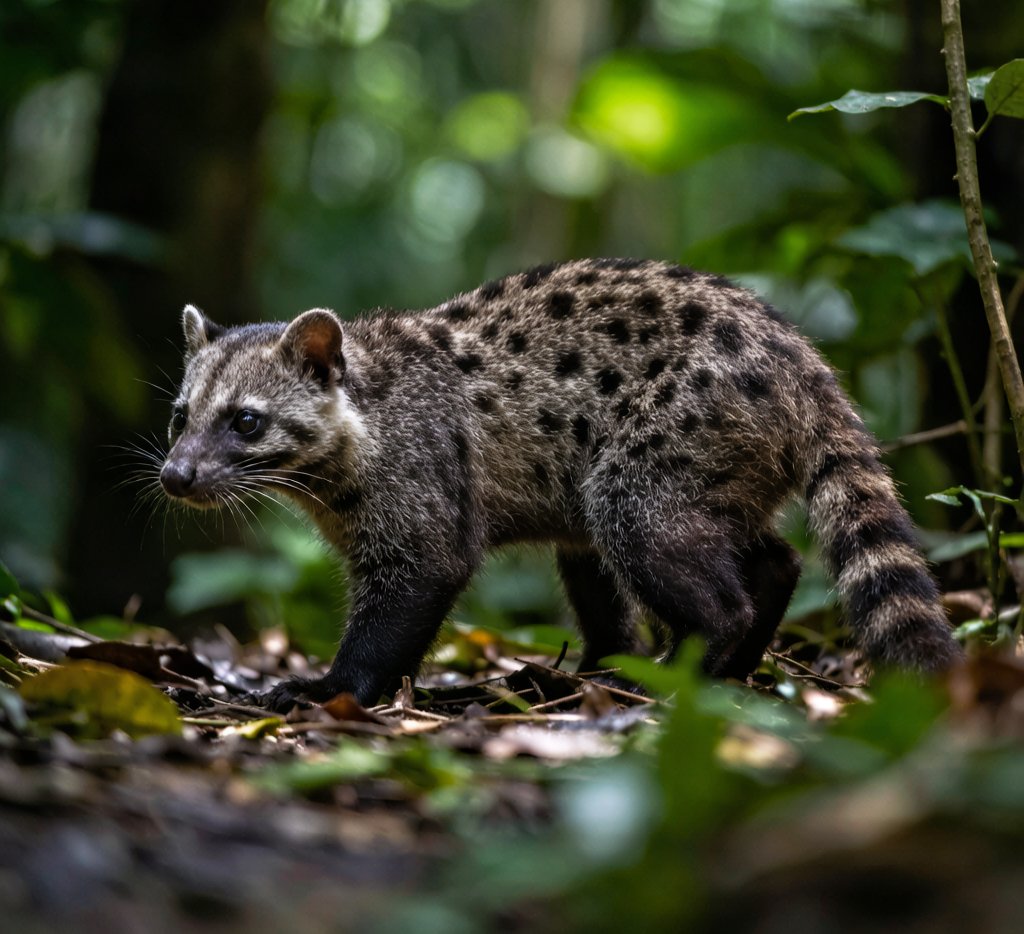
Introduction
The large-spotted civet (Viverra megaspila), also known as the large Indian civet, is a slender, cat-sized mammal belonging to the family Viverridae. It is found in the forests and wetlands of mainland Southeast Asia, from Myanmar and Thailand to Cambodia, Laos, and Vietnam. Distinguished by its bold black spots on a greyish body and a striking black-and-white ringed tail, this shy, nocturnal creature is rarely seen. It spends its nights foraging on the forest floor, where it hunts small animals and searches for fruit and carrion among the leaf litter.
Taxonomy
Viverra megaspila is one of several species in the genus Viverra, within the family Viverridae, a group that also includes the binturong and the smaller genet. Civets are Old World relatives of cats and mongooses, occupying an ecological role similar to that of small predators. The genus name Viverra is an old Latin term for civet, while megaspila means large-spotted, referring to its markings. Historically confused with the related Malabar civet and other spotted civets, it is now recognized as a distinct species with several regional populations across its range.
Physical Characteristics
Large-spotted civets have a body length of about 50 to 70 centimeters, a tail of 30 to 40 centimeters, and a shoulder height near 25 centimeters. Adults weigh roughly 4 to 9 kilograms. Their coarse fur is grey to buff, marked with rows of black spots along the back and sides, fading to stripes on the neck and shoulders. A conspicuous black stripe runs along the spine. The tail is long and ringed in black and white. Like other civets, they possess well-developed anal scent glands that produce a strong musk used for marking territory and signaling to mates.
Habitat
This species inhabits tropical and subtropical evergreen and deciduous forests, along with bamboo thickets, secondary growth, and the margins of wetlands and agricultural land. It favors dense ground cover and is most active on the forest floor, though it can climb when necessary. Large-spotted civets are found at low to moderate elevations and appear to tolerate some habitat disturbance, but they depend on contiguous vegetation for shelter and hunting. They are increasingly restricted to protected areas as forests are cleared for agriculture and timber.
Diet
Large-spotted civets are omnivorous but lean toward animal prey. They feed on small mammals, birds, frogs, lizards, insects, crabs, and other invertebrates, supplemented by fallen fruit, roots, and carrion. Their foraging method is comparable to that of the fishing cat, combining patient searching with quick pounces. Civets use their keen sense of smell to locate food and their nimble front paws to manipulate items. As opportunistic feeders, they help control pest populations and disperse seeds, linking them to the health of the wider forest ecosystem around them.
Reproduction
Relatively little is documented about the breeding of the large-spotted civet in the wild. They are thought to be polygynous, with females giving birth to litters of two to four young after a gestation of around sixty to seventy days. Births likely occur in sheltered dens among roots, rocks, or dense vegetation. The young are cared for by the mother and begin accompanying her on nocturnal foraging trips as they grow. Like other viverrids, the offspring develop rapidly and reach independence within a few months of leaving the den.
Conservation
The large-spotted civet is classified as Vulnerable by the IUCN, with populations declining because of habitat loss, hunting for meat and traditional medicine, and capture for the pet trade. In parts of its range it is among the civets most often taken by snare traps. Protected areas and stronger enforcement against trapping are essential. Community-based forest management and surveys to clarify its true distribution are also priorities. The elusive fossa of Madagascar shows how easily such secretive predators can slip toward endangerment when monitoring is weak.
Fun Facts
Civets are famous for the musky scent gland secretion once prized in perfumery, and the large-spotted civet produces its own strong odor. They are mostly silent but can hiss and growl when threatened. Uniquely among many carnivores, some civets will eat coffee cherries, and in other species this leads to the prized civet coffee. The large-spotted civet bold spots give it excellent camouflage among dappled forest light. It walks with a distinctive low-slung, hunched posture unlike that of a true cat.