 By st20113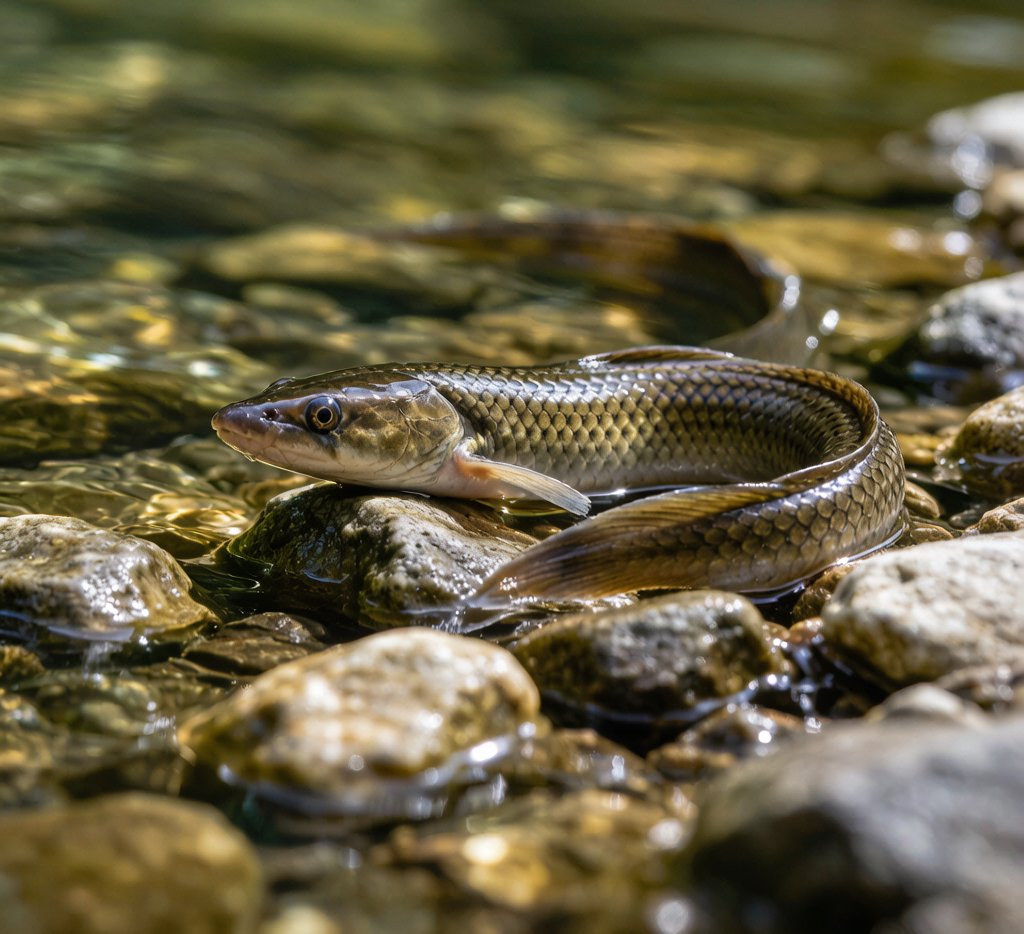
Introduction
The European eel (Anguilla anguilla) is a slender, snake-like fish found in rivers, lakes, and coastal waters across Europe and North Africa. Its mysterious lifecycle, spent mostly hidden in freshwater before a final voyage to a distant ocean spawning ground, has fascinated scientists for centuries. Adults can reach 60 to 100 centimetres, though size varies with sex and habitat. Its body is long and rounded, covered in a mucus-rich skin rather than prominent scales. Like other migratory fish such as the Atlantic salmon, the European eel undertakes one of the animal kingdom’s most remarkable journeys between freshwater and the sea.
Taxonomy
Anguilla anguilla is a member of the family Anguillidae, order Anguilliformes, the true eels. It was described by Carl Linnaeus in 1758. The genus Anguilla includes freshwater and catadromous eels found worldwide. Despite its serpentine shape, the eel is a true fish with gills, fins, and a backbone. Genetic studies have clarified its relationship to other anguillid eels, including the American eel, which shares a similar life cycle on the opposite side of the Atlantic.
Physical Characteristics
The European eel has a continuous dorsal and anal fin running much of the body length, giving it a smooth, ribbon-like outline. Small, embedded scales and a thick mucus layer protect the skin. Coloration shifts with life stage: juvenile glass eels are transparent, elvers become pigmented, and adults range from yellow to dark silver as they prepare to migrate. Like the related Atlantic sturgeon, the eel is a long-lived fish whose body shape suits both still waters and strong currents.
Habitat
European eels occupy an extraordinary range of habitats, from coastal shallows and estuaries to lowland rivers, lakes, and even landlocked ponds. They prefer soft-bottomed, vegetated waters with plenty of cover such as roots and mud. After hatching in the ocean they migrate into freshwater, where they may reside for many years. They are catadromous, meaning they live mostly in freshwater but return to the sea to spawn. Eels are nocturnal and secretive, hiding by day and foraging at night.
Diet
Eels are opportunistic feeders that consume insects, crustaceans, small fish, worms, and decaying organic matter. They are effective nocturnal predators and scavengers, using a keen sense of smell to locate food in murky water. Larger eels can take frogs, fish, and even small birds on occasion. Apex marine predators including the great white shark may prey on eels during their ocean migrations, though adult eels spend most of life hidden from large hunters.
Reproduction
European eels spawn only once, in the Sargasso Sea, a calm region of the North Atlantic. Adults migrate thousands of kilometres from freshwater to this single breeding ground, where they release eggs and sperm and then die. The tiny, leaf-shaped larvae drift with currents back toward Europe over a year or more, transforming into glass eels upon reaching coastlines. They then swim upstream, mature over several years, and finally return to the ocean to complete the cycle.
Conservation
The European eel is classified as critically endangered by the IUCN. Its populations have collapsed by more than 90 percent in recent decades due to overfishing, dam barriers that block migration, pollution, parasites such as Anguillicola crassus, and climate-related changes in ocean currents. International recovery plans promote passage at barriers, reduced exploitation, and restocking. Because the species depends on a single remote spawning area, threats anywhere in its range can affect the entire population.
Fun Facts
A European eel can survive out of water for hours if its skin stays moist, letting it cross wet grass between ponds. It can live more than twenty years in freshwater before beginning its final ocean journey. The spiral migration to the Sargasso Sea spans thousands of kilometres that the animal navigates without ever having seen the route before. Eels can absorb oxygen through their skin as well as their gills, an ability that aids survival in low-oxygen mud.