 By st20113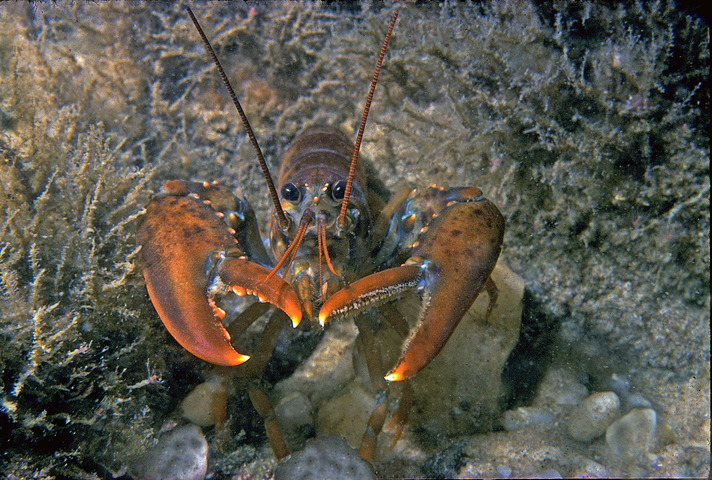
Introduction
The European lobster (Homarus gammarus) is a large marine crustacean found along the rocky coasts of the eastern Atlantic Ocean and the Mediterranean Sea. It is highly valued both ecologically as a top invertebrate predator and economically as a prized seafood across Europe. Adult lobsters are remarkably long-lived and continue growing throughout their lives, so the largest animals in a population are also usually the oldest. Adults commonly measure 25 to 50 centimetres and can weigh several kilograms, with some individuals living for decades. The body is a deep blue-black colour with lighter spotting, turning red only when cooked. It is a close relative of the Atlantic rock crab, both being decapod crustaceans of the continental shelf.
Taxonomy
Homarus gammarus belongs to the family Nephropidae, order Decapoda, within the class Malacostraca. It was described by Carl Linnaeus in 1758. The genus Homarus contains the true lobsters of the North Atlantic, distinct from clawless spiny lobsters. Its near twin, the American lobster, is a separate species occupying western Atlantic waters. Genetic and morphological evidence places the two as sister species that diverged after separation of the Atlantic basins.
Physical Characteristics
The European lobster has a segmented body protected by a hard carapace, a muscular abdomen, and a broad tail fan used for rapid backward swimming. It bears five pairs of legs, the first enlarged into powerful claws: one blunt for crushing, one slender for cutting. Long antennae sense the environment, and compound eyes sit on stalks. Like other marine invertebrates such as the common octopus, it relies on a hard structure and agility rather than speed for survival in a competitive seabed.
Habitat
This species lives on rocky, convoluted seabeds from shallow water down to about 150 metres, favouring crevices and burrows where it can hide by day. It avoids sandy or muddy bottoms lacking shelter. Lobsters are largely nocturnal, emerging at night to forage and returning to refuge before dawn. They are sensitive to temperature and are most abundant in cooler northern waters. Individuals are territorial, often reusing the same den for years and aggressively defending it from rivals.
Diet
European lobsters are opportunistic carnivores and scavengers. They feed on crabs, molluscs, worms, sea urchins, and dead fish, using their claws to seize and dismember prey. They will also consume plant material and carrion when animal food is scarce. Because they are vigorous predators, they help structure seabed communities. Large fish including the great white shark and various groundfish prey on juvenile lobsters, while adults face fewer natural enemies besides humans.
Reproduction
Mating occurs after the female moults and her shell is soft. Males deposit sperm packets that the female stores until she lays eggs, which she carries attached to her pleopods under the tail for many months. Hatched larvae pass through several planktonic stages before settling to the bottom and adopting the adult form. Growth requires periodic moulting, during which the animal is vulnerable until the new carapace hardens. Lobsters may reproduce repeatedly over a long lifespan that can exceed twenty years.
Conservation
Wild European lobster populations have declined in many areas because of intensive fishing, habitat degradation, and the loss of refuge rocks to trawling. It is not globally endangered, but several regions enforce minimum size limits, seasonal closures, and protected reserves to aid recovery. Restocking from hatcheries has been attempted with mixed success. Sustainable management is important because the species matures slowly and cannot withstand heavy continuous harvest pressure.
Fun Facts
A lobster can regrow a lost claw or leg over successive moults, a useful defence against injury. Its blood is blue because it uses copper-based haemocyanin instead of iron-based haemoglobin. Lobsters keep growing throughout life, so the largest individuals are also the oldest. Fishermen once believed that a lobster’s age could be read from its size alone, a rule that holds roughly true because growth never stops. They communicate by urine jets and gestures, and a dominant animal will often evict a rival from a prized crevice without serious fighting.