 By st20113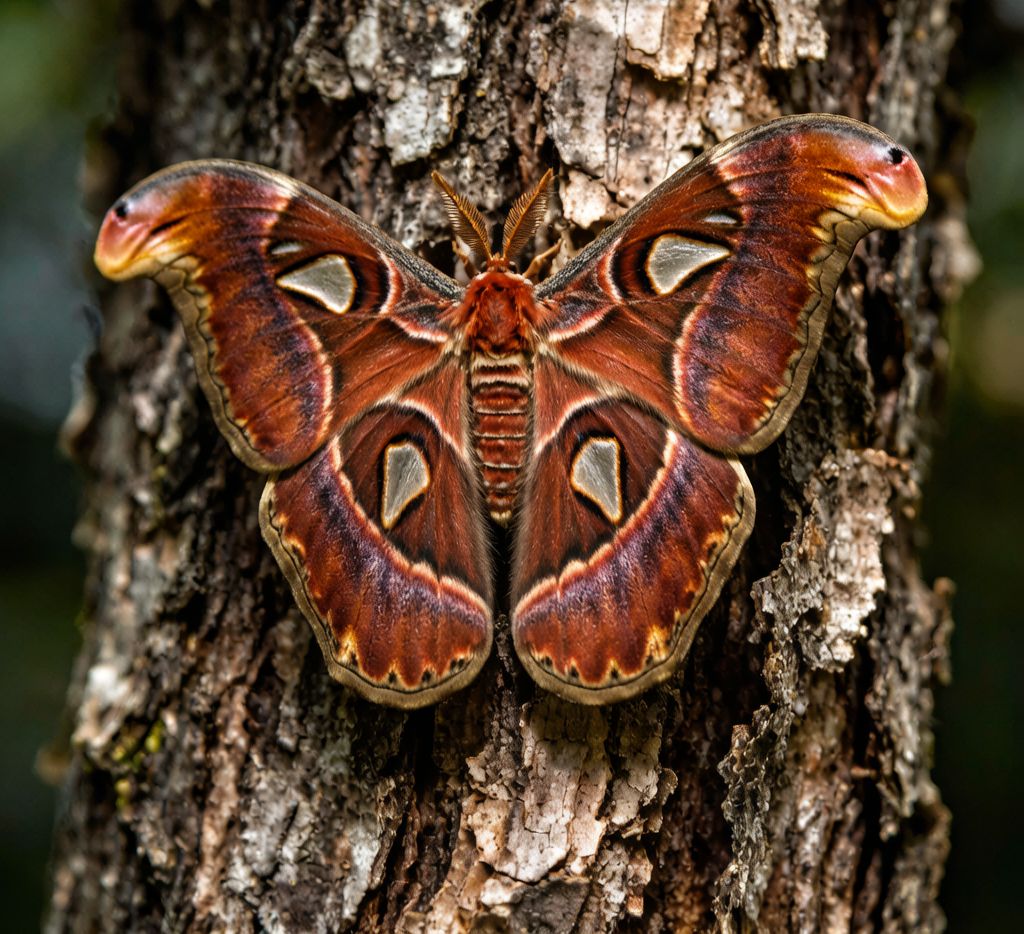
Introduction
The Atlas moth (Saturnia atlas) is one of the largest moths in the world, native to the forests of southern and southeast Asia. Its enormous size and dramatic markings have made it a favourite subject of naturalists and a symbol of tropical forest biodiversity. Females can have a wingspan reaching 24 centimetres, with males slightly smaller but more elaborately shaped. The wings are reddish-brown with striking translucent triangular windows and distinctive hooked forewing tips that resemble snake heads. Like the migratory monarch butterfly, it is celebrated for its spectacular appearance, though it belongs to the order Lepidoptera as a moth rather than a butterfly.
Taxonomy
Saturnia atlas is placed in the family Saturniidae, the giant silk moths, within the order Lepidoptera. It was first described by Carl Linnaeus in 1758. The genus Saturnia includes several large, colourful silk moths distributed across the Northern Hemisphere. The species name honours the mythological Titan Atlas, a nod to the moth’s enormous size. Close relatives include the Indian moon moth and the Polyphemus moth, all sharing the characteristic eyespots and feathery antennae of the group.
Physical Characteristics
Adult Atlas moths have broad wings marked with complex patterns of red, brown, yellow, and white that provide camouflage against bark and dappled light. Each wing bears a circular eyespot thought to startle predators. The forewing tips curve into pointed lobes resembling a snake’s head, a defence that may deter birds. Males have large, feathered antennae used to detect female pheromones from kilometres away. Notably, adults possess no functional mouthparts and do not feed during their short adult life.
Habitat
Atlas moths inhabit tropical and subtropical forests, including primary rainforest, secondary growth, and woodland margins. The caterpillars feed on a range of host plants such as citrus, cinnamon, and evergreen trees. Adults emerge during warm, humid seasons and are mostly nocturnal, resting by day on tree trunks where their camouflage hides them. They are attracted to light at night. In cooler parts of their range the species may produce one or two generations per year depending on temperature and rainfall.
Diet
The larval stage is the feeding phase. Caterpillars are voracious herbivores that consume leaves of many trees, growing rapidly through several instars while covered in waxy, tubercle-tipped protrusions. They may also eat the foliage favoured by species such as the honey bee‘s surrounding plants, though bees and moths occupy different niches. Once they pupate inside a silken cocoon, feeding stops. Adult moths survive entirely on fat reserves accumulated as caterpillars, living only a few days to mate and lay eggs.
Reproduction
Females emit powerful pheromones that draw males over long distances. After mating, a female lays clusters of eggs on host-plant leaves. The eggs hatch into spiny caterpillars that feed and grow before spinning a tough silk cocoon, often attached to a twig. Pupation lasts two to three weeks in warm conditions. Adults emerge with crumpled wings that expand and harden within hours. Because adults cannot feed, reproduction must be completed quickly before energy reserves are exhausted.
Conservation
The Atlas moth is not currently considered threatened and is locally common across its native range. It is sometimes farmed for silk and exhibited in butterfly houses worldwide. Habitat loss from deforestation poses the main long-term risk, particularly the removal of diverse host trees that caterpillars require. Because the species adapts to disturbed and cultivated land, it persists better than many forest specialists, though sustained monoculture could reduce its food-plant variety.
Fun Facts
An Atlas moth’s wingspan can rival that of some small birds, making it among the heaviest insects by wing surface area. The adults live barely a week and never eat, relying entirely on larval fat. The cocoon silk is so tough that it has historically been used to make small purses in parts of Asia. The snake-head wing tips are a brilliant example of deceptive mimicry, confusing would-be predators at the moment of threat.