 By st20113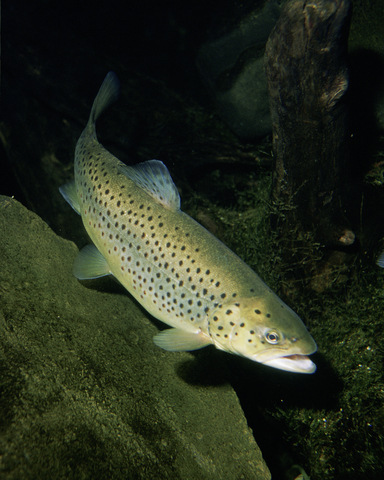
Introduction
The brown trout is a cold-water fish native to Europe, western Asia, and North Africa, and one of the most widely introduced fish species in the world. Admired by anglers for its wariness and beauty, it inhabits clean rivers, streams, and lakes, where it thrives in cool, oxygen-rich water. Remarkably adaptable, the species includes both resident freshwater forms and anadromous sea trout that migrate to the ocean to grow before returning to their home rivers to spawn.
Taxonomy
The brown trout belongs to the family Salmonidae, which also includes salmon, char, and grayling, and it is a close relative of the Atlantic salmon. It was first described by Carl Linnaeus in 1758. The species shows extraordinary variation, and many local forms were once considered separate species, such as the river-dwelling fario form and the lake-dwelling lacustris form. Today these are treated as a single, highly variable species, though some taxonomists argue the complex deserves further splitting.
Physical Characteristics
Brown trout are typically 25 to 70 centimeters long, though giants over a meter and more than 18 kilograms have been recorded in large lakes and rivers. Their coloration is variable but usually brownish or golden on the back, fading to a cream or yellow belly. The body is covered with black and red spots, often ringed with pale halos, and the tail fin is square rather than forked. Like all salmonids, they possess a small fleshy adipose fin between the dorsal fin and tail, and their streamlined bodies are built for fast currents.
Habitat
Brown trout require cool, well-oxygenated water, typically below 20 degrees Celsius, with clean gravel beds for spawning. They occur naturally from Iceland and Scandinavia across Europe to the Atlas Mountains of North Africa and eastward to the Caspian region, sharing these waterways with native fish such as the Atlantic sturgeon. Because of their popularity as a sport fish, they have been introduced to North and South America, New Zealand, Australia, and the highlands of Asia, where some populations now grow larger than in their native range.
Diet
Brown trout are opportunistic carnivores. Young fish feed on aquatic insects such as mayflies, caddisflies, and stoneflies, along with small crustaceans. As they grow, the diet expands to include snails, amphibians, and small fish such as minnows and sticklebacks. Large individuals become predominantly piscivorous and may even eat small mammals and birds that fall into the water. They are hunted in turn by wading birds like the common kingfisher and by mammals such as river otters. Feeding is most active at dawn and dusk, when trout rise to take insects from the surface.
Reproduction
Brown trout spawn in autumn and winter, when females dig shallow nests, called redds, in gravel beds. The male fertilizes the eggs as they are laid, and the female covers them with gravel before moving upstream to spawn again. The eggs incubate over winter and hatch in early spring. Sea trout follow the same pattern but spend one to several years at sea, feeding on marine fish and crustaceans, before returning to their natal river to spawn. Most trout reach maturity at two to four years of age, and some large lake-dwelling individuals live for two decades.
Conservation
Globally, the brown trout is classified as Least Concern by the IUCN because of its enormous introduced range. Native populations, however, face serious pressure from habitat degradation, dam construction, pollution, overfishing, and interbreeding with hatchery-reared stock, which erodes the genetic diversity of wild fish. In contrast, introduced populations in places such as New Zealand and Patagonia have become invasive, threatening native fish species in those regions. Sustainable management of rivers and careful stocking programs are essential to balance sport fishing with conservation.
Fun Facts
Sea trout and brown trout are the same species; the difference is simply where they choose to feed. The brown trout was one of the first fish to be raised in hatcheries, in the nineteenth century. Its Latin name Salmo trutta means “trout” in both Latin and Italian. Anglers sometimes call it “the fish of a thousand casts,” because a well-hooked brown trout almost always wins the fight and escapes.