 By st20113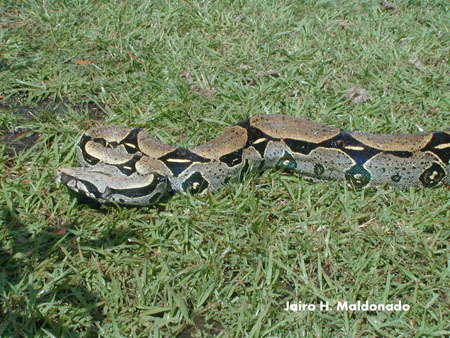
Introduction
The boa constrictor (Boa constrictor) is a large, non-venomous snake found across Central and South America, as well as several Caribbean islands. Renowned for its method of subduing prey by wrapping its muscular body around the animal and squeezing, the boa is one of the most recognizable snakes in the world. It occupies a remarkable range of habitats, from tropical rainforests and dry scrublands to agricultural areas and woodland edges. Unlike many snakes kept only in the wild, the boa constrictor has also become one of the most widely kept constrictor snakes in captivity.
Taxonomy
The boa constrictor belongs to the family Boidae, within the subfamily Boinae, a group of primitive boas that retain remnants of hind limbs in the form of small pelvic spurs. The species was first described by Carl Linnaeus in 1758. Several subspecies are recognized, including the nominate Boa constrictor constrictor of the Amazon and the smaller Boa constrictor imperator of Central America. Its closest relatives include the anacondas and the arboreal emerald tree boa, all sharing the characteristic of killing prey through constriction rather than venom.
Physical Characteristics
Adult boa constrictors typically reach lengths of 2 to 3 meters, though exceptional individuals may exceed 4 meters. Females are generally larger and heavier than males. The body is robust and muscular, covered in smooth scales that display a base color of tan, brown, or gray overlaid with a pattern of darker saddles, blotches, and tail bands. A distinctive dark stripe runs from behind each eye to the corner of the jaw. The head is broad and rounded, with heat-sensitive labial pits along the upper lip that help the snake detect warm-blooded prey in darkness.
Habitat
This adaptable snake inhabits a broad spectrum of environments. In the Amazon basin it thrives in humid lowland rainforest, while populations in northern South America and Central America also occupy dry tropical forest, savannah, and thorn scrub. Boas are partly arboreal when young and frequently climb low branches and shrubs, but adults are mostly terrestrial, sheltering in hollow logs, burrows, and leaf litter. They tolerate human-modified landscapes and are often found near farms and villages where rodents are abundant.
Diet
Boa constrictors are ambush predators that feed primarily on small to medium mammals and birds. Juveniles begin with lizards, frogs, and small rodents, gradually shifting to larger prey such as rats, squirrels, opossums, and monkeys as they grow. The snake strikes, seizes the animal with recurved teeth, and quickly coils around it, tightening its grip each time the prey exhales until circulation and breathing cease. After a large meal the boa may fast for weeks or even months while it digests.
Reproduction
Boa constrictors are ovoviviparous, meaning the young develop inside eggs that hatch within the mother’s body, so she gives birth to live young rather than laying eggs. Mating occurs during the dry season, and after a gestation of roughly 100 to 150 days the female produces a litter of 10 to 60 live offspring, each about 40 centimeters long and fully independent at birth. Unlike many reptiles, boas do not provide parental care beyond birth. Young boas grow steadily and may live for twenty to thirty years in the wild and considerably longer in captivity.
Conservation
The boa constrictor is currently listed as Least Concern by the IUCN, reflecting its wide distribution and stable populations. Nevertheless, local declines occur where the species is hunted for its skin or killed by people fearing snakes. It is also traded internationally as part of the exotic pet industry. Habitat loss in parts of its range poses a longer-term threat, though the species’ adaptability has so far buffered it against severe decline across most of its native range.
Fun Facts
The boa constrictor’s name is somewhat misleading, because it does not actually crush bones despite the popular myth. Instead, constriction prevents the prey from inhaling, causing rapid loss of consciousness. The small spurs near the cloaca are vestigial hind legs, a remnant of an ancient lizard ancestor. Boas can go months between meals, and some captive individuals have exceeded forty years of age. Their calm temperament and striking pattern have made them one of the most familiar large snakes to people worldwide.