 By st20113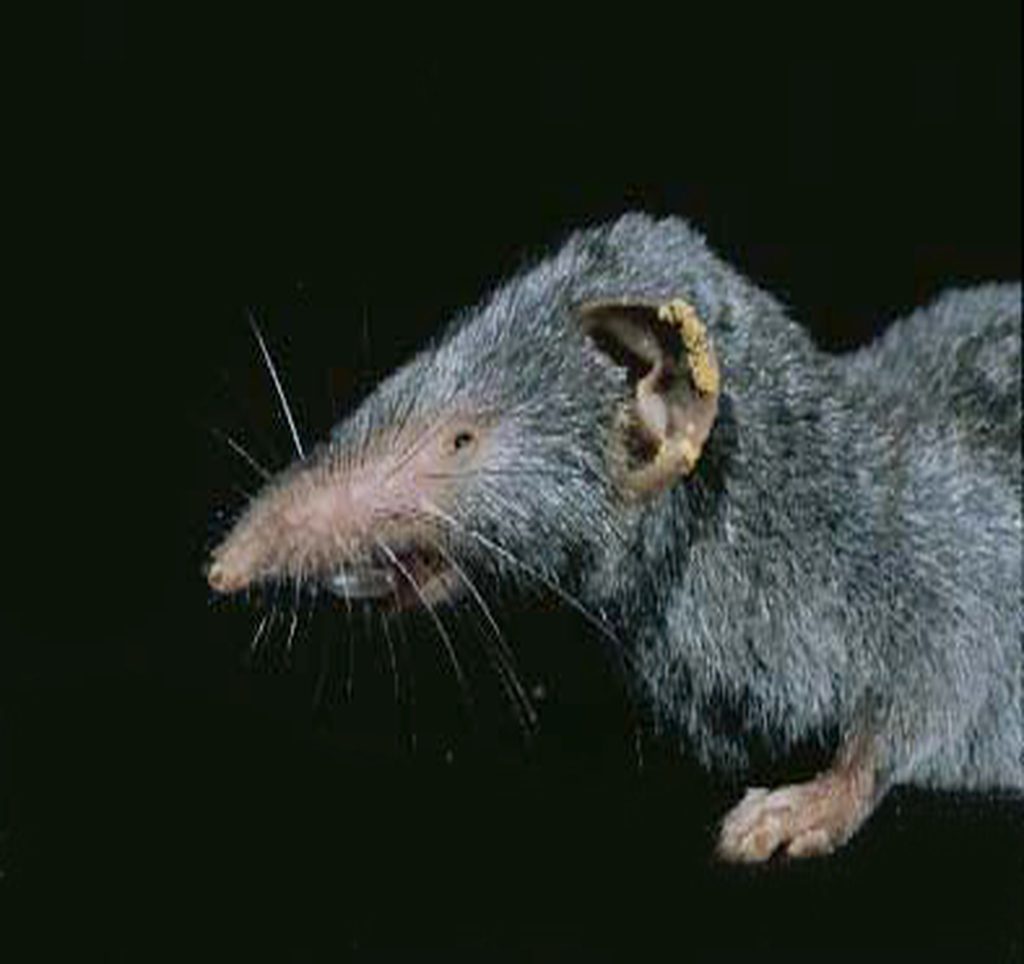
Introduction
The Asian House Shrew, Suncus murinus, is a small insectivorous mammal of the family Soricidae, widely distributed across southern Asia and introduced to many islands in the Indian and Pacific Oceans. Often mistaken for a mouse, it is actually a shrew, distinguished by a pointed snout, tiny eyes, and a musky odor. Adults measure 12 to 15 centimeters including the tail and weigh 40 to 100 grams, making this one of the largest shrews in the world. Highly synanthropic, it thrives around human homes, granaries, and gardens. Its tolerance of people has carried it to ports and islands wherever trade routes reach.
Taxonomy
Suncus murinus was first described by Linnaeus in 1766 under the name Sorex murinus before being moved to the genus Suncus. The genus name derives from the Latin suncus, an old term for shrews, while murinus means mouse-like, reflecting its superficial resemblance to a mouse. It belongs to the subfamily Crocidurinae, the white-toothed shrews, which lack the red-tipped teeth of their red-toothed relatives. Genetic work places it among the Asian crocidurines, with several subspecies recognized across its broad range. Despite its abundance, the species was long confused with unrelated rodents because of its shared habitat and size.
Physical Characteristics
The Asian House Shrew has a cylindrical body, a long mobile snout, and a scaly, sparsely haired tail. Its velvety grey-brown fur conceals a pair of scent glands that produce a strong, unpleasant musk used in defense and communication. The eyes are small and the ears are rounded and partly hidden in the fur. Like all shrews, it possesses a high metabolic rate requiring near-constant feeding. Its teeth are sharp and white-tipped, suited to a diet of insects and other small prey. The animal’s whiskers are long and sensitive, guiding it through dark crevices and dense vegetation where vision matters little.
Habitat
This species is strongly associated with human habitation, occupying houses, sheds, warehouses, gardens, and agricultural land from sea level to moderate elevations. It also persists in forests, grasslands, and scrub where shelter and insects are plentiful. Its commensal lifestyle has made it a successful colonizer of islands, including parts of Japan, the Philippines, and Madagascar, often arriving unnoticed with cargo. In its native and introduced ranges alike it is hunted by the red fox and other small carnivores, though its musk and agility help it evade many attackers. Warm climates allow activity year-round.
Diet
The Asian House Shrew is a voracious predator of invertebrates, feeding on beetles, cockroaches, crickets, termites, earthworms, and larvae. It also consumes small vertebrates such as frogs, lizards, and nestling rodents when opportunity allows. Using echolocation-like ultrasonic vocalizations, it navigates and locates prey in darkness. Its metabolism is so rapid that it must eat nearly its own body weight in food daily, making it a relentless forager. By suppressing insect pests around homes and crops, the shrew provides a modest ecological service, though its presence indoors is often unwelcome to people.
Reproduction
Breeding occurs throughout the year in warm regions, with females producing several litters annually. After a gestation of about twenty-eight to thirty days, the mother gives birth to a litter of three to six blind, helpless young in a nest of grass or leaves hidden in walls, burrows, or dense cover. The pups develop quickly, opening their eyes at roughly two weeks and weaning soon after. A remarkable behavior is caravaning, in which the young line up and grip the tail of the sibling ahead, forming a living chain that the mother leads to new foraging sites. This strategy reduces losses in complex human environments.
Conservation
The Asian House Shrew is abundant and classified as Least Concern by the IUCN. Its association with people has buffered it from the habitat loss that threatens many less adaptable small mammals. In some island ecosystems, however, its introduction has raised concerns because shrews prey on native invertebrates and small vertebrates, occasionally competing with endemic species. It is generally tolerated rather than controlled, partly because it helps check household insect populations. Research continues into its role as both a beneficial predator of pests and a potential competitor in fragile island faunas where native shrews are absent.
Fun Facts
The Asian House Shrew emits high-frequency squeaks inaudible to human ears to navigate in total darkness, a behavior once thought unique to bats. Its musky scent is so potent that some cultures use the animal to repel rats, though the two species rarely interact directly. A mother may move her entire litter at once by leading a tail-to-tail caravan through a house. Despite its tiny size, the shrew has a heart rate exceeding eight hundred beats per minute to fuel its frantic lifestyle. Perhaps most surprising, it can consume prey larger than its own head by immobilizing it with rapid, precise bites rather than sheer strength.