 By st20113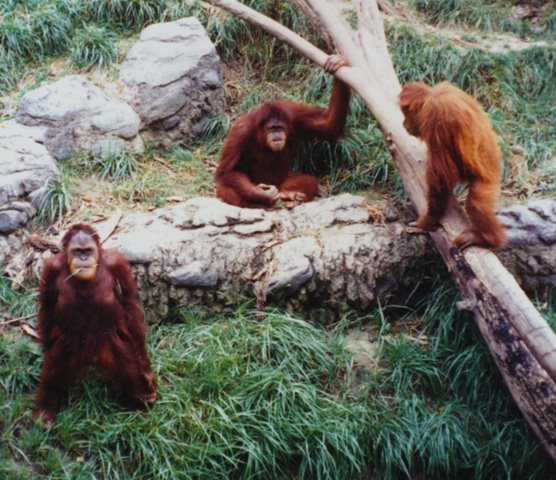
Introduction
The Bornean orangutan (Pongo pygmaeus) is one of three orangutan species and one of humanity’s closest living relatives, sharing roughly 97 percent of their DNA with modern humans. Found exclusively on the island of Borneo in Southeast Asia, the Bornean orangutan is the largest tree-dwelling animal on Earth. These great apes spend more than 90 percent of their lives in the forest canopy, moving through the treetops with remarkable ease. Orangutans are among the most intelligent of all non-human primates, capable of tool use, problem-solving, and social learning. Their striking red-orange fur and expressive faces have made them iconic ambassadors for rainforest conservation, but they are critically endangered due to massive habitat loss.
Taxonomy
The Bornean orangutan belongs to the family Hominidae, making it one of the great apes alongside humans, chimpanzees, and gorillas. Three distinct orangutan species are now recognised: the Bornean orangutan (Pongo pygmaeus), the Sumatran orangutan (Pongo abelii), and the Tapanuli orangutan (Pongo tapanuliensis), described in 2017. The Bornean species diverged from the Sumatran lineage roughly 1.1 to 2.2 million years ago. Within Pongo pygmaeus, three subspecies are recognised: northwest, northeast, and central Bornean orangutans. The orangutan lineage diverged from the African ape and human line approximately 12 to 16 million years ago.
Physical Characteristics
The Bornean orangutan is a large primate, with males growing up to 1.5 metres tall and weighing up to 100 kilograms. Females are much smaller, rarely exceeding 50 kilograms. The species is strongly sexually dimorphic: adult males develop distinctive cheek pads called flanges, a large throat sac, and a broader facial disk. The coat is long and shaggy, typically deep reddish-orange or rusty brown. Orangutans possess an extraordinary arm span of up to 2.3 metres, supremely adapted for swinging through trees. Their hands and feet are long and hook-like, ideal for grasping branches. Unlike most great apes, orangutans are almost exclusively arboreal.
Habitat
Bornean orangutans are found throughout the island of Borneo, shared by Indonesia, Malaysia, and Brunei. They inhabit peat swamp forest, tropical rainforest, and montane forest up to around 1,500 metres elevation. They occupy the forest canopy where they build sleeping nests from folded branches each night. They require large tracts of connected forest as fruit trees are widely scattered. Adult males maintain large overlapping home ranges of up to 25 square kilometres. Deforestation for palm oil plantations has severely fragmented and destroyed much of their habitat.
Diet
Orangutans are primarily frugivores, with fruit making up more than 60 percent of their diet. Figs are a particular favourite and critical during fruit scarcity. They also eat flowers, young leaves, bark, insects, and occasionally eggs or small vertebrates. A single orangutan may visit hundreds of fruit trees in a year, making them important seed dispersers. They spend six to eight hours each day foraging and eat by opening hard fruits with tools or their strong hands. Their need for large quantities of diverse fruit makes them highly vulnerable to habitat loss.
Reproduction
Orangutans have the longest birth interval of any non-human primate, with females giving birth only once every six to nine years on average. After a gestation of roughly 8.5 months, the female gives birth to one infant, which she nurses and carries constantly for the first two years. The mother-infant bond is exceptionally strong and long-lasting by primate standards. Infants learn essential survival skills by observing and imitating their mothers, including food identification, nest-building, and canopy navigation. The young may associate with their mother for several years before establishing independence around the age of 10.
Conservation
The Bornean orangutan is classified as Critically Endangered, with populations having declined by more than 50 percent over the past six decades. Fewer than 120,000 individuals remain in fragmented forest patches. Primary threats are deforestation for palm oil, selective logging, mining, and forest fires. Poaching for the illegal wildlife trade also takes a significant toll. Rehabilitation centres take in orphaned orangutans, teaching survival skills before returning them to the wild. Long-term conservation depends on reducing palm oil demand and supporting sustainable land-use practices that preserve forest connectivity.
Fun Facts
Orangutans have been observed using medicinal plants to treat joint pain, one of the few non-human animals known to self-medicate. Each night, an orangutan constructs a fresh sleeping nest from branches and leaves in just five to ten minutes. The name orangutan comes from Malay and Indonesian words meaning person of the forest. Bornean orangutans share approximately 97 percent of their DNA with modern humans, making them among our closest living relatives after bonobos and chimpanzees.