 By st20113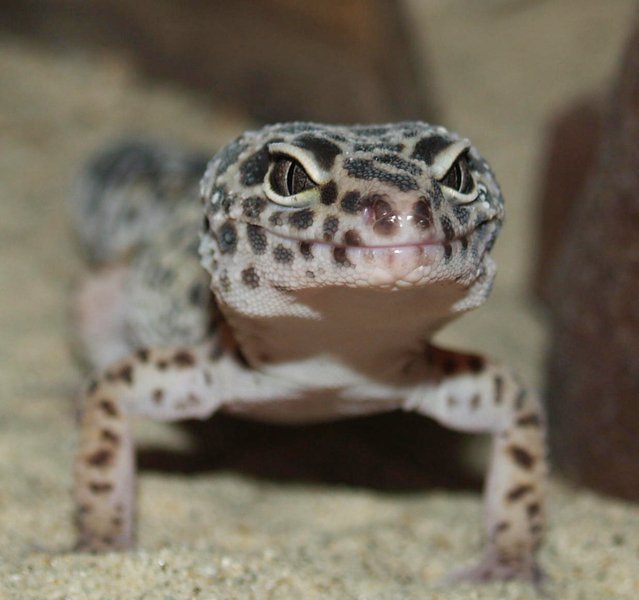
Introduction
The Leopard Gecko (Eublepharis macularius) is one of the world’s most popular reptile pets, prized for its calm temperament, bold spotted pattern, and simple care. In the wild it lives in the rocky, arid grasslands and deserts of Afghanistan, Pakistan, and north-western India, sheltering by day beneath rocks and in crevices and emerging at dusk to hunt insects. Its name comes from the yellow-and-black spots that recall a leopard’s coat, a pattern that selective breeding has transformed into an extraordinary range of colour morphs.
Although long domesticated, the Leopard Gecko remains a wild animal at heart, carrying adaptations shaped by millions of years of evolution in the semi-arid landscapes of Central Asia.
Taxonomy
The Leopard Gecko belongs to the family Eublepharidae, the so-called eyelid geckos, which, unlike most geckos, possess fully movable eyelids. The genus Eublepharis contains five species, of which E. macularius is the most widespread; its species name means “spotted” in Latin. Genetic studies indicate that this lineage diverged from other gecko groups tens of millions of years ago, and its eyelids, terrestrial habits, and fat-storing tail reflect a long association with rocky, arid landscapes.
Physical Characteristics
Adults reach 20 to 28 centimetres in total length. The body is stout and somewhat flattened, with short limbs better suited to rocky terrain than to climbing, and the skin is covered in small granular scales scattered with larger tubercles. The base colour is yellow to pale orange, overlaid with bold dark spots and bands that camouflage the gecko among desert gravel. Its large amber eyes give excellent night vision, and its thick, tapering tail stores fat for lean times; like many lizards, it can shed the tail when seized by a predator and later regrow it, a defence also used by the Frilled Dragon.
Habitat
Leopard Geckos inhabit the arid and semi-arid regions of south-central Asia, from eastern Afghanistan through Pakistan to north-western India. Their typical home is dry, rocky grassland, scrub, and gravel plain dotted with boulders, because the crevices beneath stones keep temperature and humidity more stable than the open ground. Summer daytime temperatures in this region can exceed 45 degrees Celsius, and winter nights can approach freezing, so the geckos stay active only during the cooler hours of dusk and night, retreating deep into crevices or burrows to brumate through the coldest months.
Diet
The Leopard Gecko is an obligate carnivore, feeding almost entirely on arthropods such as beetles, caterpillars, spiders, centipedes, and especially crickets and moths. It hunts by sight and smell, stalking prey across the desert floor at night and seizing it with a rapid snap of the jaws. Captive geckos are usually fed gut-loaded crickets, mealworms, and roaches, with calcium and vitamin D3 supplements to prevent metabolic bone disease. In the wild its hunting is so refined that it can locate and capture highly cryptic insects such as Common Fireflies in near-total darkness.
Reproduction
Leopard Geckos reach sexual maturity at 18 to 24 months, and breeding begins in early spring after the winter brumation. Males fight rivals in ritualised combat, then court females with tongue-flicking and tail vibration. A female lays one or two parchment-shelled eggs in a moist burrow, producing two to three clutches a season, and the eggs incubate for 45 to 60 days. Sex is determined by temperature: warmer incubation produces mostly females and cooler incubation mostly males. Hatchlings emerge fully independent, ready to hunt and hide from the moment they leave the egg.
Conservation
The Leopard Gecko is listed as Least Concern by the IUCN, with a stable population and a wide distribution. Decades of collection for the international pet trade removed hundreds of thousands of wild individuals, especially in Pakistan and Afghanistan, but captive breeding now supplies the vast majority of geckos sold in pet shops, sharply reducing pressure on wild populations. Conservation efforts in range states focus on protected areas and on regulating the export of wild-caught animals to keep any collection sustainable.
Fun Facts
A well-fed Leopard Gecko’s tail can swell to more than twice its normal diameter, storing enough fat to sustain the animal for weeks or even months without food. Captive breeding has produced more than 100 colour morphs, from the wild-type pattern to patternless, bright yellow, and marbled forms, making the gecko one of the most genetically diverse reptiles in captivity. It is also remarkably long-lived for a small lizard, routinely reaching 15 to 20 years of age with proper care.