 By st20113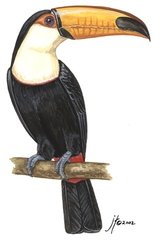
Introduction
The Toco Toucan (Ramphastos toco) is the largest and most iconic member of the toucan family, Ramphastidae, instantly recognizable by its enormous, brightly colored bill. Native to tropical and subtropical forests of South America, this charismatic bird plays a significant ecological role as a seed disperser. From the Amazon Basin to the semi-open woodlands of the Pantanal, the Toco Toucan appears frequently in wildlife photography and natural history documentaries.
Taxonomy
The Toco Toucan belongs to the family Ramphastidae, which comprises 50 to 60 species of toucans, toucanets, and aracaris found throughout the Neotropics from Mexico to Argentina. The genus Ramphastos contains five recognized species, all characterized by large bodies and massive bills. The family Ramphastidae belongs to the order Piciformes, reflecting an evolutionary relationship with woodpeckers evident in their zygodactyl foot structure — two toes pointing forward and two backward. The keel-billed toucan is the most similar species within the same genus.
Physical Characteristics
The Toco Toucan measures 55 to 65 centimeters in length and weighs 500 to 875 grams, making it the largest of all toucan species. Its most striking feature is the bill, which can reach 20 to 22 centimeters in length — up to one-third of the bird’s total body length. The upper mandible is predominantly black with a yellow-orange stripe along the base, while the lower mandible is deep orange-yellow. Despite appearing massive, the bill is remarkably lightweight due to a honeycomb internal structure of keratin and air pockets. The body is predominantly jet black, with a white throat and vivid red undertail coverts.
Habitat
The Toco Toucan occupies a broad range across South America, from Brazil through Bolivia, Paraguay, and northern Argentina. Its habitat encompasses humid tropical and subtropical forests, including terra firme and varzea forests of the Amazon Basin, gallery forests along rivers, and semi-deciduous woodland with scattered tall trees. The species prefers the forest canopy, typically occurring between 10 and 30 meters above ground below 1,000 meters elevation. Unlike many forest-dependent birds, the Toco Toucan adapts well to modified landscapes, surviving in selectively logged forest and large wooded parks where fruiting trees and nesting cavities remain. The great blue heron shares the same riverine forest habitats in parts of its range.
Diet
The diet of the Toco Toucan is primarily frugivorous, with fruit comprising approximately 80 percent of its intake. Figs (Ficus spp.) are a particularly important staple. Other favored fruits include those of the genus Cecropia, various Myrtaceae species, and palm fruits. The enormous bill is a highly effective tool for reaching, plucking, and manipulating fruit with remarkable dexterity. The Toco Toucan supplements its diet with insects, spiders, and small vertebrates including tree frogs and lizards. The bill also acts as a thermal regulator and as a threatening display structure during territorial disputes. Like the gray parrot, the toucan relies heavily on fruit resources that vary seasonally across its habitat.
Reproduction
Toco Toucans form monogamous pairs during the breeding season and share parental duties throughout the nesting period. Courtship involves mutual feeding and billing — interlocking the tips of their bills and swaying from side to side — which strengthens the pair bond. The pair selects a suitable tree cavity in a dead or decaying tree, and the female lays a clutch of 2 to 4 white eggs directly onto the cavity floor. Both parents share the approximately 16 to 18 day incubation period, and both feed the chicks through regurgitation. The young birds fledge at approximately 6 to 8 weeks of age and remain with their parents for several weeks while learning to forage independently.
Conservation
The Toco Toucan is classified as Least Concern on the IUCN Red List, reflecting its large overall population and extensive geographic range. However, population trends are downward as ongoing Amazon deforestation removes and fragments its forest habitat. The primary conservation concern is the loss of large, old-growth trees that provide essential nesting cavities. Unlike many hole-nesting birds, the Toco Toucan cannot excavate its own nest and depends entirely on natural tree hollows or those created by woodpeckers. Conservation strategies focus on protecting intact forest tracts and preserving large trees with suitable cavities.
Fun Facts
The Toco Toucan’s bill, while appearing massive and cumbersome, is remarkably lightweight yet strong due to its honeycomb internal structure. Despite its apparent unwieldiness, the bird uses it with remarkable precision to pick individual berries from a cluster. The bill’s vivid coloration is produced by carotenoid pigments in the keratin layer. The Toco Toucan plays a key role in seed dispersal, swallowing fruit whole and excreting the seeds intact in new locations. Like other members of the toucan family, it faces habitat fragmentation pressure across its range. The southern ground hornbill shares similar nesting ecology, relying on large tree hollows in forest habitats.