 By st20113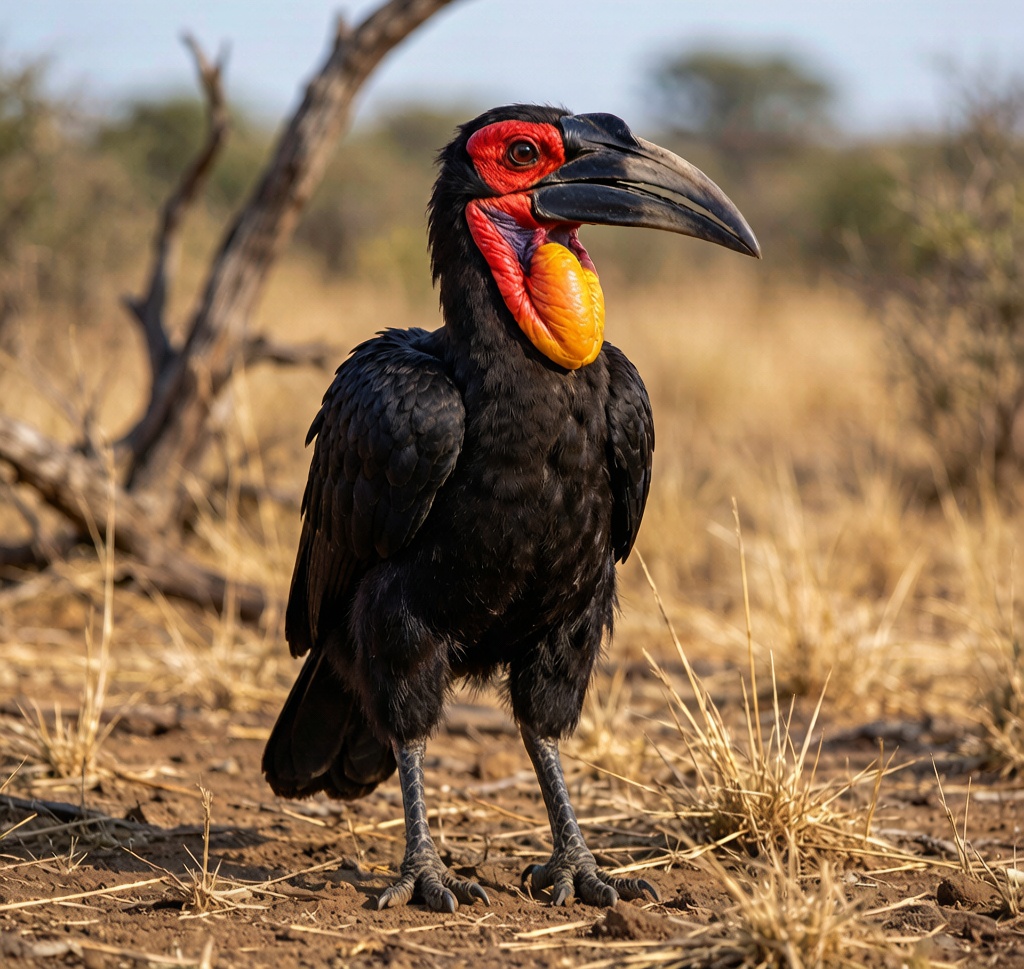
Introduction
The southern ground hornbill (Bucorvus leadbeateri) is the world’s largest hornbill species and one of Africa’s most impressive terrestrial birds. A massive, crow-like bird with jet-black plumage and a striking bare face, this species inhabits the savannas, grasslands, and open woodlands of eastern and southern Africa. Standing up to 1.3 meters tall and weighing as much as 6.2 kilograms, it is unmistakable — its enormous, downcurved ivory-colored bill dominates its profile. Unlike most hornbills, which are canopy dwellers, the southern ground hornbill spends almost all of its time on the ground, striding purposefully through the African bush in coordinated family groups. The species is revered in many African cultures and is one of the continent’s most sought-after birds for wildlife enthusiasts.
Taxonomy
The southern ground hornbill belongs to the family Bucorvidae, which contains only two extant species — the southern ground hornbill and the northern ground hornbill (Bucorvus abyssinicus) found in the Horn of Africa. These two species represent an ancient lineage within the order Buceriformes — the hornbills — a group characterized by their large bills and, in most species, a hollow casque atop the bill. The southern ground hornbill is distinguished by its more extensive red throat pouch, which inflates dramatically during its deep, booming territorial calls. Its closest relatives within the hornbill family include the great toucan-like species of the African tropics, though the ground hornbills diverged from the arboreal hornbill lineage tens of millions of years ago and have independently evolved a fully terrestrial lifestyle.
Physical Characteristics
The southern ground hornbill is a striking bird: the plumage is entirely black except for white primary feathers visible in flight. Its face is largely bare, with vivid red skin on the face, throat, and an inflatable throat pouch that can hold up to a liter of water. The beak is massive, blackish with a red ridge, topped with a large, hollow, ivory-colored casque that extends from the base of the bill almost to the tip. The purpose of the casque is debated — it may function as a resonating chamber to amplify the bird’s deep calls, or as a weapon in territorial disputes. The legs are thick and powerful, with strong toes and blunt claws adapted for walking and scratching on the ground. The eyes are pale yellow to cream. Juveniles have a smaller, more grayish-brown casque and duller facial coloration, gradually acquiring full adult plumage over five to six years.
Habitat
Southern ground hornbills inhabit the savannas, open woodlands, and grasslands of sub-Saharan Africa, ranging from Kenya and Uganda in the north to South Africa in the south. They are most commonly associated with riparian corridors — river valleys with adjacent woodland — and with areas of open grassland interspersed with large trees suitable for nesting. The species requires very large territories — a single group may range over 100 square kilometers — and is highly sensitive to habitat fragmentation. Within their range, they are often observed alongside other large African wildlife, including African elephants, African lions, and cape buffaloes.
Diet
The southern ground hornbill is a powerful predator and opportunistic omnivore, with a diet dominated by invertebrates, small vertebrates, and some plant matter. Insects — particularly beetles, caterpillars, grasshoppers, and termites — form the bulk of the diet year-round. The birds also hunt reptiles including lizards and small snakes, small mammals such as rodents and hares, and occasionally birds up to the size of a francolin. Prey is typically captured on the ground during methodical, stalking walks through the grass, with larger prey stomped or pecked to death. Remarkably, groups have been recorded cooperatively hunting larger prey, with members surrounding and dispatching prey too large for a single bird. They supplement their diet with some fruits and seeds, particularly during the dry season.
Reproduction
Southern ground hornbills are cooperative breeders, living in stable family groups of 2 to 11 individuals that typically include a dominant breeding pair and their offspring from multiple years. Only the dominant pair breeds, while other group members act as helpers, assisting with territory defense, predator mobbing, and feeding the incubating female and chicks. The nest is constructed in a large natural tree cavity, typically a hollow in a marula or baobab tree. The female lays 1 to 3 white eggs (usually 2), incubated for approximately 37 to 43 days. Chicks hatch asynchronously, and in most cases only one chick survives to fledging due to food limitation. The surviving chick remains with the family group for one to six years before dispersing.
Conservation
The southern ground hornbill is listed as Vulnerable globally and Endangered in South Africa, where populations have declined by as much as 90 percent over the past 50 years. Primary threats include widespread poisoning from pesticides and lead ammunition in carcasses, habitat loss through agricultural expansion, and habitat degradation from overgrazing. In many parts of southern Africa, the species has been deliberately killed because of superstitious beliefs. Southern ground hornbills have very low reproductive rates — a pair may successfully raise only one chick every nine years — making population recovery extremely slow. Conservation programs focus on nest protection, supplementary feeding, reintroduction, and community education.
Fun Facts
The southern ground hornbill has one of the lowest reproductive rates of any bird, with breeding pairs successfully raising a chick only every 6 to 9 years on average. Its deep, booming call is one of the most iconic sounds of the African bush — a low, resonant grunt repeated several times, audible up to three kilometers away, produced with the help of the large hollow casque acting as a resonating chamber. The bird is long-lived, with individuals known to survive more than 70 years in captivity. In traditional African culture, it is associated with great power and sometimes called the “lion bird” — a reference to its fearless mobbing of African lions and other large predators that intrude on its territory.