 By st20113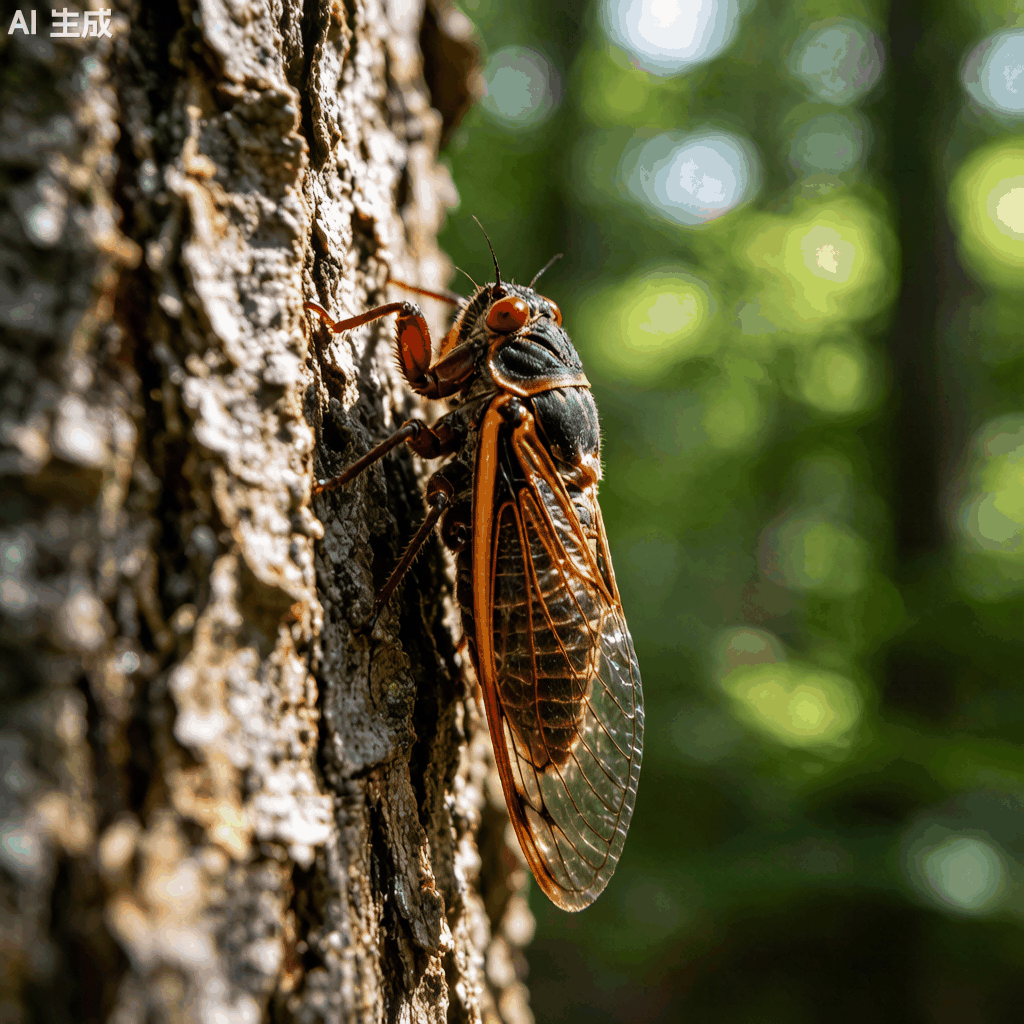
Introduction
The periodical cicada Magicicada septendecim is one of the most extraordinary insects in the world, famous for spending seventeen years as a subterranean nymph before emerging in staggering numbers to breed. Native to the eastern and central United States, it belongs to a small group of species whose life cycles are synchronized to prime-numbered durations of thirteen or seventeen years. When the moment arrives, hundreds of thousands of individuals can emerge per acre, filling the air with a chorus of buzzing songs and transforming forests into a shimmering spectacle. Few events in the natural world match the scale of a periodical cicada emergence; among the rare phenomena that compare are the synchronized songs of the humpback whale during breeding season, both showcasing how animals coordinate en masse for reproduction. After a brief adult life of just a few weeks, the cicadas mate, lay eggs, and die, leaving the next generation to begin another long countdown underground. This remarkable rhythm has fascinated scientists and the public alike, offering insights into evolution, predator satiation, and the mathematics of prime numbers in nature.
Taxonomy
Magicicada septendecim is a member of the order Hemiptera, the true bugs, and the family Cicadidae, the cicadas. The genus Magicicada is unique to eastern North America and contains seven described species divided into thirteen-year and seventeen-year groups. M. septendecim is the type species of the seventeen-year cohort and was first scientifically described in the eighteenth century. Its name combines a coined genus prefix with the Latin for “seventeen,” reflecting its life cycle. Periodical cicadas are distinct from the familiar annual or dog-day cicadas that appear every summer; the periodical species are smaller, have striking black bodies with red eyes and orange wing veins, and emerge in precise broods. The seventeen-year species are further categorized into broods designated by Roman numerals, each tied to a geographic region and a specific calendar year. Genetic and morphological studies confirm that the periodical cicadas form a cohesive group that split from annual ancestors, evolving their unusual synchronized cycles relatively recently in evolutionary terms. Their classification continues to be refined as researchers study hybridization between broods.
Physical Characteristics
Adult Magicicada septendecim measures roughly two to three centimeters in length, with a wingspan of about three to four centimeters. Its body is glossy black, set off by prominent red eyes and reddish-orange markings on the thorax and wing veins, making it visually distinct from the drab brown annual cicadas. The two pairs of membranous wings are held tent-like over the abdomen and bear characteristic orange coloration along the leading edges. Males possess a pair of ribbed tymbal organs on the abdomen that, when rapidly buckled, produce the species’ signature clicking and buzzing song. Females lack tymbals but have a sharply pointed ovipositor for cutting slits in twigs to deposit eggs. The nymphal stage, by contrast, is pale, wingless, and equipped with powerful front legs adapted for digging in soil. Nymphs have a robust build and hooked appendages for clinging to roots. The transition from nymph to adult occurs during a final molt above ground, during which the insect expands its wings and darkens to the adult coloration. Despite their alien appearance, periodical cicadas are harmless and do not bite or sting.
Habitat and Distribution
Magicicada septendecim is found across the eastern and midwestern United States, from the Great Plains eastward to the Atlantic seaboard and from the Gulf states northward into the Great Lakes region. It inhabits deciduous forests, woodlands, orchards, suburban shade trees, and parks, anywhere mature trees provide the root systems that sustain the subterranean nymphs. Each brood occupies a distinct portion of this range, so a given location may experience an emergence only once every seventeen years while neighboring broods emerge in different years. The nymphs live exclusively underground, feeding on xylem sap from tree roots at depths of several centimeters to more than a meter, and are remarkably tolerant of varied soil types. Above ground, adults prefer the trunks and branches of hardwood trees such as oak, hickory, maple, and apple. Because their cycle is so long, the landscape can change dramatically between emergences, with urban development sometimes replacing the forests the cicadas depend on. Connectivity of woody habitat is important, as it allows the mass emergence and mating to proceed across a continuous chorus range.
Diet and Behavior
Throughout their lives, periodical cicadas feed on plant fluids. As nymphs, they pierce tree roots with their straw-like mouthparts and sip nutrient-poor xylem sap, a diet that helps explain their extremely slow growth over seventeen years. Above ground, adults similarly feed on sap from twigs, though feeding is minimal compared with the nymphal stage. The defining behavior of the adult phase is reproduction, orchestrated by sound. Males aggregate in trees and sing in chorus, with each species producing a distinctive rhythmic song; M. septendecim has a calling song described as a rising buzz punctuated by ticks. Females respond with wing flicks, and mating follows. Periodical cicadas are harmless to humans and do not consume leaves or damage healthy trees significantly, though females’ egg-laying can cause minor flagging of branch tips on young trees. Their emergence is synchronized to overwhelm predators through sheer numbers, a strategy called predator satiation, ensuring that even if many are eaten, enough survive to reproduce. After mating, adults live only a few weeks before dying, their bodies returning nutrients to the forest floor.
Reproduction
Reproduction in Magicicada septendecim is tightly linked to the brief adult window. Shortly after emergence and hardening of the exoskeleton, males form singing aggregations that attract females. A successful male mates and the female then seeks suitable twigs, usually on the underside of branches, where she cuts a series of slits and inserts her eggs, sometimes dozens per site and several hundred in total. The eggs incubate for six to ten weeks before hatching into tiny first-instar nymphs that drop to the ground and burrow into the soil, beginning the long subterranean phase. There the nymphs feed and grow through five instars over the next seventeen years, molting between stages. The precise timing of emergence is triggered when soil temperatures at root depth reach about eighteen degrees Celsius in the spring, ensuring that all members of a brood surface together. This synchronization is the key to the species’ survival strategy. Because the entire brood emerges at once, predators cannot consume them all, and the next generation is secured. The long juvenile period also means that successful reproduction occurs only once per individual, making each emergence a high-stakes event.
Conservation Status
Periodical cicadas as a group are not considered globally threatened, and Magicicada septendecim remains abundant across its range wherever suitable woodland persists. Their enormous numbers and synchronized emergences give them a natural buffer against predation. However, they face localized threats from habitat loss and fragmentation caused by agriculture, urban expansion, and the removal of mature trees that support their root-feeding nymphs. Because each brood is tied to a specific region and calendar year, the extirpation of a brood from a developed area is effectively a seventeen-year-setback for local presence, and some historical broods have disappeared entirely where forests were cleared. Climate change may also shift emergence timing, potentially desynchronizing broods or exposing nymphs to unusual temperature cues. Conservation of periodical cicadas is largely a matter of preserving connected deciduous habitats and mature tree cover. They are generally protected by their sheer abundance and by public fascination, but monitoring brood distributions through citizen science has become an important tool for detecting declines. Protecting woody corridors benefits countless other forest species as well.
Fun Facts
Periodical cicadas spend up to ninety-nine percent of their lives underground, making the adult phase a fleeting finale to a seventeen-year wait. Their life cycles use prime numbers, thirteen and seventeen, which scientists believe help the cicadas avoid synchronization with predator population cycles, a clever natural safeguard. When they emerge, densities can exceed one million individuals per hectare, loud enough to rival the sound of a lawnmower. The empty nymph shells left clinging to tree trunks after molting are a familiar sight and are sometimes mistaken for the live insects. Cicadas do not bite or sting and are edible, having been eaten by humans and wildlife for centuries. Their sudden appearance after so many years underground has inspired folklore and wonder across the regions they inhabit. The nutrient pulse from millions of dying adults enriches forest soil and feeds a variety of animals. Perhaps most astonishing is that an individual cicada’s internal clock is so precise it can “count” seventeen years beneath the soil before surfacing on cue.
[…] insect shares the family with the Periodical Cicada. That insect spends 17 years underground. Our insect spends only 2 to 4 years there. Both belong to […]