 By st20113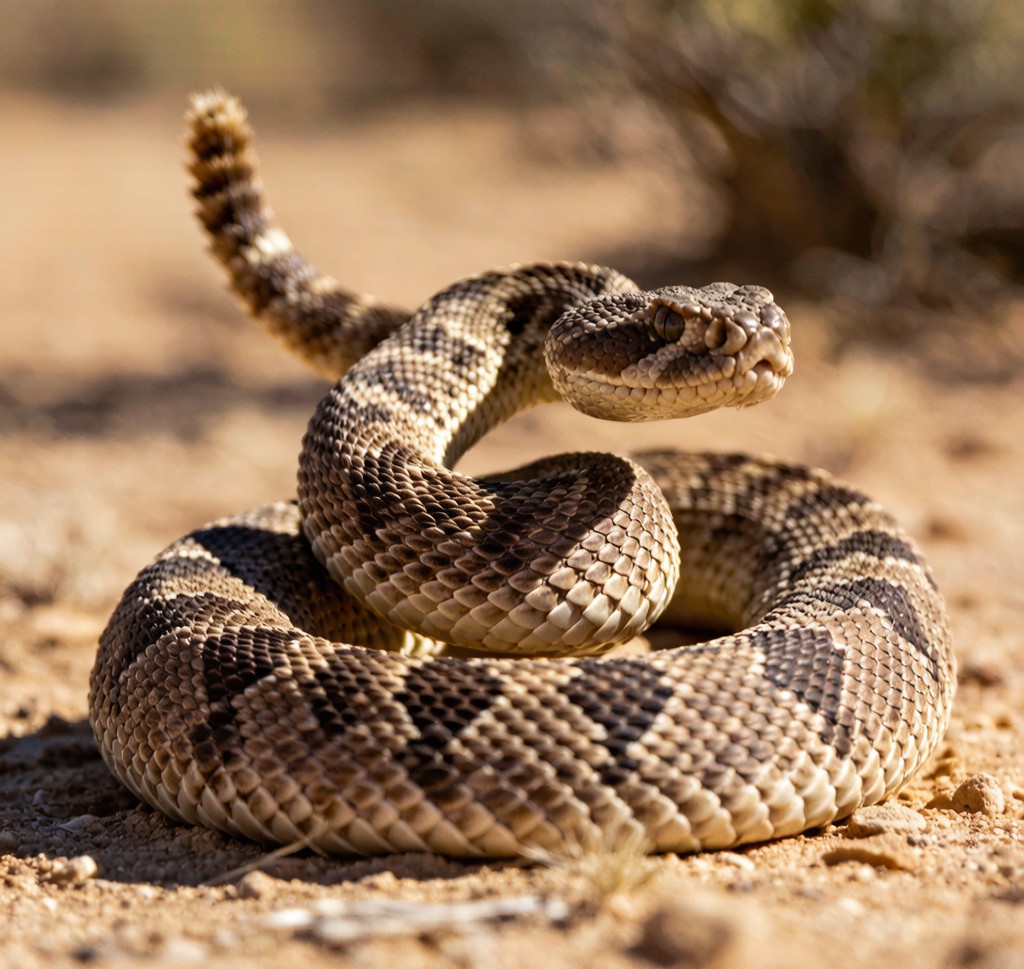
Introduction
The Western Diamondback Rattlesnake (Crotalus atrox) is a stout, venomous pit viper of the American Southwest and northern Mexico, famous for the distinctive diamond pattern along its back and the warning rattle at the tip of its tail. Reaching lengths of 1 to 1.5 meters, it is one of the most recognizable and ecologically important snakes of the arid West, playing a key role in controlling rodent populations.
Although feared, it is generally not aggressive and prefers to avoid humans, rattling as a warning before striking only when threatened. As a venomous hunter it contrasts sharply with the ball python, a harmless African constrictor that subdues prey without venom, the two representing opposite strategies among the world’s snakes.
Taxonomy and Classification
The Western Diamondback belongs to the family Viperidae, the vipers, and the subfamily Crotalinae, the pit vipers, which include rattlesnakes, copperheads, and lanceheads. Its scientific name, Crotalus atrox, means rattle and fierce or terrible, reflecting both its warning device and fearsome reputation.
Pit vipers are distinguished by heat-sensing pits between the eye and nostril that detect warm-blooded prey. The species is one of many rattlesnakes native to the Americas and is not closely related to the constrictors such as the South American green anaconda, which overwhelms prey by coiling rather than envenomation.
Physical Characteristics
Western Diamondbacks are heavy-bodied, with adults measuring 1 to 1.5 meters and weighing 1.5 to 3 kilograms. Their coloring is gray, tan, or pinkish brown with a row of dark diamond-shaped blotches edged in white or cream running down the back, and banded black-and-white rings on the tail.
The broad, triangular head houses long, hollow fangs, and the eyes have vertical pupils. The rattle is made of interlocking keratin segments that buzz when shaken, a sound unique to rattlesnakes.
Habitat and Distribution
This rattlesnake occupies deserts, grasslands, shrublands, and rocky foothills from central Arkansas and Oklahoma through Texas, New Mexico, Arizona, and into Mexico. It favors areas with cover such as brush, rocks, and burrows where it can hide and hunt.
It is well adapted to heat and aridity, active mainly at dawn, dusk, and night in hot months, and basking in cooler seasons. It often uses rodent burrows for shelter and thermoregulation.
Diet and Behavior
Western Diamondbacks are ambush predators that eat rodents, rabbits, ground-nesting birds, and lizards. They strike with venom that quickly immobilizes prey, then release and track it by scent before swallowing it whole.
Their heat pits let them hunt accurately in total darkness. Despite their fearsome image, they are cautious and use their rattle to avoid conflict, striking mainly when stepped on or cornered.
Reproduction and Life Cycle
Unlike many snakes, rattlesnakes are ovoviviparous, bearing live young. After a gestation of about six to seven months, females give birth to 10 to 20 babies, each equipped with a tiny button rattle and fully functional venom.
The young are independent at birth and must fend for themselves. They grow by shedding their skin several times a year, adding a new rattle segment each time, though rattles break and are not reliable age indicators.
Conservation Status
The Western Diamondback is listed as Least Concern, abundant across much of its range. It is, however, killed by vehicle traffic, fear-based persecution, and habitat loss in developed areas.
It provides valuable rodent control that benefits agriculture and human health. Education and coexistence programs help reduce needless killing and promote appreciation of its ecological role.
Fun Facts
A rattlesnake’s rattle is made of the same material as human fingernails and grows a new segment each time the snake sheds. The sound can warn large animals, including humans, to keep their distance.
The species can survive long periods without food by slowing its metabolism. Among the world’s non-venomous giants, the green anaconda of South America uses sheer size and constriction rather than venom, while the small African ball python simply curls into a defensive ball, a reminder of how differently snakes have evolved to hunt and survive.