 By st20113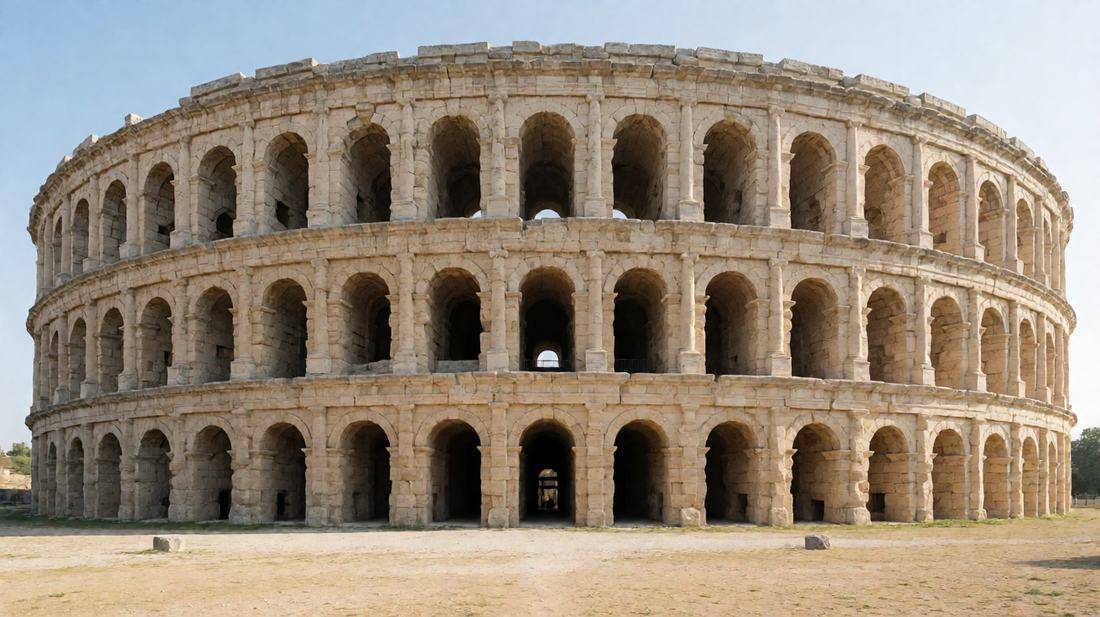
The Colosseum | The Flavian Amphitheatre
Historical Profile · Rome, Italy
The Colosseum | The Flavian Amphitheatre
Concrete, crowd control and eighty numbered gates let 50000 people watch the games and leave again in minutes.
AD 72-80
Begun
Opened
Capacity
Entrances
Listed
The big picture
Introduction
The Colosseum is the largest arena ever built by the Roman world. Work began in AD 72 under the emperor Vespasian. It opened in AD 80 under his son Titus. The next emperor, Domitian, finished it.
He ruled from AD 81 to AD 96. The building could hold about 50000 people. It stands in the centre of Rome today. It is worn but still whole enough to show how it worked.
For almost 400 years it was the chief stage of the Roman games. It remains the best-known ruin of the old world.
Setting
Historical Context
Rome had just come through a hard decade. A great fire had burned much of the city in AD 64. The emperor Nero took a large area of the centre for his own palace and lake. In AD 69 the state fell into civil war. That year saw four emperors.
Vespasian won it and began a new line, the Flavians. He had to show that the land Nero took belonged to the people again. The drained lake gave him a perfect site. The spoils of the war in Judaea gave him the money. The form of the building was not new.
Towns across Italy already had arenas. One at Pompeii was more than 100 years old. What was new was the scale. Rome had the money and the crowds to build far bigger than any town could.
Turning points
Key Events
Vespasian began in AD 72 and died in AD 79. That same year Vesuvius buried Pompeii and Herculaneum. The ash kept a smaller arena safe. His son Titus opened the new building in AD 80. The games lasted 100 days. Domitian added the highest tier of seats.
He also built walls and passages below the floor. Those let fighters and stage gear appear without warning. Fire damaged the building in AD 217. It was repaired more than once. The games went on for hundreds of years. By the late 400s they had stopped.
After that the building was used as a stone yard. Stone was taken for churches and palaces. In the 1800s the popes called it a sacred place. The mining of stone then ended.
1
2
3
Who held power
People and Powers
Vespasian and his sons were practical rulers. They were not from the old noble families. They used huge building work to make their name. The arena carried the family name for hundreds of years. The real power in the building belonged to the crowd. Seating followed rank exactly. The emperor had his own box. Senators and officials sat in the lowest ring, close to the action. Ordinary citizens sat higher up.
Women and the poor went to the top. The front rows were reserved by law. A numbered ticket told every person where to go. There were 80 entrances, each with its own number. The whole crowd could leave in a few minutes. Below the floor ran a small city. There were rooms for fighters and stores for stage gear. There were shafts and lifts as well. Sailors from the fleet worked the great awning.
It could be pulled across the whole arena to give shade. The staff who ran the place were as organised as an army. There were crews for the awning and keepers of the passages. Men worked the lifts, and a band of guards kept order. A doctor and a small team stood by for the fighters. Water was piped in, and drains carried it away. The passage walls were built strong enough to take the weight of the crowd above.
Everyday world
Daily Life and Society
A day at the games was free and it was long. It began early and ran into the evening. Officials handed out bread. The crowd drank and shouted. Fights between trained fighters were the main event. Each match ended when the referee decided.
Between the matches came staged set pieces. Whole scenes were built and pulled away again. On some days the arena was flooded for a fake sea battle. The building was also a machine. It rested on a ring of concrete and stone. The face was blocks of travertine from quarries outside the city.
Brick and concrete did the hidden work. Three levels of arches carried the upper seats. The ground floor was full of shops and stairs. The arches were framed with half columns in three styles.
Craft and ideas
Trade, Technology and Ideas
The Roman gift here was concrete and order. Roman concrete could be poured into shapes. It set under water. It could carry enormous weight. It let builders throw arches and vaults across wide spaces.
They needed no mass of supports. The same method built baths, water bridges, harbour walls and domes in every province. The columns on the outside were borrowed from Classical Greece. The three styles were stacked in order. The heaviest stood at the bottom and the lightest at the top.
This mix of Greek order and Roman engineering became the standard look of Roman public building. It is why the ruin still reads clearly from a distance. A smaller arena at Pompeii and Herculaneum shows how the plan worked in a country town. It was sealed under ash in AD 79. It has the same rank order and the same numbered entrances.
What lasted
Legacy
The Colosseum set the shape of the modern stadium. Seats round a central field, exits at every level, a canopy overhead: all of this was worked out here first. Its name became a general word for a large arena. The name comes from a huge statue that once stood nearby. The building has been a mirror for each age that used it.
In the Middle Ages it was a fort and a stone yard. In the 1700s it became a stop on the grand tour of Europe. In 1980 it was listed as a world heritage site. Today about 6 million people walk through it each year. Modern arenas still copy the plan.
They copy the oval field and the numbered gates. Engineers who have studied the ruin report that its crowd control was very good. It was better than that of many stadiums built in the last century. The empty arches have also been used for concerts at night. That has brought its own problems of wear.
Quick hits
Five Things to Remember
- Work on the Colosseum began in AD 72 under Vespasian.
- It opened in AD 80 with games lasting 100 days.
- It could hold about 50000 people.
- Pompeii and Herculaneum were buried by Vesuvius in AD 79.
- Three levels of arches carried the seats, each framed in a different Greek style.