 By st20113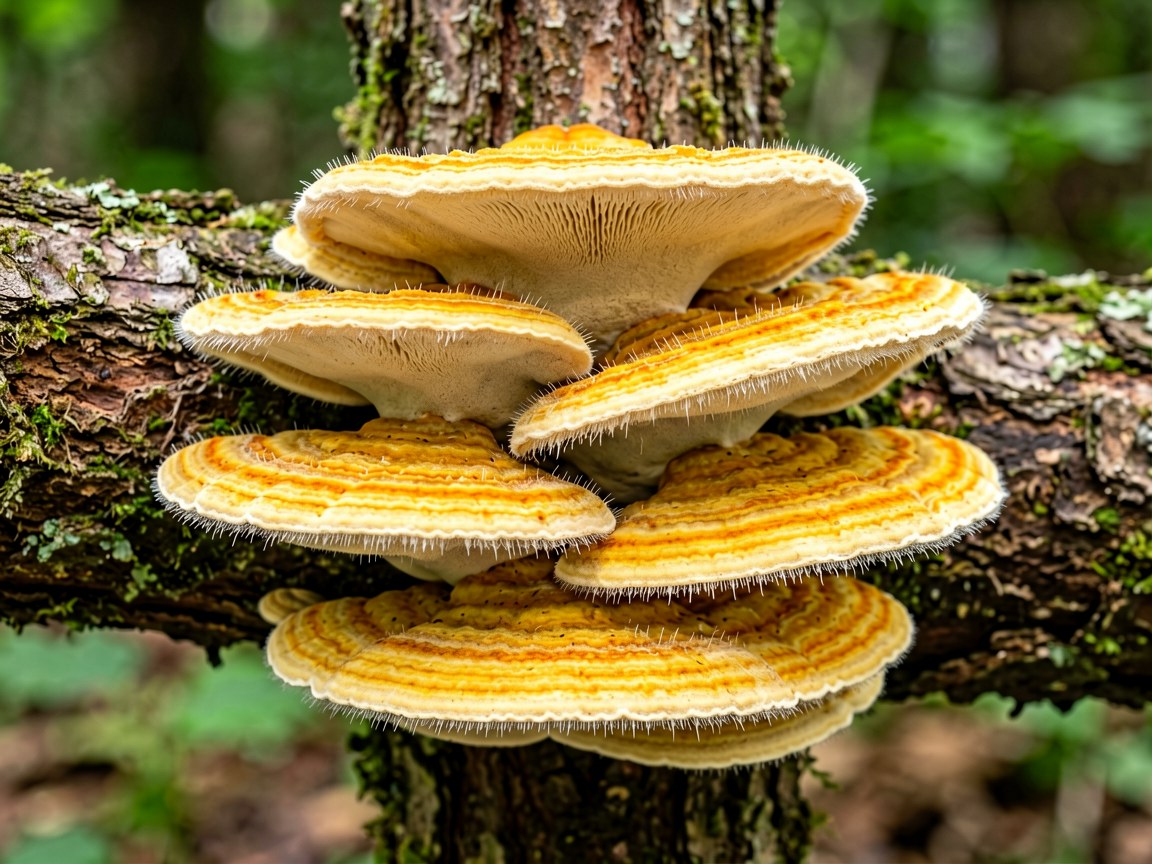
Stereum hirsutum | Hairy Curtain Crust
Introduction
The hairy curtain crust (Stereum hirsutum) is one of the commonest fungi of dead wood, a thin, leathery, bracket-like crust that spreads across the underside of fallen branches and logs in overlapping tiers, its upper surface zoned in bands of grey, fawn, ochre, and rusty orange, its underside smooth and brilliant egg-yellow. It is one of the first fungi most people learn, because it is everywhere, because the yellow underside is so striking when a log is turned over, and because the zoned, hairy upper surface is quite unlike anything else. It is not a true bracket fungus but a crust fungus that has lifted its edge away from the wood, and the result is a flexible, leathery sheet that can be peeled off in strips. Common, colourful, and present in every month of the year, it is one of the more rewarding of the smaller fungi to look at closely.
Taxonomy
Stereum hirsutum is a basidiomycete in the order Russulales and the family Stereaceae, the crust fungi, a group whose members form thin, resupinate or bracket-like sheets on wood with a smooth spore-bearing surface rather than gills, pores, or teeth. The genus name comes from the Greek for “solid” or “firm”, a reference to the tough, leathery texture, and the specific epithet hirsutum means “hairy”, which describes the felted upper surface. Its relatives include the bleeding broadleaf crust Stereum rugosum, which bruises blood-red when scratched, and a number of other thin, leathery wood fungi. As a basidiomycete it produces its spores externally on club-shaped basidia, as does Amanita muscaria, but the basidia are packed together over a smooth, flat surface on the underside rather than hanging from gills, and the whole fruit body is reduced to a thin sheet.
Physical Characteristics
The fruit body is thin, tough, leathery, and flexible, spreading over the wood as a resupinate patch when young and then lifting at one edge, usually the lower or outer edge, to form a narrow, wavy, shell-shaped or bracket-like projection one to four centimetres wide; several often arise in overlapping tiers along the underside of a branch. The upper surface of the projecting part is distinctly hairy or felted, zoned concentrically in bands of grey, pale fawn, ochre, and rusty orange, and it is often greenish from the algae that grow on it in damp situations. The margin is thin, wavy, and sharply defined. The underside, which is the fertile surface, is smooth, and it is a bright, clear egg-yellow to orange-yellow when fresh and actively growing, fading to dull ochre or brownish with age; it is this bright yellow underside that makes the fungus so easy to recognise. The flesh is thin, tough, and pale. The spores are small, smooth, cylindrical, and hyaline, and the spore print is white to pale cream.
Habitat
It grows on dead wood of all kinds but especially on the fallen branches, logs, and stumps of broadleaf trees — oak, beech, hazel, birch, and many others — and it is one of the commonest fungi of dead timber in woodland, hedgerows, parks, gardens, and anywhere with rotting wood. It is particularly abundant on branches that are still on the ground but not yet deeply decayed, and it favours the underside of a log, where it is protected from direct sun and drying wind. It also occurs on worked timber, on fence posts, and on stacked logs. The species is virtually cosmopolitan and is found throughout the world’s temperate regions; it is abundant everywhere in Britain and Ireland. It can be found at any time of year, since the fruit bodies are perennial and tough, but it is most conspicuous in autumn and winter, when few other fungi are about.
Diet
It is a saprotroph and a white-rot fungus, decomposing the dead wood of broadleaf trees by breaking down both the cellulose and the lignin, and it is one of the important early and middle-stage decay organisms of fallen branches. It is one of the first fungi to colonise a branch after it falls, and it persists as the wood softens and as other fungi and invertebrates move in. It also occurs on wood that has already been attacked by other species, and it is frequently found alongside them. Although it is principally a decay organism, it is occasionally found on living but weakened branches, and it can be a minor cause of dieback. Its significance lies in the sheer volume of woody material it processes: because it is so abundant and so universal, it is one of the fungi most responsible for the disappearance of dead branches from the woodland floor.
Reproduction
The spores are produced over the smooth, yellow underside of the fruit body and are released into the air beneath the log, where they are carried away by air currents. Because the fungus fruits on the underside of fallen wood, the spores are shed into a narrow space, and the fruit body’s habit of lifting its edge and of growing on the lower surface of a raised log is thought to help the spores escape into the moving air rather than simply falling to the ground. The spores are produced in enormous numbers over a long season, since the fruit bodies are perennial and grow slowly. Those that land on suitable dead wood germinate into a mycelium that must meet a compatible partner before it can fruit, and the mycelium then spreads through the wood well beyond the visible fruit bodies. Because the fungus is so common, its spores are almost always present in the air, and any suitable piece of dead wood is colonised rapidly once it becomes available.
Conservation
The species is abundant, virtually cosmopolitan, and under no threat, and it is one of the fungi most tolerant of managed and disturbed habitats, since any pile of prunings, any log stack, and any pile of firewood will carry it. If there is a conservation message it concerns dead wood in general: the fungus is an indicator that woody material is being left to decay, and its disappearance from a site would mean that dead wood was being systematically cleared, chipped, or burnt. Leaving fallen branches, logs, and stumps where they lie is enough to maintain it and the whole community of species that depends on it. For the naturalist it is one of the most rewarding species to look at closely, since a single log will often show the zoned, hairy upper surface, the bright yellow fertile layer, and the green algal staining all at once.
Fun Facts
- The underside is a brilliant egg-yellow, which makes it easy to spot when a log is turned over.
- The upper surface is hairy and zoned in concentric bands of grey, ochre, and rusty orange.
- It is a crust fungus that has lifted its edge into a bracket shape rather than a true bracket fungus.
- It is found in every month of the year and is one of the commonest fungi on dead wood.
- Old specimens are often stained green by the algae that grow on the hairy upper surface.