 By st20113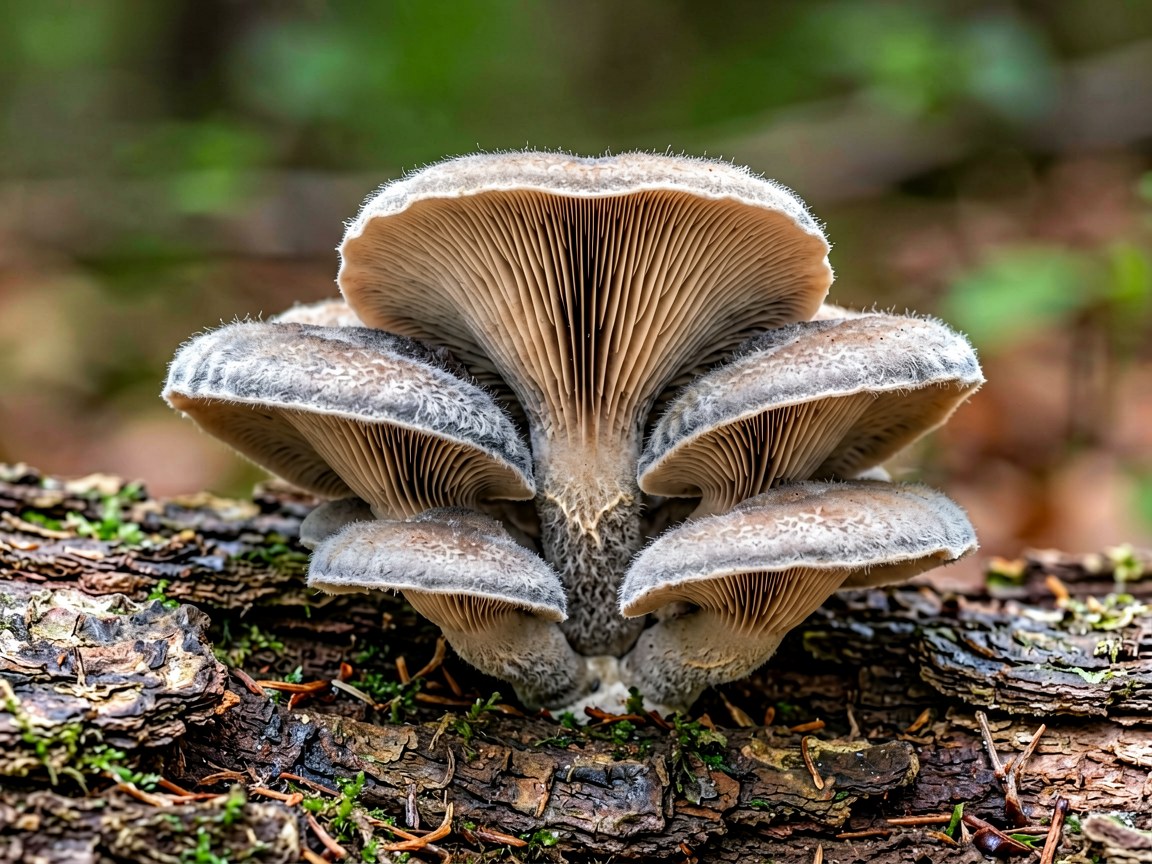
Schizophyllum commune | Split Gill
Introduction
The split gill (Schizophyllum commune) is one of the most widespread fungi on earth, found on every continent except Antarctica and recorded from more countries than almost any other fungus. It is a small, tough, hairy, fan-shaped or shell-shaped bracket that grows in dense, overlapping tiers on dead wood, and its name comes from its most distinctive feature: the “gills” on the underside are not true gills at all but narrow, radiating folds, each of which is split down its length and rolled back at the edges, so that the underside looks like a series of little split lips rather than the flat blades of a mushroom. It is also remarkable for its tolerance of drying: a specimen can shrivel to a hard, curled husk in dry weather and then reopen and resume spore production after a single night of rain, and it can repeat this cycle for years.
Taxonomy
Schizophyllum commune is a basidiomycete in the order Agaricales and the family Schizophyllaceae, and despite its bracket-like shape it is a gilled mushroom that has adapted to life on wood, rather than a bracket fungus in the polypore sense. The genus name means “split leaf”, referring to the split gill folds, and the specific epithet commune means “common”, which is an understatement. Molecular work has shown that it is a species complex, with several cryptic lineages that look the same but will not mate with one another, and it has been studied more intensively than almost any other fungus: it was a model organism for research on mating types, on the genetics of development, and on the industrial production of the polysaccharide schizophyllan. As a basidiomycete it produces spores externally on club-shaped basidia, as does Amanita muscaria, but the basidia line the two faces of each narrow, split fold rather than the sides of a gill.
Physical Characteristics
The fruit body is small, tough, leathery, and flexible, usually one to four centimetres across, and it is fan-shaped, shell-shaped, or roughly semicircular, attached to the wood at the side or by a very short, rudimentary stem, with no true cap and stem. The upper surface is dry, densely hairy or felted, and greyish-white to pale grey or pale fawn, sometimes with a faint lilac or pinkish tinge when young, and it is often zoned or faintly lobed; the margin is thin, wavy, and often lobed or split. The underside carries the diagnostic feature: a series of narrow, radiating, gill-like folds running from the point of attachment to the margin, each one greyish-white to pale pinkish-grey or lilac-grey, and each split down the middle so that the two halves curl back and away from one another, exposing the spore-bearing surface on both halves. The whole structure is tough and pliable when moist and hard, brittle, and curled when dry. The spores are small, smooth, cylindrical, and hyaline, and the spore print is white.
Habitat
It grows on dead wood of all kinds, both broadleaf and conifer, on stumps, logs, fallen branches, fence posts, worked and sawn timber, and occasionally on the bark of living but damaged trees, and it is one of the first fungi to appear on newly dead wood in warm, dry situations. It is particularly characteristic of dry, exposed, sunlit wood — fence rails, stacked logs, dead branches still attached to a tree — because its ability to shrivel and revive lets it survive conditions that would destroy a soft, fleshy mushroom. It occurs in woodland, hedgerows, gardens, parks, farmyards, and on timber in use, and it is found worldwide; it is common throughout Britain and Ireland. Fruiting is mainly from late summer into winter, though the dry, hardened fruit bodies persist for months or years.
Diet
It is a saprotroph and a white-rot fungus, able to break down both the cellulose and the lignin of the wood it colonises, and it is one of the important decomposers of dry, exposed timber, where its tolerance of desiccation gives it an advantage over most of its competitors. It is found on hardwood far more often than on softwood in Europe, though it will grow on conifer wood readily, and it is a common cause of rot in fence posts, railings, and other timber in contact with the ground. It can also act as a weak pathogen, colonising the damaged bark of living trees, and it is occasionally recorded as a cause of disease in people and animals, though such cases are rare and generally involve people with weakened immune systems. In the laboratory it is grown readily on simple media, which is why it became such an important experimental organism.
Reproduction
The spores are produced on both faces of each split fold and are released in enormous numbers into the air, and the species is one of the most abundant sources of airborne fungal spores in many parts of the world, with implications for respiratory allergy. Sexuality in this fungus is famously complex: rather than two mating types, it has tens of thousands, determined by two separate genetic loci, so that almost any two individuals that meet are compatible, and the details of this system were worked out in Schizophyllum and were fundamental to the modern understanding of fungal mating. The fruit bodies are perennial in the sense that they dry out and revive repeatedly, and a single individual can produce and release spores over a period of several years, opening its folds and resuming discharge after each period of rain. This combination of abundant spores, near-universal compatibility, and extreme tolerance of drying is the basis of its worldwide success.
Conservation
The species is one of the most abundant and widely distributed fungi on earth and is under no threat of any kind; if anything it is expanding, since it colonises sawn timber, fence posts, and wood chips as readily as natural dead wood and is tolerant of warm, dry, and disturbed conditions. Its abundance makes it a familiar species in fungal surveys, and because it fruits on worked timber it is one of the fungi most often noticed by people who would not think of themselves as naturalists. Its significance is scientific and economic: it provides the polysaccharide schizophyllan, which is used in industry and studied for its medical properties, it is a model organism in fungal genetics, and it is one of the commonest causes of rot in timber in service.
Fun Facts
- It is found on every continent except Antarctica, and is one of the most widespread fungi in the world.
- The “gills” are split down the middle and rolled back, which is what gives it its name.
- It can dry to a curled husk and reopen to release spores again after rain, over and over for years.
- Instead of two mating types it has tens of thousands, so almost any two individuals are compatible.
- It is a major source of airborne spores and is used in industry to produce the polysaccharide schizophyllan.