 By st20113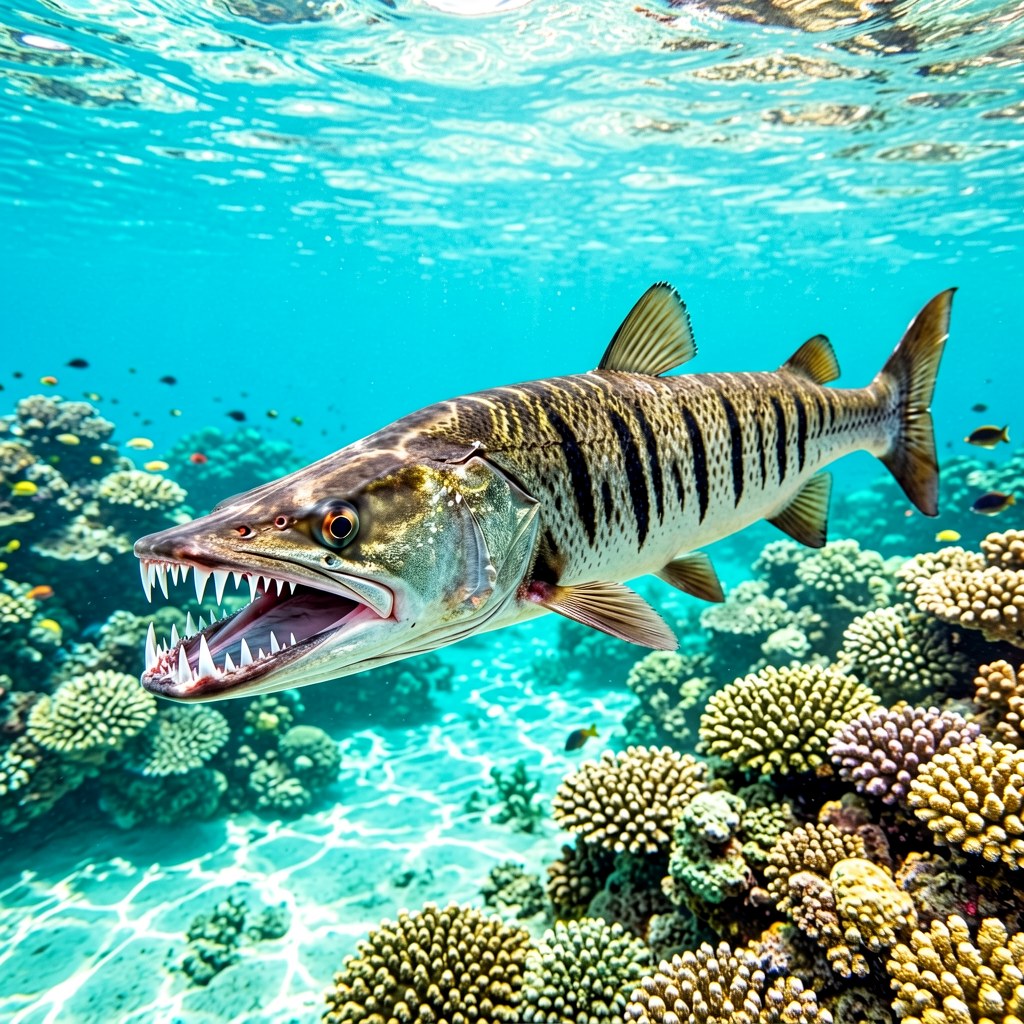
Sphyraena barracuda | Great Barracuda
Introduction
The great barracuda is a formidable predatory fish of tropical and subtropical seas, renowned for its elongated body, razor-edged jaws, and explosive ambush attacks. Adults commonly reach lengths of 60 to 100 centimeters and weights of 5 to 15 kilograms, though the largest specimens can exceed two meters and approach 50 kilograms, making the species the biggest member of the family Sphyraenidae. Silver-flanked with a row of dark blotches along the sides, the great barracuda is a familiar sight around coral reefs, mangrove shorelines, and seagrass meadows throughout the Indo-Pacific and the warmer Atlantic. Despite its fearsome reputation, unprovoked attacks on people are rare, and most incidents involve mistaken identity or the defense of a speared fish. As an apex inshore predator it helps regulate the abundance of smaller reef fishes and maintains balance within coastal food webs.
Taxonomy
The great barracuda belongs to the family Sphyraenidae, the barracudas, within the order Perciformes, the perch-like fishes, and is placed in the genus Sphyraena, the only genus in its family. Its scientific name, Sphyraena barracuda, has remained stable in modern ichthyology, though the species was historically described under several junior synonyms. As a bony fish it shares the teleost lineage with a great many commercially important species, and among its pelagic relatives it is ecologically comparable to swift predators such as the [Yellowfin Tuna](https://www.gloencyc.com/tuna-thunnus-albacares/), which also hunts schooling fish in open warm waters. Barracudas are distinguished from tunas by their elongated, pike-like body, enlarged jaw, and absence of a fused tail keel, traits that reflect a lie-in-wait hunting style rather than sustained cruising. Roughly two dozen Sphyraena species exist worldwide, but the great barracuda is the largest and most widely distributed of the group. Molecular studies place the family close to the perciform suborder that includes jacks and snappers.
Physical Characteristics
The great barracuda has a long, cylindrical, and powerfully muscled body built for sudden acceleration rather than endurance swimming. The head is large and the lower jaw projects well beyond the upper, armed with a terrifying array of sharp, fang-like teeth of unequal size, including a prominent pair of canine teeth visible even when the mouth is closed. Coloration is silvery overall with a greenish or bluish back and a series of 18 to 22 dark vertical bars or blotches along the upper flanks that fade with age in larger fish. The dorsal fins are widely separated, the first small and spiny and the second soft-rayed and set far back near the forked caudal fin, an arrangement that aids rapid starts. Pectoral and pelvic fins are small and positioned low on the body, and the lateral line runs straight along the midline. Juveniles are more boldly barred and often school in shallow habitats, while adults become solitary, less marked, and far larger. The eyes are large and keen, adapted to detect movement in clear, sunlit water.
Habitat
Great barracudas occupy a wide band of warm, shallow marine habitats, from mangrove-lined estuaries and seagrass beds to coral reefs, rocky points, and the edges of continental shelves down to about 100 meters. They are frequently encountered patrolling reef drop-offs and the margins of channels where currents concentrate prey, and they will also enter brackish and, occasionally, fresh water in search of food. The species ranges across the tropical and subtropical Indo-Pacific, the Red Sea, and the western and central Atlantic, including the Caribbean and the Gulf of Mexico, though it is largely absent from the cooler eastern Pacific. Smaller fish favor very shallow nursery areas such as seagrass meadows and reef flats, whereas large adults move into deeper reef passes and offshore waters. Seasonal shifts in temperature and prey abundance drive local movements, and individuals may show strong site fidelity to particular reef systems for extended periods.
Diet
The great barracuda is an opportunistic, largely piscivorous predator that captures prey with spectacular bursts of speed. Its diet is dominated by smaller schooling fishes such as grunts, snappers, jacks, mullets, and herrings, which it ambushes from cover or intercepts in open water. Squid and large crustaceans are taken when available, and very large adults may consume smaller barracudas and other reef predators. Hunting strategy relies on stealth and a final, lightning-fast lunge, often from near the substrate or behind structure, followed by a slashing bite that incapacitates the victim. The barracuda’s keen eyesight and sensitivity to contrast explain its occasional confusion of shiny objects, such as jewelry or a diver’s knife, with the flashing scales of prey fish. Stomach-content studies show that diet shifts with size, with juveniles taking shrimp and small fish and adults specializing in larger finfish. As a top predator it can influence the composition of reef fish assemblages by suppressing abundant prey species.
Reproduction
Great barracudas reproduce by spawning in the water column, with external fertilization and no parental care. Spawning typically occurs offshore in warmer months, often in spring and summer, when mature adults aggregate and release buoyant, transparent eggs and sperm into the open sea. The pelagic eggs hatch into tiny larval fish that drift with currents before settling into shallow nursery habitats such as seagrass beds and reef flats. Growth is rapid in the first years of life, and individuals reach sexual maturity at around two to four years of age, though this varies with latitude and population. Little is known about the precise timing and location of spawning grounds for most stocks, and there is evidence that some populations are sedentary while others undertake broader movements tied to reproduction. Because adults are long-lived and may not breed every year, sustained fishing pressure on mature fish can reduce recruitment more sharply than simple biomass estimates suggest.
Conservation
The great barracuda is listed by the IUCN as Least Concern, reflecting its wide distribution and the generally healthy status of many populations across the Indo-Pacific and Atlantic. It is caught in a variety of fisheries, both as a target species for its firm, white flesh and as incidental bycatch in gillnets, traps, and line gear, and it is also a popular game fish in parts of the Caribbean and Florida. A notable concern is the accumulation of ciguatoxins in larger individuals, which can cause ciguatera poisoning in people who eat the meat, so management advice often limits consumption of big barracudas. Local declines have been documented where inshore gillnetting is intense or where reef habitats have degraded. Recommended measures include size limits, protection of nursery seagrass beds, and monitoring of bycatch in small-scale fisheries. Because the species is relatively resilient compared with slow-growing sharks and rays, well-enforced local rules are usually sufficient to keep stocks stable.
Fun Facts
- A great barracuda can accelerate from a standstill to strike prey in a fraction of a second using its powerful, forked tail.
- Large adults sometimes harbor ciguatoxins, making bigger barracudas riskier to eat than smaller ones.
- The fish has two prominent fang-like canine teeth that remain visible even when its mouth is shut.
- Juvenile barracudas school in shallow seagrass beds before turning solitary as they grow.
- Great barracudas are known to follow divers and snorkelers, likely out of curiosity rather than aggression.