 By st20113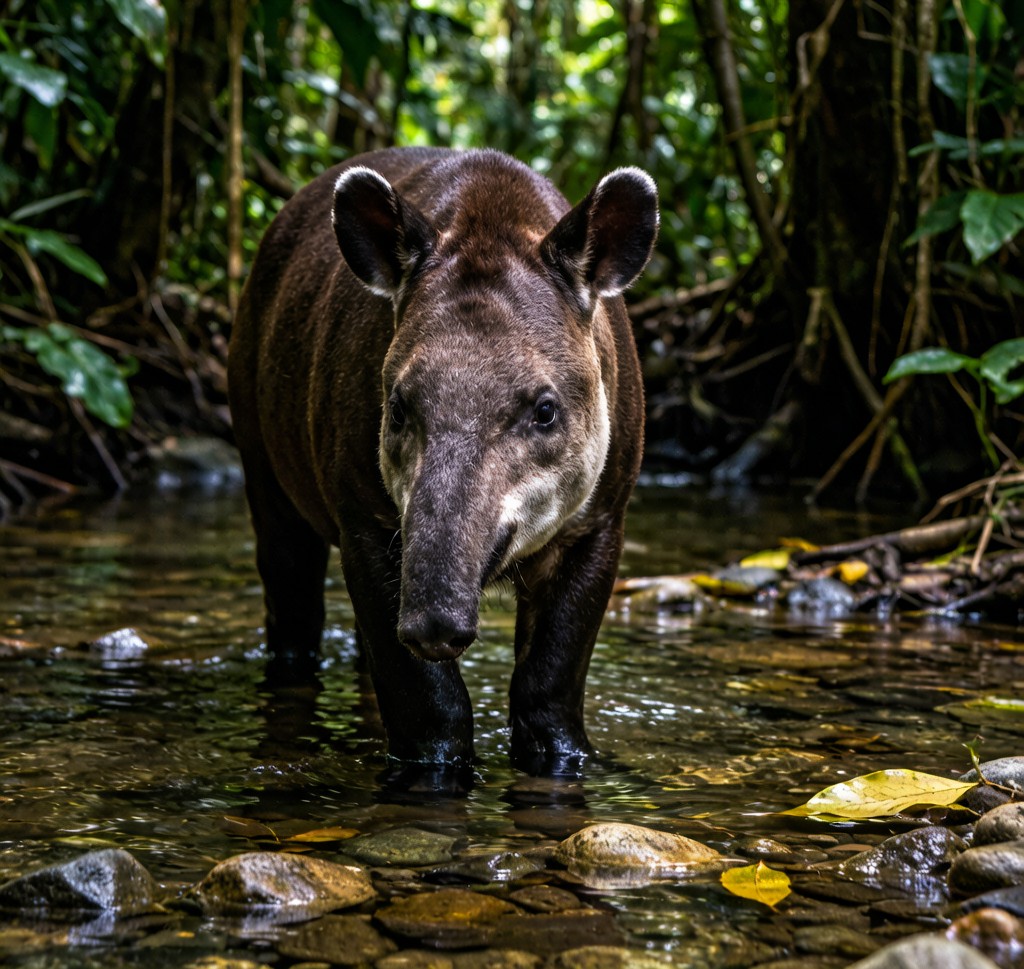
A South American Tapir (Tapirus terrestris) wading in an Amazon rainforest stream, showing its dark coat and white ear margins
Overview
The South American Tapir (Tapirus terrestris), also known as the Brazilian Tapir or Lowland Tapir, is the largest native land mammal in South America. Standing approximately 77 to 108 centimeters at the shoulder and weighing 150 to 320 kilograms, the tapir is a stout, powerfully built animal with a distinctive short, flexible proboscis or trunk – a shortened version of the elephant’s trunk that the tapir uses to grasp leaves, pluck fruit, and snorkel while wading. Despite their prehistoric appearance – tapirs are among the most ancient surviving mammals, with origins dating back approximately 50 million years – they remain widespread and ecologically vital throughout the forests and wetlands of South America.
The South American Tapir has a dark brown to black coat, short rounded ears with distinctive white margins on the ear tips – a key field identification feature – and a low, rounded dorsal ridge. It is one of four surviving species of tapir, which are the only living members of the family Tapiridae and among the most ancient groups of hoofed mammals (perissodactyls). Tapirs are highly valued as ecosystem engineers in the Amazon, as their role as the largest native fruit-eaters and primary seed dispersers in many parts of their range makes them critical for maintaining forest regeneration and diversity.
Habitat and Distribution
The South American Tapir has the widest distribution of any tapir species, occurring from Colombia and Venezuela in the north through the Amazon basin of Brazil, Peru, Ecuador, and Bolivia, to northern Argentina in the south. Within this vast range, the species occupies a wide variety of forested and open habitats including tropical rainforest, cloud forest, seasonally flooded várzea forest, cerrado savanna, and grassland adjacent to water. The species is strongly associated with water and is rarely found far from rivers, streams, lakes, or swamps.
Tapirs are highly dependent on forest cover and water bodies, and they require large areas of undisturbed habitat to maintain viable populations. They are excellent swimmers and use water bodies not only for foraging but also as a refuge from predators including jaguars and pumas. They can remain submerged for several minutes, with only the tip of the proboscis breaking the surface to allow breathing. The species’ habitat requirements and low reproductive rate make it highly sensitive to forest fragmentation and hunting pressure, and tapirs have been eliminated from much of their former range in the Atlantic Forest of southeastern Brazil.
Ecology and Behavior
The South American Tapir is primarily nocturnal and crepuscular, spending the daylight hours resting in dense forest cover and emerging to forage at night. As a large-bodied herbivore, it feeds on a wide variety of vegetation including leaves, buds, twigs, fruits, and aquatic plants. Its flexible proboscis is used to strip leaves from branches, pluck fruit from trees, and shovel aquatic vegetation into its mouth. Research from Brazil’s Pantanal has documented tapirs consuming fruit from over 300 plant species, making them one of the most important seed dispersers in South American forests.
The tapir’s role as a seed disperser is particularly significant for large-seeded fruits that cannot be dispersed by smaller animals. By swallowing seeds and passing them intact through its digestive system, the tapir deposits seeds at great distances from the parent plant, often along riverbanks and water bodies where the tapir frequently defecates. These large seeds would otherwise have no means of dispersal in fragmented landscapes where the tapir has been eliminated. The loss of tapirs from forest fragments therefore has cascading effects on forest regeneration and tree species diversity.
Reproduction and Conservation
Female South American Tapirs give birth to a single calf after a gestation of approximately 13 to 14 months – one of the longest gestation periods of any land mammal. Calves are born throughout the year but with seasonal peaks in some regions. Newborn tapirs weigh approximately 3 to 5 kilograms and are immediately capable of walking and following their mother. Critically, tapir calves are uniquely camouflaged: they are covered in a distinctive pattern of white stripes and spots on a dark brown background, which provides excellent camouflage in the dappled light of the forest floor. This juvenile coat is gradually replaced by the adult solid brown coat at approximately 4 to 6 months of age.
The South American Tapir is listed as Vulnerable on the IUCN Red List, with populations declining across much of its range. The primary threats are hunting (tapirs are widely hunted for their meat, which is prized in rural communities throughout their range), habitat loss from deforestation for agriculture and cattle ranching, and direct mortality from roadkill. The species’ low reproductive rate – females produce only one calf every 2 to 3 years – means that populations recover very slowly from additional mortality. Conservation efforts focus on reducing hunting pressure through community-based monitoring programs, protecting habitat corridors that allow tapirs to move between forest fragments, and restoring populations in degraded areas through reintroduction programs in countries such as Argentina and Uruguay.