 By st20113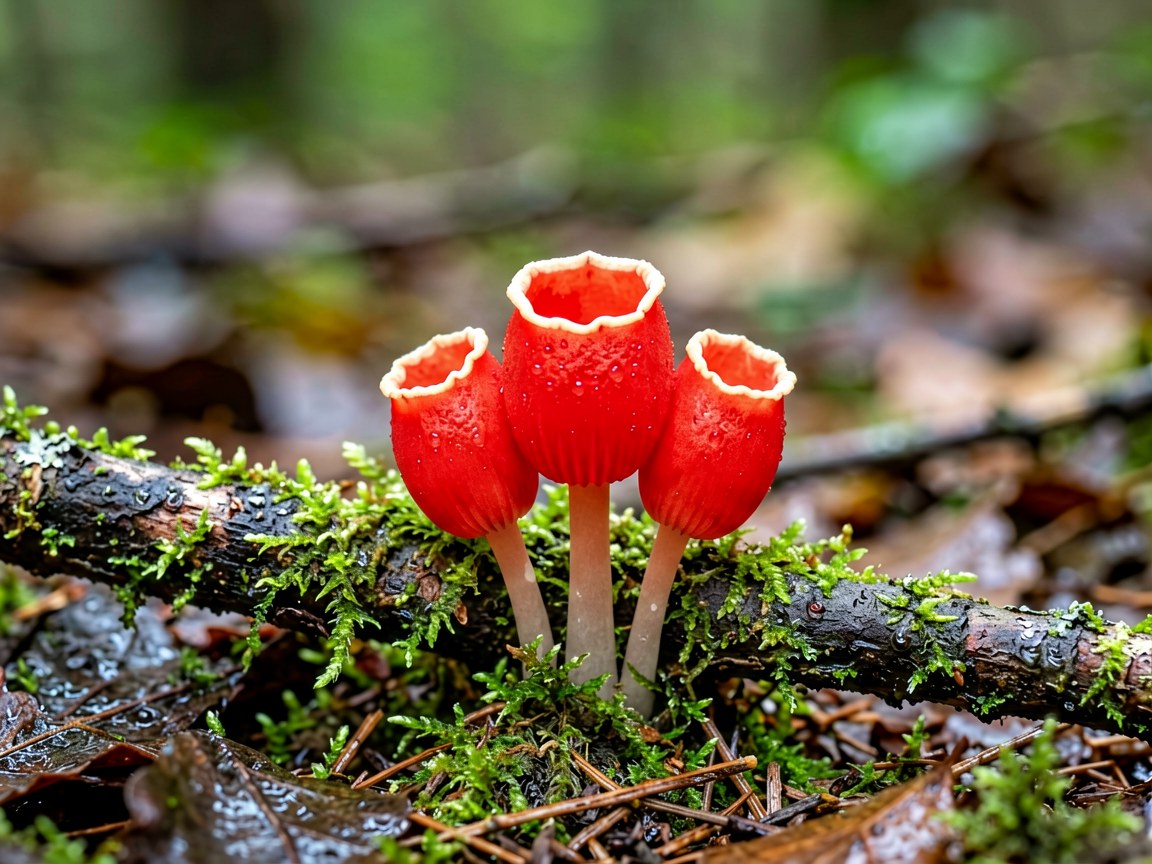
Sarcoscypha coccinea | Scarlet Elf Cup
Introduction
The scarlet elf cup (Sarcoscypha coccinea) is one of the first bright things to appear in the year’s woodlands: a small, brilliant scarlet cup with a pale rim, sitting on mossy dead twigs and branches from late winter into spring. Barely a few centimetres across, its intense colour against wet, dark bark makes it one of the most photographed fungi of the year. It is widespread but local, and it prefers damp, sheltered woodland.
Taxonomy
Sarcoscypha coccinea is an ascomycete fungus in the family Sarcoscyphaceae, the scarlet cup fungi. Unlike the familiar capped mushrooms, which are basidiomycetes that shed spores from gills or pores, it belongs to the group that produces its spores inside microscopic sacs, or asci, lining the inner surface of the cup—much like the morels and the familiar woodland species typified by Amanita‘s distant cousins but formed in a completely different way.
Physical Characteristics
The fruit body is a cup, one to five centimetres across, shallow when young and expanding to a shallow saucer with age. The inner surface is smooth and brilliant scarlet to crimson; the outer surface is paler, pinkish-buff to whitish, and covered in a fine felt of tangled hairs. The rim is often wavy and distinctly paler, sometimes almost white. There may be a short, stubby, whitish stem, often buried in moss. The flesh is thin, pale, and rubbery rather than brittle.
Habitat
It grows on dead, decaying twigs, branches, and fallen wood of broadleaved trees—especially hazel, willow, alder, oak, and beech—usually partly buried in moss or leaf litter and often in damp, shaded places. It favours sheltered woodland, stream banks, and damp hedgerows, and fruits from late winter through spring, occasionally earlier in mild years. Found across Europe, North America, and beyond, it often returns to exactly the same log year after year.
Diet
The fungus is a saprotroph. Its network of threads grows through dead wood and leaf litter, releasing enzymes that break down the tough material and absorbing the released nutrients. It is one of the organisms that helps clear away fallen twigs in woodland, working slowly and invisibly for most of the year. The red cups are only the brief reproductive stage; the feeding body lives in the wood all year round.
Reproduction
Spores are produced in microscopic sacs, or asci, that line the brilliant inner surface of the cup. When conditions are right the asci fire their spores into the air in tiny puffs, and the spores drift away on the breeze to land on new dead wood. The cups are long-lived for a fungus—weeks rather than days—and their intense colour is thought to help them absorb warmth and attract insects, which may also carry spores.
Conservation
The species is widespread and not formally threatened, though it is local and often scarce, especially where woodland is tidied and all dead wood removed. Because it depends on small, damp, decaying branches left lying in shelter, the removal of dead wood from woods and gardens is the main thing that reduces it. Leaving a pile of decaying twigs in a damp, shady corner is enough to encourage it.
Fun Facts
- It is one of the first fungi of the year, often appearing while snow is still possible.
- The scarlet inner surface is the spore-producing layer; the pale felty outside is not.
- Cups can persist for several weeks, far longer than most fleshy fungi.
- It often returns to exactly the same branch year after year.
- The intense red pigment is thought to help the cup warm in weak spring sunlight.