 By st20113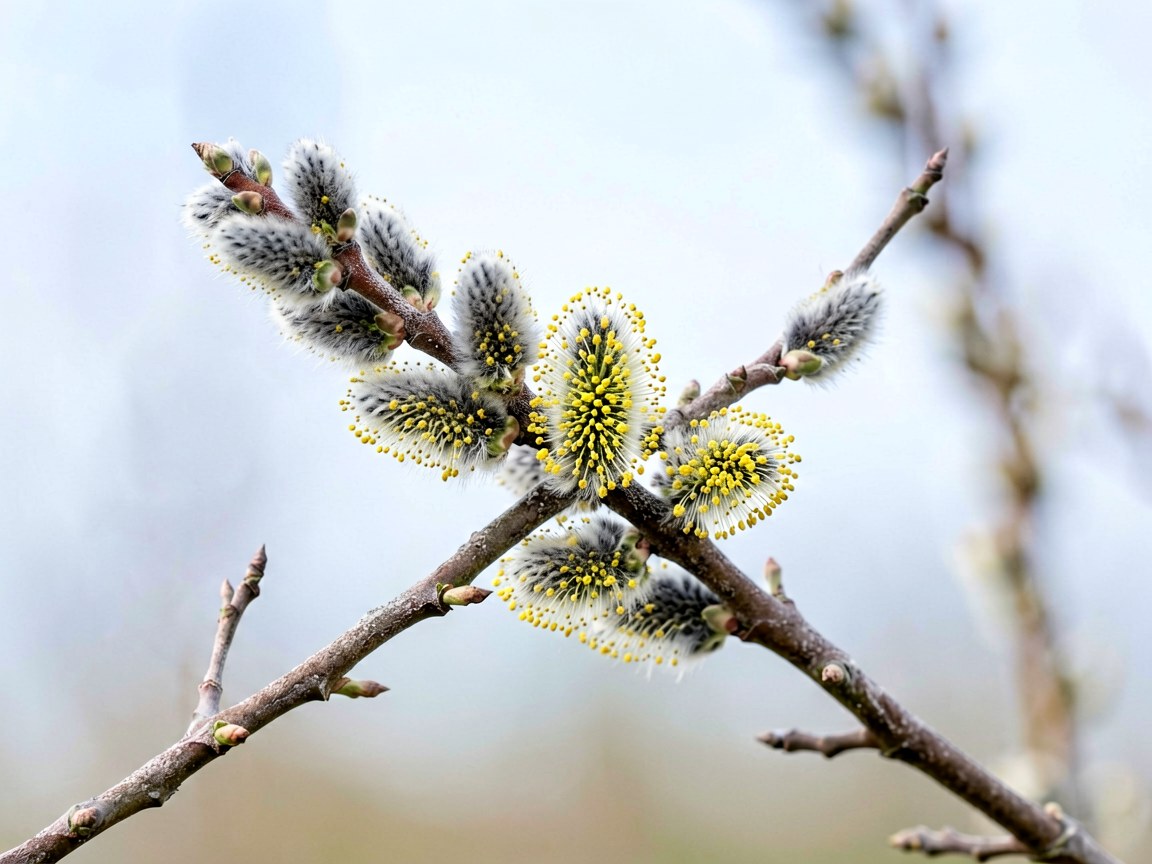
Salix caprea | Goat Willow
Introduction
Goat willow (Salix caprea) is a small, broad-crowned tree or large shrub of damp ground, hedgerows, and woodland edges, found across Europe and into western Asia. It is one of the first trees to break into flower in spring, bearing fat, silvery-grey male catkins—the familiar “pussy willow”—that turn yellow with pollen. Tough, fast-growing, and quick to colonise bare ground, it is a key early source of pollen and nectar for bees.
Taxonomy
Salix caprea sits in the family Salicaceae, the willow family, within the large genus Salix that includes hundreds of willows and sallows. It is a diploid willow and a parent of several natural hybrids. Like its green relatives it lives by Photosynthesis, capturing sunlight in its broad leaves to build the sugars that fuel its rapid spring growth.
Physical Characteristics
Goat willow usually grows 6–10 m tall, with a rounded, often leaning crown and grey-brown, fissured bark. The leaves are broad and oval, 3–10 cm long, with a wrinkled surface, a felted grey underside, and a finely toothed edge. The twigs are slender and flexible. In early spring the bare branches carry the catkins: males are stout, grey, and furry, opening to yellow anthers; females are slimmer, green, and develop into cottony seed heads.
Habitat
This willow favours moist, low-lying ground but also tolerates drier soils, thriving on riverbanks, in damp meadows, at woodland margins, and along hedgerows. It is a pioneer that springs up on disturbed or cleared land, including former arable fields and floodbanks. It grows from sea level into the hills and is unfussy about soil, provided it is not waterlogged for too long.
Diet
Goat willow is autotrophic. Its leaves carry out photosynthesis through the growing season, turning sunlight, water, and carbon dioxide into the carbohydrates the tree needs. A deep, spreading root system draws up water and minerals from the soil. It makes no food from animals and asks only for light and moisture.
Reproduction
Willows are dioecious, with male and female catkins on separate trees. Early in spring the catkins open and are wind- and insect-pollinated; the males shed clouds of yellow pollen, and the females receive it to form seeds. Each fertilised female catkin ripens into a cluster of tiny seeds, each with a tuft of white fluff that carries it on the wind to new ground—hence the tree’s talent for swift colonisation.
Conservation
Goat willow is common and widespread and is not considered threatened. Its value to wildlife—especially as one of the earliest spring pollen sources for bees and as caterpillar food for several moth and butterfly species—makes it a welcome component of hedgerows and naturalised land. Leaving wet corners and field margins unmanaged helps it persist.
Fun Facts
- Its early “pussy willow” catkins are among the first signs of spring pollen for bees waking from winter.
- The seeds ride the wind on little parachutes of white fluff, like tiny dandelions.
- Male and female catkins grow on separate trees, so only some willows produce the cottony seeds.
- The flexible twigs were traditionally used for basketry and hurdles.
- It is a fast coloniser of disturbed ground, often the first tree back after land is cleared.