 By st20113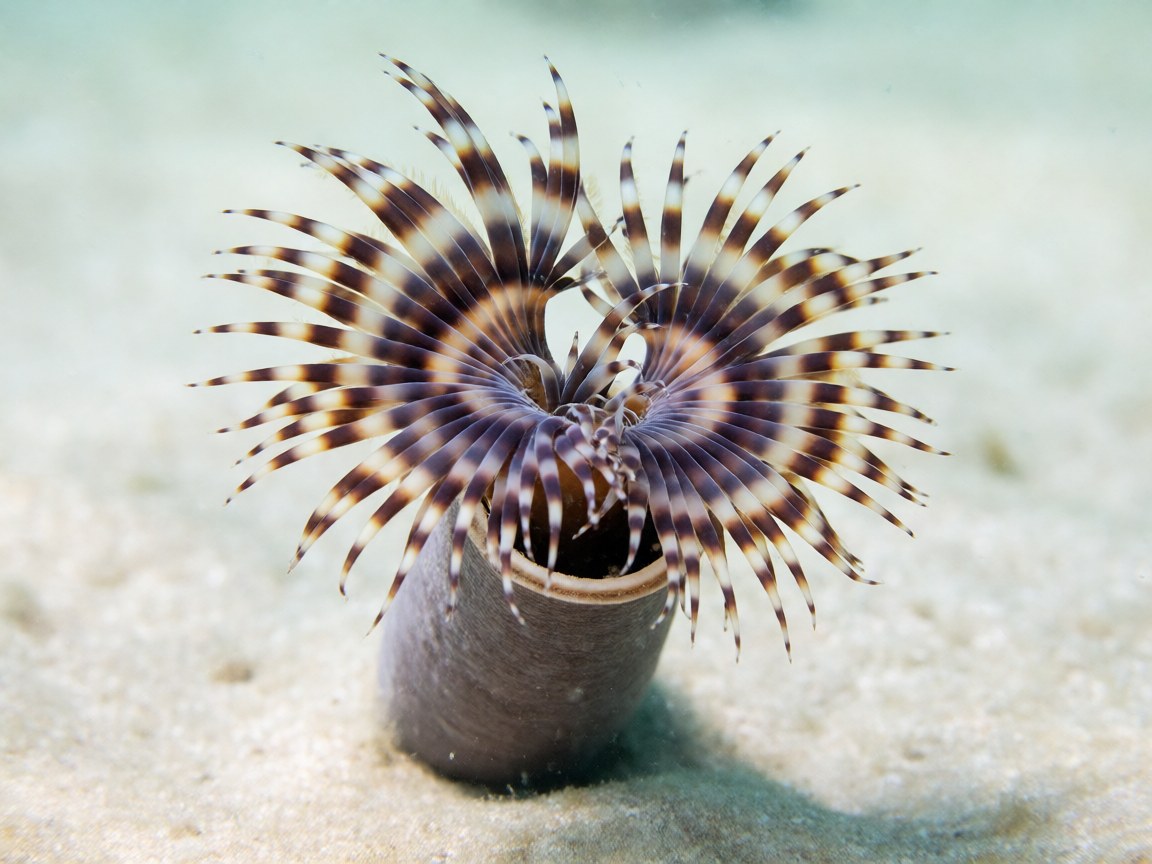
Sabella pavonina | Peacock Worm
Introduction
The peacock worm (Sabella pavonina) is a tube-dwelling marine worm with one of the most beautiful feeding structures on the shore: a fan of banded, feathery tentacles in browns, purples, and cream that opens like a flower from the top of a soft, muddy tube. At the slightest vibration or shadow the whole fan snaps shut and disappears, leaving only a leathery tube in the mud. It is a highlight of any muddy shore or harbour wall.
Taxonomy
Sabella pavonina is a polychaete worm in the family Sabellidae, the fan worms. It belongs to the same phylum as the earthworm, Lumbricus terrestris, sharing the segmented body and the bristle-bearing appendages that define the annelids, but instead of burrowing through soil it builds a permanent tube in marine mud and feeds with a crown of tentacles held out into open water.
Physical Characteristics
The body is soft and segmented, up to thirty centimetres long but slender, and lives entirely inside a tube. The tube itself is tough, flexible, and leathery rather than hard, made of mucus cemented with fine mud and silt, and it stands partly proud of the sediment. The crown of feeding tentacles, two to four centimetres across, is the striking part: two spiralling lobes of feathery radioles, banded in concentric rings of purple, brown, cream, and white, which act both as gills and as a feeding net.
Habitat
Peacock worms live buried in mud, muddy sand, and gravel, in crevices, among stones and shells, and on harbour walls, jetties, and beneath boulders, from the middle shore down to considerable depth. They are found around the coasts of Britain, Ireland, and north-west Europe and into the Mediterranean. They need sheltered water with plenty of fine suspended sediment to build with, and they are particularly characteristic of muddy estuaries and marina pontoons.
Diet
They are suspension feeders. The feathery crown is held out into the water, and the fine side branches trap plankton and suspended organic particles; the trapped material is sorted, with the finest particles carried along ciliated grooves to the mouth and larger grains passed down the outside of the crown to be used for extending and repairing the tube. The same crown serves as the animal’s gills for breathing.
Reproduction
The sexes are separate and spawning occurs in spring and summer, with eggs and sperm released into the water. The larvae drift in the plankton for a period before settling onto suitable sheltered, muddy ground and beginning to build a tube immediately. Once settled the animal is essentially fixed in place for life, though it can retreat deep into the tube and repair it from the inside.
Conservation
The species is widespread and not threatened, but like other sheltered-shore animals it depends on clean, undisturbed muddy habitat. Dredging, marina and harbour construction, pollution, and heavy sedimentation all affect it. Where muddy ground is left alone, peacock worms are often very abundant, and a single pontoon pile or harbour wall may carry dozens of crowns opening and closing with the tide.
Fun Facts
- The whole feathery crown can be withdrawn into the tube in a fraction of a second.
- The tube is soft and leathery, built from mucus and fine mud, not from calcium.
- The banded crown serves as both a feeding net and the animal’s gills.
- The tube often stands several centimetres proud of the mud, unlike most worm tubes.
- Its scientific name means “little peacock”, after the banded, eye-like pattern of the crown.